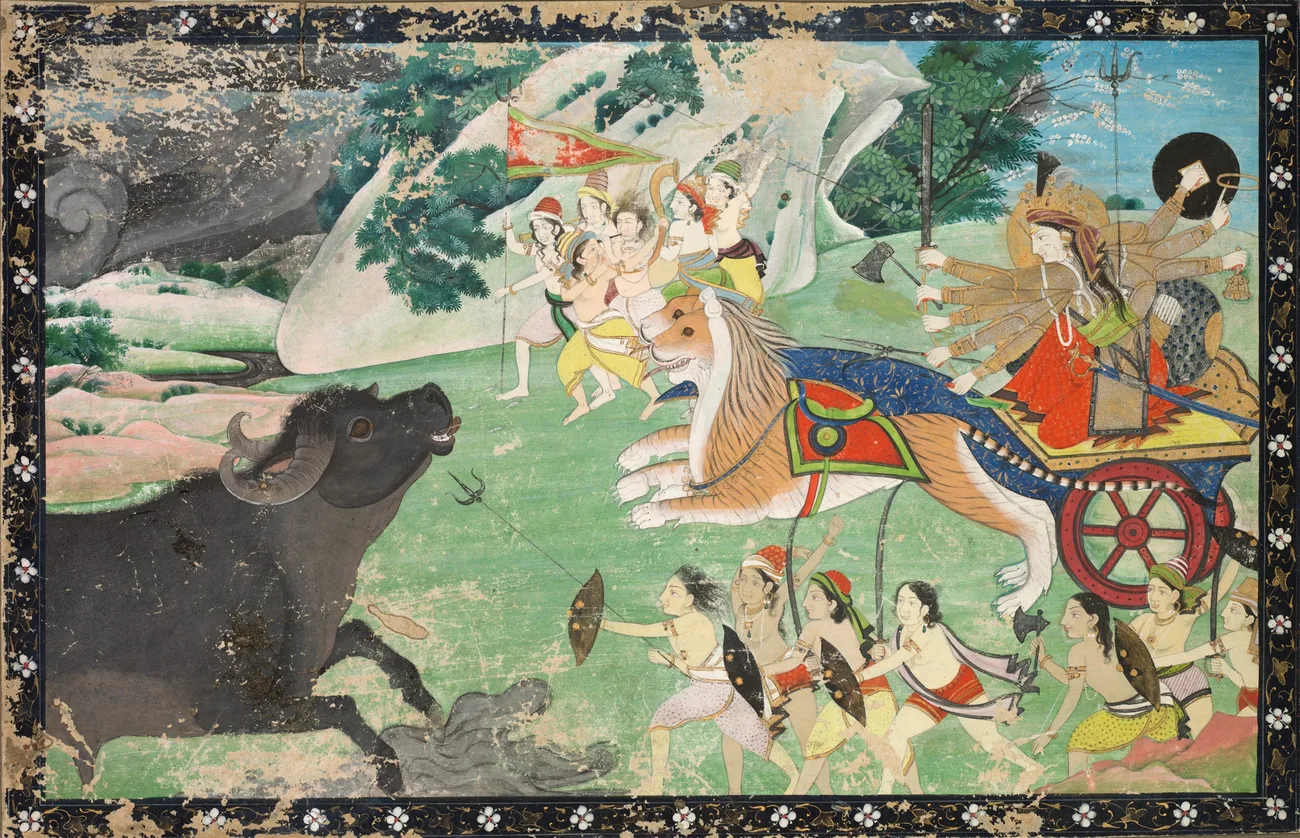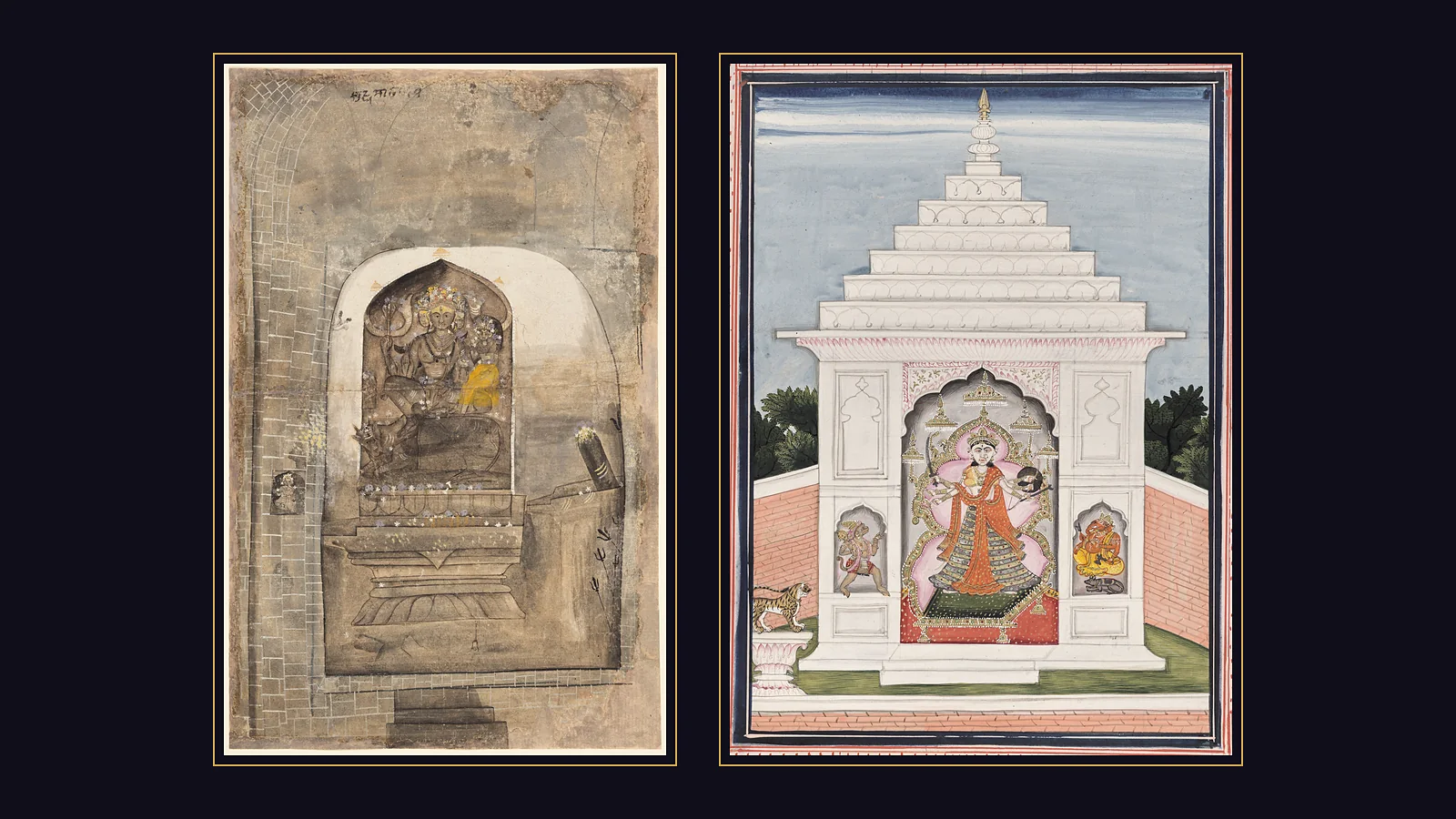
Technical disputes · Kāla Puruṣa · 13 min read
Every English source will tell you the Kāla Puruṣa comes from the Puruṣa Sūkta of the Ṛgveda. I went looking for the citation and couldn’t find one. What’s actually in the texts is stranger than the story we keep repeating, and quite a lot older.
What Kāla Puruṣa means
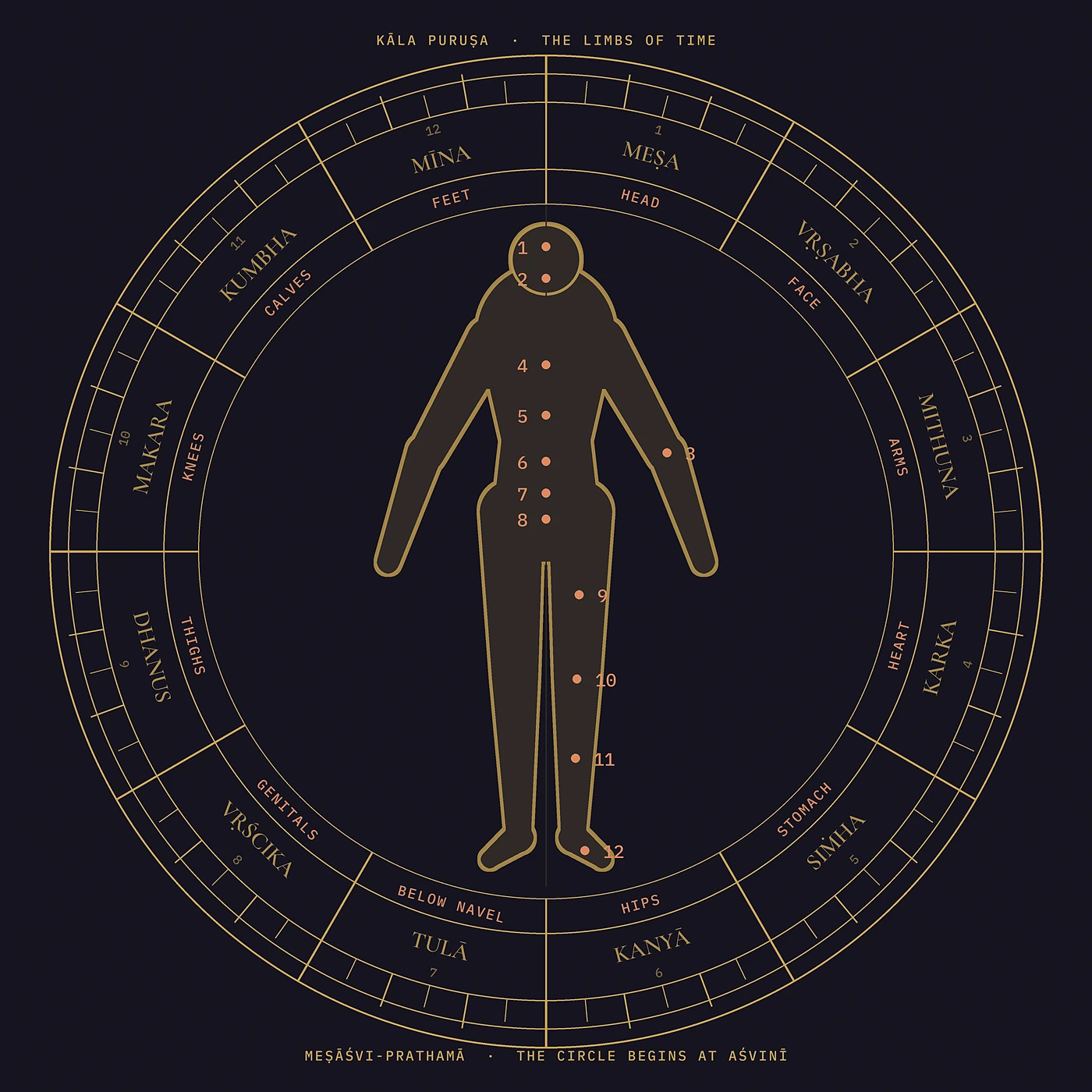
Kāla Puruṣa is the zodiac read as a body. Aries is the head, Taurus the face, and so on down to Pisces at the feet. Twelve signs, twelve limbs, one figure whose name means Person of Time. If the vocabulary here is new, the rest of the library starts gentler than this piece does.
You can find as much on a hundred websites. What almost none of them give you is a verse number. And when you chase the claim that the doctrine descends from the Puruṣa Sūkta (Ṛgveda 10.90, the hymn of the cosmic man dismembered into the world), the citations evaporate.
I read Varāhamihira’s verse in Sanskrit, and Kalyāṇavarma’s, and Mantreśvara’s, and the oldest of them all, the Yavanajātaka. Not one mentions the Puruṣa Sūkta.
Either the connection is a modern invention, or it’s something subtler than a citation. I think it’s the second, and this article is the case for why.
What the jyotiṣa texts actually say
Four classical texts give the scheme and none of them cites a source for it. Varāhamihira calls it kālāṅga, the limbs of Time. Parāśara calls the body Viṣṇu. The Yavanajātaka calls it Prajāpati. Not one of them mentions the Ṛgveda.
कालाङ्गानि वराङ्गमाननमुरो हृत्क्रोडवासोभृतो बस्तिर्व्यञ्जनमूरुजानुयुगले जङ्घे ततोऽङ्घ्रिद्वयम् ।
मेषाश्विप्रथमा नवऋक्षचरणाश्चक्रस्थिता राशयो राशिक्षेत्रगृहऋक्षभानि भवनं चैकार्थसम्प्रत्ययाः ॥ ४ ॥kālāṅgāni varāṅgam ānanam uro hṛt-kroḍa-vāso-bhṛto bastir vyañjanam ūru-jānu-yugale jaṅghe tato’ṅghri-dvayam |
meṣāśvi-prathamā nava-ṛkṣa-caraṇāś cakra-sthitā rāśayo rāśi-kṣetra-gṛha-ṛkṣa-bhāni bhavanaṃ caikārtha-sampratyayāḥ || 4 ||Bṛhat Jātaka 1.4 · Sanskrit and Chidambaram Aiyar’s English, wisdomlib
Head, face, chest, heart, belly, the garment-bearer (waist), bladder, genitals, thighs, knees, calves, and then the two feet. Then, inside the very same verse, he defines the circle they belong to: beginning with Aries and with Aśvinī, each sign nine nakṣatra quarters.
Varāhamihira writes kālāṅga, the limbs of Time. He never writes kālapuruṣa. Neither does Mantreśvara, who uses the identical term four centuries later. Today’s standard compound belongs to the commentators, not to the primary texts at all.
Parāśara puts a god in the frame
Parāśara does something Varāhamihira doesn’t. Before giving the limbs, he names the body:
Śrī Viṣṇu, the Invisible, is Time personified. His limbs are the twelve rāśis commencing from Aries.
Bṛhat Parāśara Horā Śāstra 4.1–2 · R. Santhanam translation, full text at archive.org
Then, two verses later, the list: head, face, arms, heart, stomach, hip, the space below the navel, privities, thighs, knees, ankles, feet. Santhanam’s note is the one that matters in practice. The limbs are counted treating Aries as the ascendant, but for an individual chart the rising sign becomes the head and you count from there.
शीर्षानने तथा बाहू हृत्क्रोडकटिबस्तयः।
गुह्योरुयुगले जानुयुग्मे वै जङ्घके तथा॥४॥
चरनौ द्वौ तथा मेषात् ज्ञेयाः शीर्षादयं क्रमात्।śīrṣānane tathā bāhū hṛt-kroḍa-kaṭi-bastayaḥ |
guhyorū-yugale jānu-yugme vai jaṅghake tathā || 4 ||
caraṇau dvau tathā meṣāt jñeyāḥ śīrṣādayaḥ kramāt |Head and face, then the arms, the heart, belly, hip and bladder; the privities, the pair of thighs, the pair of knees, and the shanks; then the two feet. Beginning from Aries these are to be known in order, starting with the head.
Bṛhat Parāśara Horā Śāstra 4.4–4½ · Santhanam edition, p. 27
The printed edition reads चरनौ where the sense wants चरणौ, and शीर्षादयं where it wants शीर्षादयः. Both look like typesetting slips rather than variants. And the digital copies floating around online are worse: the archive scans OCR this Devanāgarī into garbage, which is why I spent a long time unable to quote it at all. If you find BPHS 4.4 in Sanskrit on a website, ask where it came from before you repeat it.
Parāśara writes जङ्घके, jaṅghake. Santhanam translates it “ankles.”
Where the classics disagree
The real split is Gemini: Parāśara and Kalyāṇavarma give it the arms, Varāhamihira and Mantreśvara give it the chest. The Yavanajātaka runs the whole torso one position out of step with everybody. And Aquarius is calves, not the “ankles” you’ll find in most English books.
| Sign | BPHS 4.4 | Bṛhat Jātaka 1.4 | Sārāvalī 3.5–6 | Phaladīpikā 1.4 | Yavanajātaka 1.14–25 |
|---|---|---|---|---|---|
| Aries | head | head | head | head | head of Kāla |
| Taurus | face | face | face | face | mouth & throat of Vidhātṛ |
| Gemini | arms | chest | arms | chest | shoulders & arms of Prajāpati |
| Cancer | heart | heart | heart | heart | chest |
| Leo | stomach | belly | stomach | belly | heart of Prajāpati |
| Virgo | hip | navel, waist | hip | hip | belly of the Creator |
| Libra | below navel | abdomen | below navel | groin | navel, hips, bladder |
| Scorpio | privities | genitals | privities | private part | penis & anus |
| Sagittarius | thighs | thighs | thighs | thighs | thighs |
| Capricorn | knees | knees | knees | knees | knees |
| Aquarius | jaṅghake, tr. “ankles” | calves | ankles | calves | shanks |
| Pisces | feet | feet | feet | feet | feet of Kāla |
Gemini is the real fault line
Parāśara and Kalyāṇavarma give Gemini the arms. Varāhamihira and Mantreśvara give it the chest, uras. Two readings of the same sign, and the split propagates: if Gemini takes the chest, everything below shifts, and Cancer’s heart ends up sitting inside a differently organised torso.
I follow Parāśara here, arms for Gemini, and I follow it for a reason that has nothing to do with authority. The arms are the limb of exchange, of carrying and handing over, and Gemini’s whole signification is transaction. That’s an argument from coherence, not from scripture, and you’re perfectly entitled to weigh it less than Varāhamihira’s word.
The Yavanajātaka runs a different body
Earliest of the lot, the Yavanajātaka shifts the whole torso by one. Cancer takes the chest, Leo takes the heart, Virgo the belly. Every later Sanskrit text has Cancer as the heart and Leo as the stomach.
I’ve seen the variation written up online as a modern muddle between Cancer and Leo. It’s the earliest scheme we have, and the tradition moved away from it.
Aquarius: calves, not ankles
Varāhamihira’s word is जङ्घे, jaṅghe: shanks, dual. Chidambaram Aiyar’s much-copied English renders it “two ankles,” and from there the mistake has propagated through very nearly every English book and website in the field.
Parāśara uses the same word, jaṅghake, and Santhanam translates that as “ankles” too. Two independent editions, two independent translators, one Sanskrit word, and the identical mistake in both. Phaladīpikā’s translator gives “calves.” So does Pingree, rendering the Yavanajātaka’s shanks.
Mantreśvara counts from the ascendant, not from Aries
Phaladīpikā 1.4 reads vilagnāt kālāṅgāni, the limbs of Kāla from the ascendant. Mantreśvara builds the relativity into the verse itself. Practically it makes no difference, though it does tell you the tradition understood the figure as a template you lay over a chart, and not as a fixed picture of the sky.
The Puruṣa Sūkta, on its own terms
Ṛgveda 10.90 is sixteen verses. Fifteen anuṣṭubh and a closing triṣṭubh, as Sāyaṇa notes in his introduction to the hymn. It opens enormous:
सहस्रशीर्षा पुरुषः सहस्राक्षः सहस्रपात् ।
स भूमिं विश्वतो वृत्वात्यतिष्ठद्दशाङ्गुलम् ॥sahasraśīrṣā puruṣaḥ sahasrākṣaḥ sahasrapāt |
sa bhūmiṃ viśvato vṛtvāty atiṣṭhad daśāṅgulam ||“The Man has a thousand heads, a thousand eyes, a thousand feet. He pervaded the earth on all sides and extended beyond it as far as ten fingers.”
Ṛgveda 10.90.1 · Devanāgarī from Sanskrit Wikisource, IAST from GRETIL, translation Doniger
पादोऽस्य विश्वा भूतानि त्रिपादस्यामृतं दिवि ॥
pādo ‘sya viśvā bhūtāni tripād asyāmṛtaṃ divi ||
“All creatures are a quarter of him; three quarters are what is immortal in heaven.”
Ṛgveda 10.90.3 · trans. Doniger; Wilson and Sāyaṇa’s gloss at wisdomlib
One quarter became everything there is. The rest never entered the world at all, and the hymn is entirely calm about that.
The gods make a sacrifice of him, and the hymn asks the question straight out: katidhā vy akalpayan, into how many parts did they apportion him? The answer runs across verses 12 to 14.
चन्द्रमा मनसो जातश्चक्षोः सूर्यो अजायत ।
मुखादिन्द्रश्चाग्निश्च प्राणाद्वायुरजायत ॥
नाभ्या आसीदन्तरिक्षं शीर्ष्णो द्यौः समवर्तत ।
पद्भ्यां भूमिर्दिशः श्रोत्रात्तथा लोकाँ अकल्पयन् ॥candramā manaso jātaś cakṣoḥ sūryo ajāyata |
mukhād indraś cāgniś ca prāṇād vāyur ajāyata ||
nābhyā āsīd antarikṣaṃ śīrṣṇo dyauḥ sam avartata |
padbhyām bhūmir diśaḥ śrotrāt tathā lokāṃ akalpayan ||“The moon was born from his mind; from his eye the sun was born… From his navel the middle realm arose; from his head the sky evolved. From his two feet came the earth, and the quarters of the sky from his ear.”
Ṛgveda 10.90.13–14 · trans. Doniger; Sāyaṇa flags the Yajurveda variant in his note
Any jyotiṣī reading it for the first time feels the floor move, because Parāśara’s third chapter says the same thing in the same order, the Sun being the soul and the Moon the mind, and says it without citing anybody.
The Śukla Yajurveda recension replaces the second half of verse 13 outright: śrotrād vāyuś ca prāṇaś ca mukhād agnir ajāyata, “from his ear Vāyu and Prāṇa, from his mouth Agni.” Indra vanishes. Sāyaṇa flags the variant himself. The Taittirīya recension sides with the Ṛgveda, so the split is Śukla Yajurveda against everyone else, and if you were taught the hymn for recitation you may well have the other line in your head.
The hymn is late. Doniger’s argument for it is internal: verse 9 refers to the three Vedas as established categories, and verse 12 contains the first appearance of the four varṇas anywhere in Indian literature. A hymn that presupposes both isn’t from the old layer.
Does the Kāla Puruṣa come from the Puruṣa Sūkta?
No classical jyotiṣa text says so. You have two body-cosmologies a thousand years apart or so, and an entire modern literature asserting that the second descends from the first, and not one primary source that makes the claim.
Now, I checked the complete Santhanam text of Parāśara: “Purusha Sukta” appears zero times, and the two occurrences of “Rigveda” both sit in Santhanam’s own twentieth-century preface. Varāhamihira states the doctrine flat, with no theological attribution. Kalyāṇavarma does too, and Mantreśvara, and Vaidyanātha, and the Yavanajātaka.
The academic position points somewhere else entirely. Tejas Aralere’s 2023 study of astrological melothesia, Astrological Melothesia in Ancient Rome and India, treats the sign-to-limb scheme as a Babylonian technique transmitted through Hellenistic astrology and absorbed into Indian frames. It’s the same body that turns up in Greek, Latin, Arabic and Persian manuscripts, and it arrived in Sanskrit along the very same road as the horā in horāśāstra.
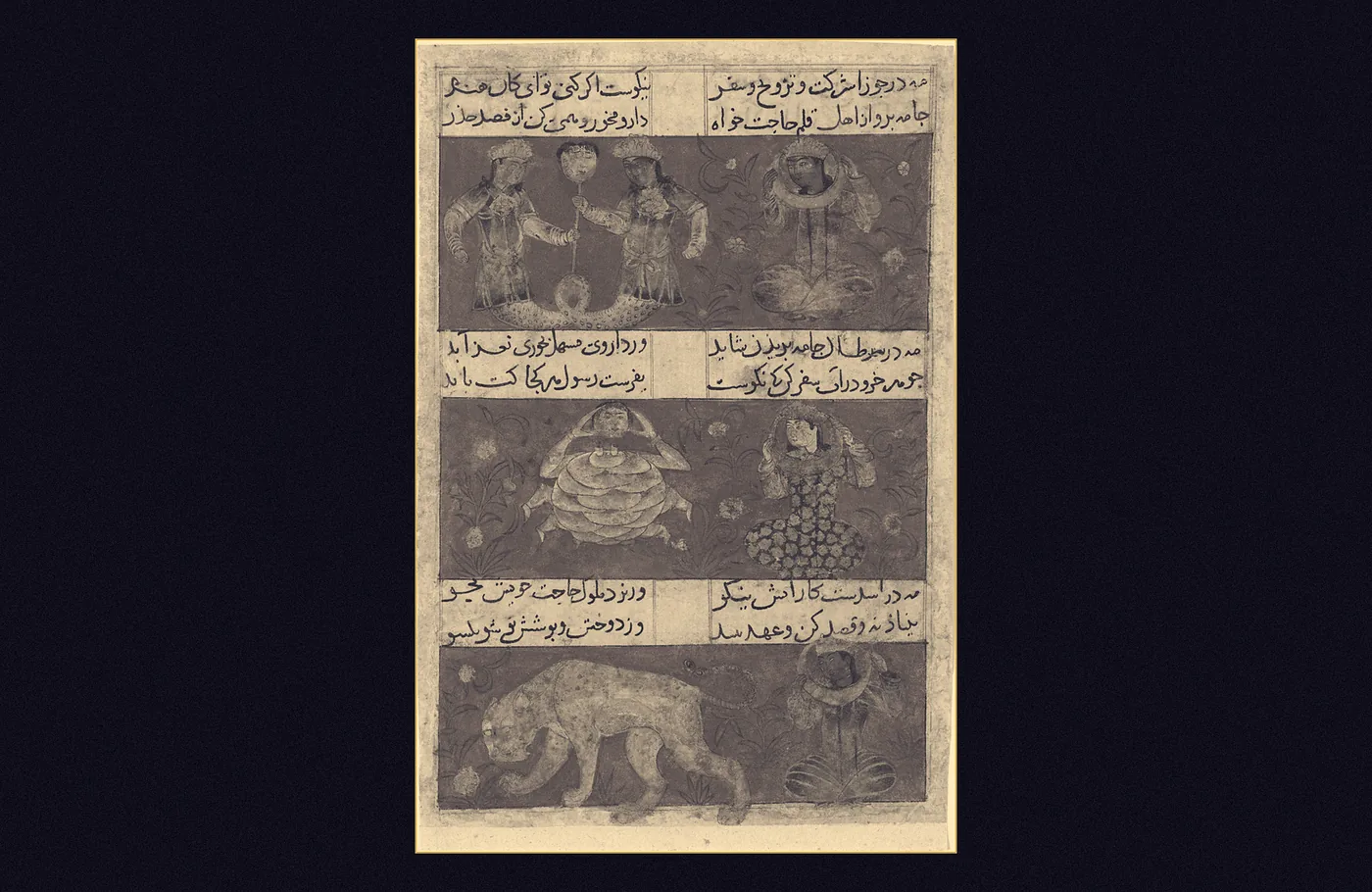
I find that argument persuasive on the history and incomplete on the meaning. A technique can be borrowed and still have to be understood in the language it lands in.
Which cosmic person the texts do name
The classical texts do name the cosmic person. They just don’t name the Ṛgvedic one.
The Yavanajātaka, in Pingree’s translation, calls the figure by four names in twelve verses. Aries is the head of Kāla. Taurus the mouth and throat of Vidhātṛ, the Ordainer. Gemini the shoulders and arms of Prajāpati. And the summary verse closes ityeṣa sorvītalamaṇḍalasya sraṣṭur nirukto’ṅgavibhāgacakraḥ: thus is told the circle of the divisions of the limbs of the Creator who made the circular surface of the earth.
Prajāpati isn’t a neutral choice of word. Puruṣo vai prajāpatiḥ. The Brāhmaṇa literature identifies Prajāpati with the Puruṣa of the hymn, and it’s Prajāpati who gets dismembered and reassembled through sacrifice all through that literature. So the oldest Sanskrit horoscopic text we have, describing a zodiac of limbs, reaches for the name of the god who is the sacrificed cosmic body.
And then there is BPHS 1.10–11
Three chapters before he gives the limbs of Kāla Puruṣa, Parāśara writes this about the Lord:
संसारकारकः श्रीमान्निमित्तात्मा प्रतापवान् ।
एकांशेन जगत्सर्व सृजत्यवति लीलया॥१०॥
त्रिपादं तस्य देवत्य ह्यमृतं तत्त्वदर्शिनः ।
विदन्ति तत्प्रमाणं च सप्रधानं तथैकपात्॥११॥saṃsāra-kārakaḥ śrīmān nimittātmā pratāpavān |
ekāṃśena jagat-sarva sṛjaty avati līlayā || 10 ||
tripādaṃ tasya devatya hy amṛtaṃ tattva-darśinaḥ |
vidanti tat-pramāṇaṃ ca sapradhānaṃ tathaikapāt || 11 ||“He authored the Universe and administers it with a quarter of his power. The other three quarters of Him, filled with nectar, are knowable to (only) the philosophers.”
Bṛhat Parāśara Horā Śāstra 1.10–11 · Santhanam edition, p. 3, English from p. 4
पादोऽस्य विश्वा भूतानि त्रिपादस्यामृतं दिवि ॥
pādo ‘sya viśvā bhūtāni tripād asyāmṛtaṃ divi ||
Ṛgveda 10.90.3, again
त्रिपाद and अमृत. The same two words, in the same relation, in the same order, in a text that never once names the hymn they come from. Parāśara adds ekāṃśena in the previous line and ekapāt in the next, so the one-part-to-three-parts structure is there twice over.
I had this section written from Santhanam’s English alone, and it was a weaker claim: a formula that matched. The Sanskrit is the actual evidence, and I only got hold of a clean copy of it late.
The printed edition gives तत्त्वदऋइअनः in the second line, which isn’t a Sanskrit word; I’ve read it as तत्त्वदर्शिनः, “the seers of truth,” which is what Santhanam’s “philosophers” translates and what the metre wants. That’s my reconstruction of a typesetting error, so treat it as such.
The hymn isn’t named. The passage sits inside a Pāñcarātra cosmology (Saṅkarṣaṇa, Pradyumna and Aniruddha all turn up within a few verses), so the formula most likely reaches Parāśara through Vaiṣṇava and Purāṇic channels and not from the Ṛgveda directly. And it’s said of the Lord, not of the Kāla Puruṣa. What links the two passages is three chapters of proximity plus the identification of Viṣṇu with Time in 4.1. Thinner than I’d like, though the two shared words carry more weight than the proximity does.
Two bodies, running in opposite directions
What follows is my reading. No classical text argues it, and you should treat it as an argument to test rather than a doctrine to accept.
These two schemes aren’t the same operation at all. They’re inverses.
The Puruṣa Sūkta runs body to cosmos. It’s a cosmogony. A body is divided and the divisions become the world: the head becomes the sky, the feet become the earth. It happens once. It’s vertical, with heaven above the head and earth beneath the feet, and the whole thing is a picture of extent. And it’s a sacrifice, which means it’s an act, with cost, performed by the gods at the beginning of things.
The kālāṅga scheme runs cosmos to body. It’s a reading instrument. The circle is already there, and the body is what you project onto it in order to interpret. It happens every single time a chart is cast. It’s circular where the hymn is vertical: the head sits above nothing, it’s simply the first arc, and Pisces meets Aries with no gap in between, and nothing gets sacrificed.
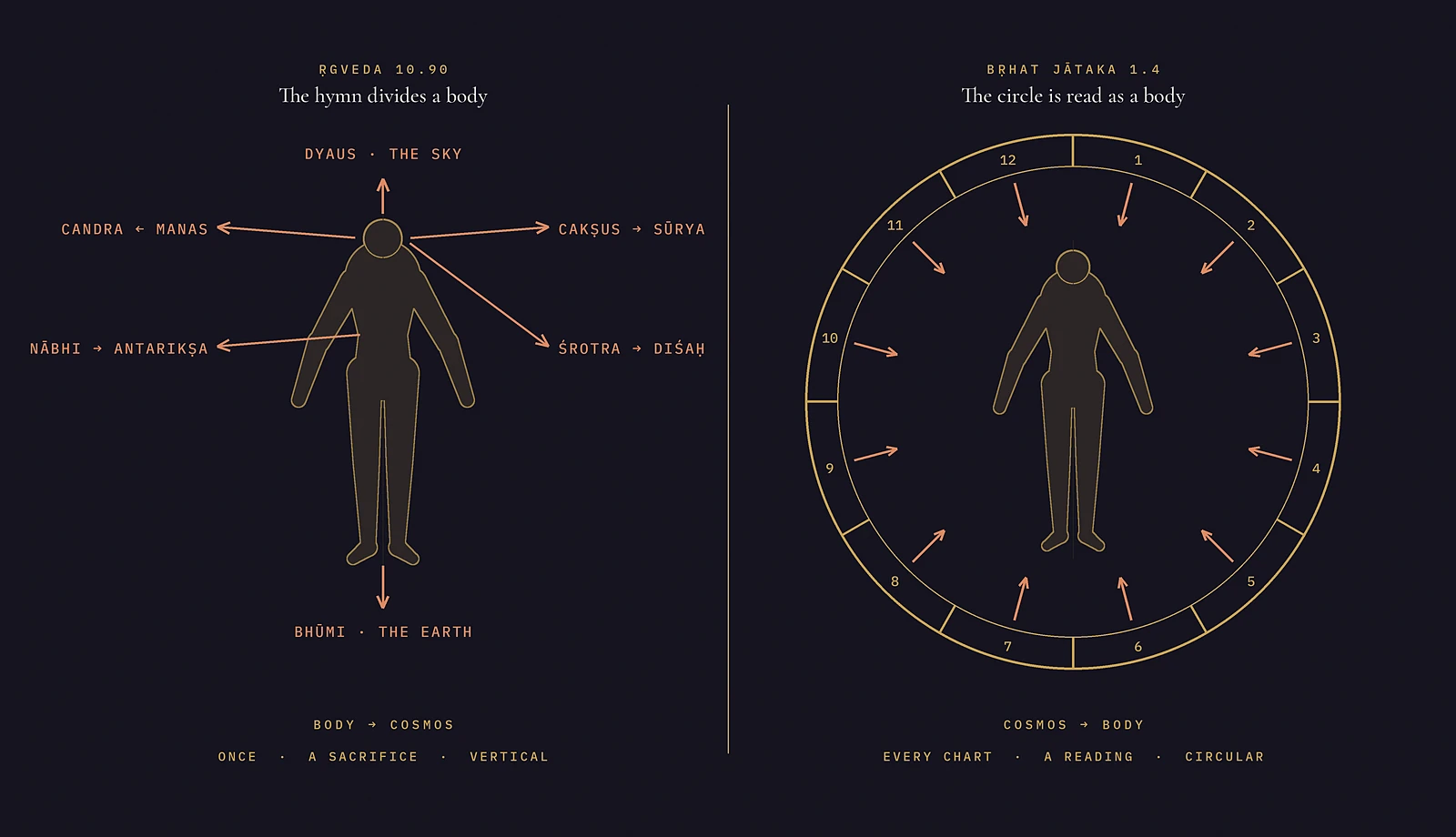
Put like that, the relationship stops being descent and becomes something better. The melothesia arrived from outside, as a technique, with a Greek accent. What the Sanskrit tradition did with it was to recognise it: to look at a foreign diagram of a man laid across the signs, see a figure they had known since the hymn, and name him Prajāpati, Vidhātṛ, the Creator, Time.
Which is why there’s no citation. You don’t cite a scripture to justify a recognition. Parāśara can say “Viṣṇu, the Invisible, is Time personified” and move straight to the limb list without arguing for it, because his reader already knows what a cosmic body is. The Puruṣa Sūkta isn’t the doctrine’s source. It’s the thing that made the doctrine legible when it showed up.
If I’m wrong, the place it breaks is Bhaṭṭotpala. His commentary on Bṛhat Jātaka 1.4 is the one text where an explicit Vedic citation could plausibly be hiding, and I haven’t been able to get at the Sanskrit. Should somebody with library access find a Puruṣa Sūkta reference there, the whole argument above becomes unnecessary and the traditional story turns out to be right all along.
How the limbs are actually used
For moles, birthmarks, scars and wounds. Kalyāṇavarma and Parāśara both use the scheme to locate marks on the body, refined by the rising decanate, and neither uses it to predict illness.
The classical use of the kālāṅga scheme is marks, moles, scars and wounds. Disease in Parāśara gets handled through the 6th house, the planetary kārakas and the Śayanādi avasthās: different chapters, completely different machinery. Somewhere in the last few decades the two got welded together, and now you can read that Saturn in the 8th predicts a urological condition.
Kalyāṇavarma states the rule in the same breath as the mapping:
If at birth one has a benefic planet in a particular sign, the particular limb will be strong. A malefic makes such a limb weak.
Sārāvalī 3.5–6 · Kalyāṇavarma, Santhanam translation (PDF)
Parāśara, on the first house: the limb related to a malefic by occupation will have ulcers or scars, while the one related to a benefic will carry a mark, a mole and such. Then Kalyāṇavarma refines it into something far more specific than the sign-level scheme, using the decanate:
If the first decanate rises, count from the head. If the second, from the neck, and if the third, from the pelvis. The six rāśis backwards from the ascendant denote the left side of the body, while the six forward rāśis from the lagna indicate the right side… the decanates occupied by malefics denote wounds, while those by benefics indicate marks on the limbs concerned. Should these planets be in their own rāśi or aṃśa at birth, the wound or mole is present from birth. Otherwise these will be caused later on.
Sārāvalī 4.3–6 · the decanate refinement (PDF)
Read it carefully and you’ve got a technique with real resolution, and one the course covers properly when we get to the vargas. There are four variables in play: decanate for vertical position, direction of count for left or right side, benefic or malefic for mark or wound, dignity for congenital or acquired. That’s a proper diagnostic, and it’s testable in a way that most of what gets called Vedic astrology online simply isn’t. Ask a client where their scars are before you look. It’s the same discipline I use when a written prediction report has to stand on its own without me in the room.
Before you go and panic about your own chart. A malefic in the sign of a limb doesn’t mean that part of your body is doomed. In the classical texts the technique predicts a mole, a birthmark, a scar: the sort of thing you’ve probably had since childhood without ever giving it a thought. Most of my clients have one somewhere. I do too. It’s also one of the weaker-signal tools you have, dependent on an exact birth time and on a decanate that shifts every forty minutes. If your birth time is rounded to the nearest quarter hour, the decanate refinement above is telling you nothing at all. Treat it as a way of testing whether a rectified chart is right, and not as a medical reading. If you want the remedial side of a difficult placement instead, that lives in the spiritual guidance report and in the 9th-from-Moon deity method.
Is the Kāla Puruṣa sidereal or tropical?
Sidereal, and Varāhamihira settles it in the same verse that gives the limbs. Meṣāśvi-prathamā nava-ṛkṣa-caraṇāḥ: beginning with Aries and with Aśvinī, of nine nakṣatra quarters each.
Varāhamihira defines the limb-bearing zodiac in the same verse that gives the limbs, and he defines it by the stars. The body is pinned to the nakṣatras and not to an equinox. Vaidyanātha does the identical thing in the identical order: Jātakapārijāta 1.7 establishes the signs beginning with Aśvinī, and 1.8 immediately gives the limbs of kālātmaka, the one whose nature is Time.
No classical text discusses ayanāṃśa in connection with the kālāṅga scheme, and the reason is probably dull rather than deep. When the texts were composed the ayanāṃśa was near zero, so there was no practical bite to the question, though it has plenty now. The body of Time is a sidereal body. Whatever you make of the tropical argument elsewhere, this particular doctrine was built on a star-referenced frame, and it stops meaning what it says the moment you move it.
Where this leaves you
All three consultations and reports I offer lean on this distinction. Use the limbs for marks, not for medicine. Count from the lagna once you’ve a real chart in front of you. Use the decanate refinement only when the birth time will carry it. Take Gemini as the arms if you follow Parāśara, as the chest if you follow Varāhamihira, and know which one you’re doing and why.
And when somebody tells you the Kāla Puruṣa comes from the Puruṣa Sūkta, ask them for the verse. There’s something more interesting instead: a borrowed Greek diagram that a Sanskrit-speaking world looked at and immediately knew the name of.
Questions people ask
Which body part does each zodiac sign rule?
Aries the head, Taurus the face, Gemini the arms or chest depending on the text, Cancer the heart, Leo the stomach, Virgo the hips, Libra the lower abdomen, Scorpio the genitals, Sagittarius the thighs, Capricorn the knees, Aquarius the calves, Pisces the feet. In a real chart you count from the ascendant instead of from Aries, so the rising sign takes the head. The other pieces in the library assume you already know how to find yours.
Is Kāla Puruṣa in the Puruṣa Sūkta?
No. The Puruṣa Sūkta (Ṛgveda 10.90) describes a cosmic body divided into the world, but there is no zodiac in it and there are no twelve signs, and no classical jyotiṣa text cites it when giving the Kāla Puruṣa. The connection is a modern one, though there are real echoes of the hymn elsewhere in Parāśara.
What is the difference between Kāla Puruṣa and kālāṅga?
Kālāṅga, the limbs of Time, is the term Varāhamihira and Mantreśvara actually use in their verses. Kālapuruṣa came later, from the commentators. Same doctrine either way.
Can the Kāla Puruṣa scheme predict illness?
Not in the classical texts, and you should be wary of anyone who says otherwise in a paid reading. Sārāvalī and Parāśara use it for moles, birthmarks, scars and wounds, and for the relative strength of a limb. Disease gets read through the 6th house, the planetary kārakas and the avasthās, which are separate techniques in separate chapters.
Does it work with the tropical zodiac?
The scheme is defined in the same verse that fixes Aries to the start of Aśvinī and gives each sign nine nakṣatra quarters, so it’s sidereal by construction. Moving it to a tropical frame detaches it from the definition Varāhamihira gives it.
Going further
If you want to test the decanate technique on your own chart you need an accurate birth time first, and that’s a rectification problem before it’s an astrological one. I do that work as part of a full reading, so book a consultation if you’d like me to look.
If the Sanskrit here was heavy going and you’d rather build up to it, the structured course starts from the beginning. And why astrology still matters is the place to start if you’re not yet convinced any of this is worth the effort.
Sources cited: Ṛgveda 10.90 (Sanskrit from Wikisource and GRETIL; translations Doniger, Wilson). Bṛhat Jātaka 1.4 (Sanskrit, wisdomlib; translation Chidambaram Aiyar). Bṛhat Parāśara Horā Śāstra 1.10–11, 4.1–4½, 12.15, Sanskrit and English from the Santhanam edition. Sārāvalī 3.5–6, 4.3–6 (Santhanam). Phaladīpikā 1.4. Yavanajātaka 1.14–26 (Pingree). Jātakapārijāta 1.7–1.8. Aralere, “Astrological Melothesia in Ancient Rome and India,” UCSB 2023.