Vimśāṁśa series · Aṁśas 3, 5 and 18, odd signs · Jayā and Vijayā · 11 min read
Two guards at a gate turned away four visitors who looked like children. Parāśara gives their names to three of the forty aṁśas of the D20, and one of those names is the only one in the list he repeats.
Four boys walk up to the seventh gate of Vaikuṇṭha. They’re naked, and they look about five years old.
They aren’t five. They’re the Kumāras, Brahmā’s mind-born sons, older than most of what exists, and they’ve come to see the Lord. Two guards at the gate look them over and put a staff across the door.
Jayā holds aṁśa 3 of every odd sign, 3°00′ to 4°30′, and again aṁśa 18, 25°30′ to 27°00′. Vijayā holds aṁśa 5, 6°00′ to 7°30′. Jayā is the only name in Parāśara’s forty that he gives twice, fifteen aṁśas apart.
Part 1 has the full table of forty names. Divide your planet’s degrees inside its sign by 1.5 and round up.
The seventh gate
The story is in the third book of the Bhāgavata, chapters 15 and 16. Vaikuṇṭha has seven gates. The Kumāras get through six of them without anyone asking a question. At the seventh, two men stop them.
तान् वीक्ष्य वातरशनांश् चतुरः कुमारान्
वृद्धान् दशार्धवयसो विदितात्मतत्त्वान्।
वेत्रेण चास्खलयताम् अतदर्हणांस् तौ
तेजो विहस्य भगवत्प्रतिकूलशीलौ॥३०॥tān vīkṣya vāta-raśanāṃś caturaḥ kumārān
vṛddhān daśārdha-vayaso viditātma-tattvān |
vetreṇa cāskhalayatām atad-arhaṇāṃs tau
tejo vihasya bhagavat-pratikūla-śīlau ||30||“Seeing those four Kumāras, girded with wind, ancient, of half-ten years in appearance, knowers of the truth of the self, those two, whose nature ran contrary to the Lord’s, laughed off their brilliance and barred with a staff those who deserved no barring.”
Bhāgavata Purāṇa 3.15.30 · GRETIL e-text
Vāta-raśana, wind-girded, means naked. Daśārdha-vayasaḥ, of half-ten years, means they looked five. Vṛddhān, in the same line, means they were old. And viditātma-tattvān says they knew exactly what they were, which the guards did not.
What they were actually cursed for
तद् वाम् अमुष्य परमस्य विकुण्ठभर्तुः
कर्तुं प्रकृष्टम् इह धीमहि मन्दधीभ्याम्।
लोकान् इतो व्रजतम् अन्तरभावदृष्ट्या
पापीयसस् त्रय इमे रिपवो ऽस्य यत्र॥३४॥tad vām amuṣya paramasya vikuṇṭha-bhartuḥ
kartuṃ prakṛṣṭam iha dhīmahi manda-dhībhyām |
lokān ito vrajatam antara-bhāva-dṛṣṭyā
pāpīyasas traya ime ripavo ‘sya yatra ||34||“So for you two dull-witted ones, servants of that supreme lord of Vaikuṇṭha, we here decide what is fitting. By reason of your seeing-of-difference, go from here to the worlds of the more sinful, where these three are his enemies.”
Bhāgavata Purāṇa 3.15.34 · GRETIL e-text
Antara-bhāva-dṛṣṭi. The sight that sees a difference.
Then the Lord comes out himself, and the first thing he says is their names.
एतौ तौ पार्षदौ मह्यं जयो विजय एव च।
कदर्थीकृत्य मां यद् वो बह्व् अक्राताम् अतिक्रमम्॥२॥etau tau pārṣadau mahyaṃ jayo vijaya eva ca |
kadarthī-kṛtya māṃ yad vo bahv akrātām atikramam ||2||“These two are attendants of mine, Jaya and Vijaya indeed. Holding me of no account, they have done you a great wrong.”
Bhāgavata Purāṇa 3.16.2 · GRETIL e-text
Ten verses later he says the curse was his own doing. Śāpo mayaiva nimitas tad aveta viprāḥ, “know, brāhmaṇas, that this curse of yours was ordained by me alone” (3.16.26).
What everyone gets wrong about this story
You’ve probably heard that Viṣṇu offered them a choice. Seven lives as his devotees, or three as his enemies, and they took the three because it was faster.
There’s no offer and no choice anywhere in Bhāgavata 3.15, 3.16 or 7.1. The number seven occurs exactly once in those two chapters, as saptamāyām, “at the seventh”, and it’s the gate, not a count of births. The three lifetimes are handed down by the Kumāras themselves as they soften their own curse: proktau punar-janmabhir vāṃ tribhir lokāya kalpatām, “they were told: let your return to your world come about through three rebirths” (7.1.38). Hiraṇyakaśipu and Hiraṇyākṣa (7.1.39). Rāvaṇa and Kumbhakarṇa (7.1.43). Śiśupāla and Dantavakra, killed by Kṛṣṇa’s disc (7.1.45).
The ones in your chart are women
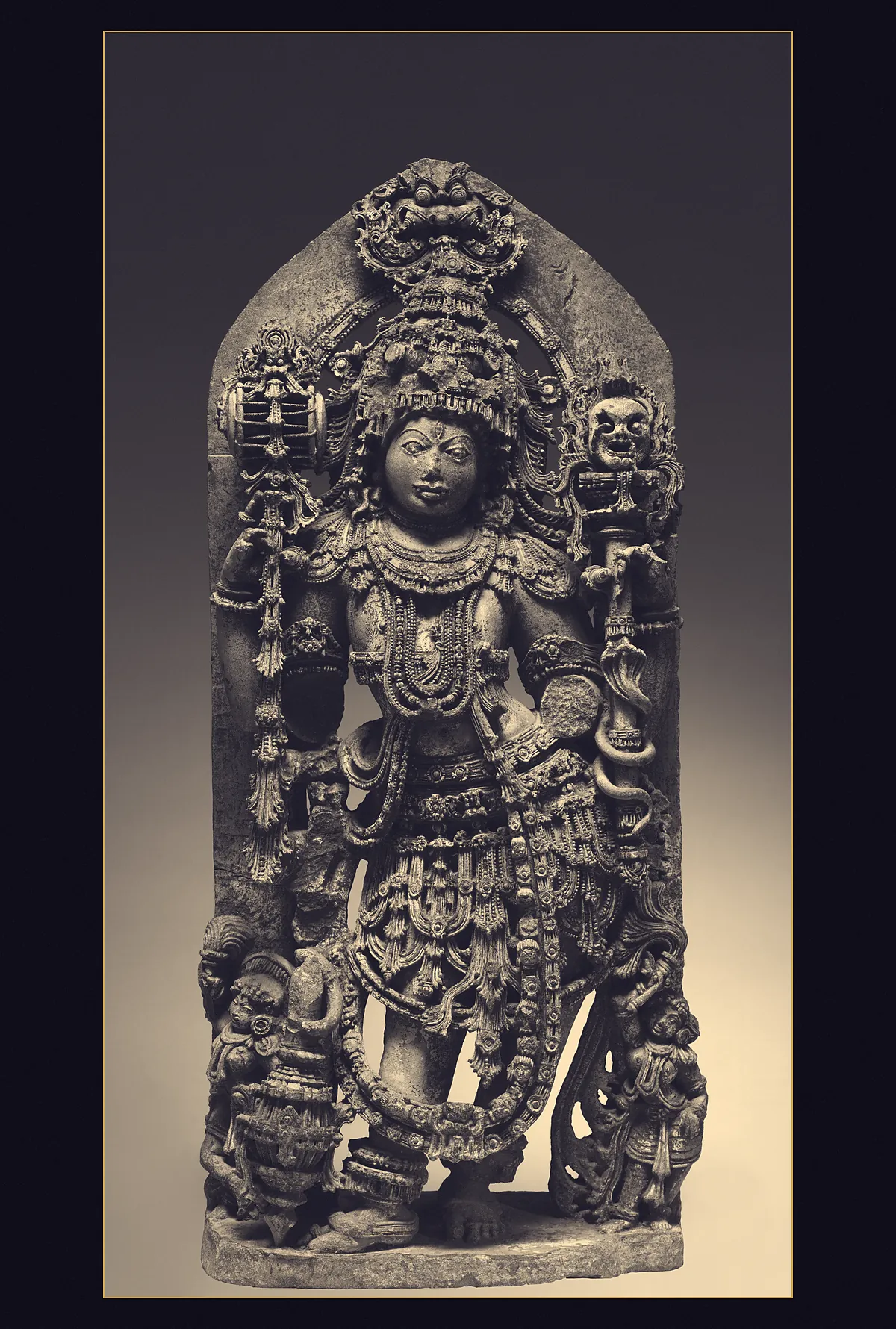
Jaya and Vijaya at the gate of Vaikuṇṭha are men. Parāśara’s Jayā and Vijayā are feminine, and I have found no text that says they’re the same figures.
The oldest clear witness is a Śaiva text of the Tumburu cult, the Vīṇāśikhatantra, where the four are placed on the four petals around the god, each with her own colour.
White, red, gold, black, at east, south, west and north. The same text gives their mantras: Jayā’s bīja is the seventeenth seed joined to the eleventh, and Vijayā’s is the same seed joined to nothing at all (Vīṇāśikhatantra 125).
The Devī Kavaca, the armour of the Goddess, spends twenty verses posting deities around the body and the ten directions, and then adds a second ring.
जया मामग्रतः पातु विजया पातु पृष्ठतः।
अजिता वामपार्श्वे तु दक्षिणे चापराजिता॥२२॥jayā mām agrataḥ pātu vijayā pātu pṛṣṭhataḥ |
ajitā vāma-pārśve tu dakṣiṇe cāparājitā ||22||“May Jayā guard me in front, may Vijayā guard me behind; Ajitā on the left side, and Aparājitā on the right.”
Devī Kavaca 22 · proofread text
Twenty-two verses later: rāja-dvāre mahālakṣmīr vijayā satata sthitā, “at the king’s gate, Mahālakṣmī, who is Vijayā, stands always” (Devī Kavaca 44).
Jayā is there twice, Vijayā once, and Aparājitā once, as the fortieth and last name in the list. Only Ajitā, who the Vīṇāśikha also calls Jayantī, is missing.
| Aṁśa and degrees | What the daśā does |
|---|---|
| Jayā, aṁśa 3 3°00′–4°30′ |
The fall. You are turned away, or you turn somebody away, and the bill comes. Long consequences from one short decision. |
| Vijayā, aṁśa 5 6°00′–7°30′ |
The carry-through. Whatever was begun gets finished, past the point most people stop, and usually past the point it was still enjoyable. |
| Jayā, aṁśa 18 25°30′–27°00′ |
The return. The debt is finished and the post is given back. Authority arrives late and is not taken away again. |
What they do to a planet
A planet under Jayā is standing at a door with the authority to open it. Somewhere in that planet’s department of life you’re the one who decides who gets in. Sometimes the door is small and you don’t notice you’re holding it. Which client is worth the time. Which relative gets told the truth. The charge in the Bhāgavata is antara-bhāva-dṛṣṭi: they looked at a body and decided what it was worth.
Aṁśa 3 is the fall. What I see in these charts is one decision, usually made young and usually made with real confidence, that turns out to have shut the wrong person out. And then a long stretch of paying for it, in a form that has nothing obviously to do with the original door.
Aṁśa 18 is the return. These are the people who get their position back after losing it, and get it back in a way nobody can undo. The daśā arrives late, hands over an office, and leaves it alone afterwards. If you’ve been carrying something for years that you thought was permanent, an aṁśa 18 daśā is where it turns out to have been a sentence with an end date.
Vijayā is the road after the door. Vi-jaya is the victory carried all the way out to its edges, and her aṁśa sits at the opening of the adolescent state, where a thing that has been begun has to be taken seriously or dropped. The Mars-to-Rāhu seam under her three air-sign aṁśas is the flavour: a clean effort that turns into something obsessive on the way through, and delivers anyway.
The Sun under Jayā is the gate placement in its purest form, because the Sun is office and position. Aṁśa 18: the same office handed back, twenty years later, by the institution that took it. I’ve seen this one twice and both times the person had stopped asking for it.
Saturn is the best of the ten in aṁśa 18 and among the hardest in aṁśa 3. Saturn is the one graha that actually enjoys being a doorkeeper, and in the dead state near the top of the sign he’s a man who kept his post through everything. In aṁśa 3 he’s the guard who turned the sages away and then served the full sentence without complaining, which is admirable and takes a very long time.
Rāhu is the outsider at the door by nature, and here he’s on both sides of it. What tends to happen is that you are refused entry somewhere that matters, become the person who guards that same threshold, and then have to decide whether to do to the next outsider what was done to you.
Mars under Vijayā is the strongest carry-through in the twenty and I’d take it over most placements for anything that needs finishing.
Mercury, Venus, Jupiter and the Moon in these aṁśas read as milder versions of the same thing: a gatekeeping function in speech, in marriage, in teaching, in the home. Ketu has no interest in the door, so under Jayā he’s the guard who walks off the post, and your daśā is usually a departure that other people find inexplicable.
Aṁśa 18 is easy to find, because it’s near the top of a sign and plenty of planets sit there. Aṁśa 3 is a degree and a half in the opening of a sign, and I have far fewer charts for it.
When one of them holds a kāraka
Parāśara ranks the kārakas by degrees, highest first. Aṁśa 18 is at 25°30′, so here the Ātmakāraka is the common case.
Ātmakāraka under Jayā, aṁśa 18
The life has a long middle section that looks like exile. Early promise, then a removal, then fifteen or twenty years of work done away from the place the person belongs, and then a return that surprises everybody except them.
Amātyakāraka under Jayā or Vijayā
The minister is the one who gets you your work, and under these two the work is gatekeeping for a living. The fields are admissions, immigration, licensing, editing, curation, casting, credit, security and the courts, anything that decides who gets in. Under Vijayā, add the completion trades. The money is in finishing what other people abandoned.
Under aṁśa 3 it’s a single early misjudgment that costs a decade. Under Vijayā it’s steadier and longer than anyone expects, and the reputation is for not quitting.
Gnātikāraka under Jayā or Vijayā
The kāraka of rivals, disease, debt and litigation. Under Kālī the enemy is removed and under Gaurī he becomes a dependent. Under Jayā he’s on the other side of a door, and the door holds. Your cases go quiet instead of resolving.
Inside the daśā
All three aṁśas run long, in two halves that don’t feel related while you’re in them. The first half is the decision and its fallout. Something gets refused, by you or to you, and then the period stops being about that and becomes about everything the refusal set off. People describe the middle of a Jayā daśā as a stretch where they were living someone else’s life.
The second half is the return, and positions come back. Usually not the same job, but the same standing, arriving from the direction that removed it. When a client tells me an old employer or an old institution or an old family has approached them after years of silence, the vimśāṁśa is the first place I look.
What they ask for
The Devī Kavaca is the practice for these aṁśas. It’s the armour hymn that opens the Durgā Saptaśatī. It holds both of them by name in verse 22. If a planet of yours is in aṁśa 3, 5 or 18, learn it and say it.
Past that, Durgā herself, because they’re her guard. Navarātri, Tuesdays, the Saptaśatī if you have the Sanskrit and a translation if you don’t. Jayā is name 377 of the Lalitā Sahasranāma and Vijayā is 346.
Questions people ask
Which degrees belong to Jayā and Vijayā in the D20?
Jayā has two aṁśas in every odd sign: 3°00′ to 4°30′, and 25°30′ to 27°00′. Vijayā has one, 6°00′ to 7°30′. The signs are Aries, Gemini, Leo, Libra, Sagittarius and Aquarius. In the even signs those three aṁśas belong to Chinnaśīrṣā, Dhūmāvatī and Bhairavī.
Why does Jayā appear twice?
Parāśara doesn’t say. I read the two aṁśas as the same gatekeeper at the two ends of a life, aṁśa 3 where the refusal is made and aṁśa 18 where the post is handed back.
Are these the Jaya and Vijaya from the Vaikuṇṭha gate?
Not demonstrably. Those two are male and Parāśara’s are female, and no text I know of connects them.
What is the difference between Jayā and Vijayā?
Less than you’d want. The dictionaries give the two feminines almost identical entries, and the Vīṇāśikhatantra distinguishes their mantras by a single conjunct. In practice I read Jayā as the door and Vijayā as the road.
Where does this reading come from?
No classical text explains what a vimśāṁśa deity does to a planet. Parāśara names the twenty and assigns the varga to upāsanā, and the commentaries go no further. What’s here comes from the Bhāgavata, the Vīṇāśikhatantra, the Devī Kavaca and the Purāṇas on one side, and from charts on the other.
Next in the series is Lakṣmī, aṁśa 4 of the odd signs. Part 1, with the full table of all forty names, is here. If you want your own vimśāṁśa read properly, with the deity and the daśā sequence together, that’s what a consultation is for.
Sources: Bhāgavata Purāṇa 3.15.30, 3.15.34, 3.16.2, 3.16.26 and 7.1.37–45, GRETIL e-text. Vīṇāśikhatantra 125, GRETIL e-text of T. Goudriaan’s edition, served in IAST. Devī Kavaca 22 and 44, Devanāgarī from the proofread Durgā Saptaśatī at sanskritdocuments.org; the Kavaca is an appended aṅga and is not in the critically transmitted Mārkaṇḍeya Purāṇa. Bṛhat Parāśara Horā Śāstra 6.17–21 for the twenty names, 7.4 for the varga assigned to upāsanā, and chapter 32 for the kārakas; Chaukhamba edition with the Sudhā commentary, English checked against R. Santhanam. Lalitā Sahasranāma names 346 and 377. Images: Cleveland Museum of Art, CC0.