Tithi · The Moon’s day you were born on · the masterclass, the video and 51 slides
Your family says you were born on a lucky day. In this teaching the tithi you were born on is the one place your light did not reach, and the deity of that tithi is the one who brings it back. The whole masterclass as a page: what a tithi is, the five families and their lords, all fifteen tithis and the new moon with the story and the remedy of each, the signs your tithi burns, and four public charts.
Find your birth tithi first. The birth panchang calculator gives it in ten seconds from your date, time and place of birth, with the bright or dark half. Then find your tithi in the list below. How a tithi is found is explained in janam tithi: what your birth tithi means.
Watch the masterclass
Twenty-three minutes. Each chapter below opens the video at that moment. The slides and the text further down are the same class, to read at your own pace.
- 0:00 His self, his house, his marriage, his career: all burning
- 0:15 Your birth tithi is not your lucky day
- 0:37 What a tithi really is
- 2:00 The five tithi families and their planets
- 3:10 Tithi 1, Pratipadā: Brahmā and King Bali
- 4:14 Tithi 2, Dvitīyā: Yama visits his sister
- 5:18 Tithi 3, Tṛtīyā: the vows for a lasting marriage
- 6:10 Tithi 4, Chaturthī: Gaṇeśa and blocked learning
- 7:21 Tithi 5, Pañchamī: Sarasvatī’s promise
- 8:08 Tithi 6, Ṣaṣṭhī: Skanda and the child brought back
- 9:05 Tithi 7, Saptamī: the prince the Sun healed
- 10:08 Tithi 8, Aṣṭamī: Ilā and the son of the Moon
- 11:18 Tithi 9, Navamī: the birth of Rāma
- 12:10 Tithi 10, Daśamī: Bhagīratha brings the Gaṅgā down
- 12:57 Tithi 11, Ekādaśī: the goddess from Viṣṇu’s body
- 13:38 Tithi 12, Dvādaśī: the king who would not burn
- 14:47 Tithi 13, Trayodaśī: Kāmadeva turned to ash
- 15:38 Tithi 14, Chaturdaśī: the hunter’s accidental Śivarātri
- 16:37 Tithi 15, Pūrṇimā: one arrow, three cities
- 17:24 Amāvāsyā: the ancestors’ night
- 18:17 Burning signs, dagdha rāśi, for every tithi
- 19:18 The six rules of a burning sign
- 19:56 Chart: Serena Williams
- 20:23 Chart: Tiger Woods
- 21:10 Chart: Debbie Reynolds
- 21:42 Chart: Sam Bankman-Fried
- 22:25 Three layers of remedy
The tithi you were born on
What a tithi is, and why yours is a weak spot.
Namaste everyone. Almost everybody knows their sign. Many of you know your nakṣatra. But ask people their tithi, the lunar day they were born on, and you get a blank face. And honestly, it is one of the most useful things in the whole chart.
So today we go through all of it. What a tithi is. What your birth tithi quietly takes away from you. Which deity fixes that. The story behind every single tithi. And at the end, the signs your tithi sets on fire, with real charts. Let’s start.
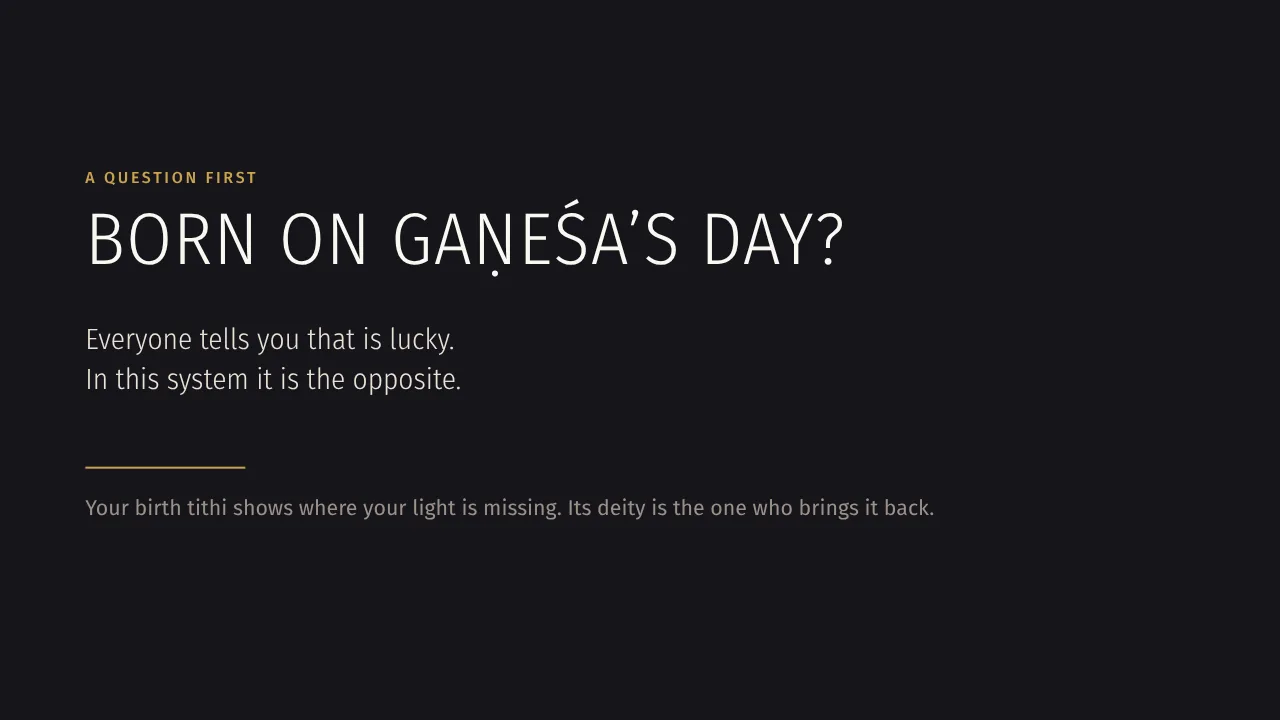
Let me ask you something. Say you were born on Gaṇeśa Chaturthī. Your family probably told you, wow, Gaṇeśa’s day, so lucky. And I am going to tell you the opposite. In this system the tithi you are born on is your weak spot. It shows exactly where your light is missing. And the deity of that tithi is not a lucky charm, it is the medicine.
So if you are born on Gaṇeśa’s day, Gaṇeśa is the one you need. Stay with me, because by the end you will know what your own tithi is asking from you.
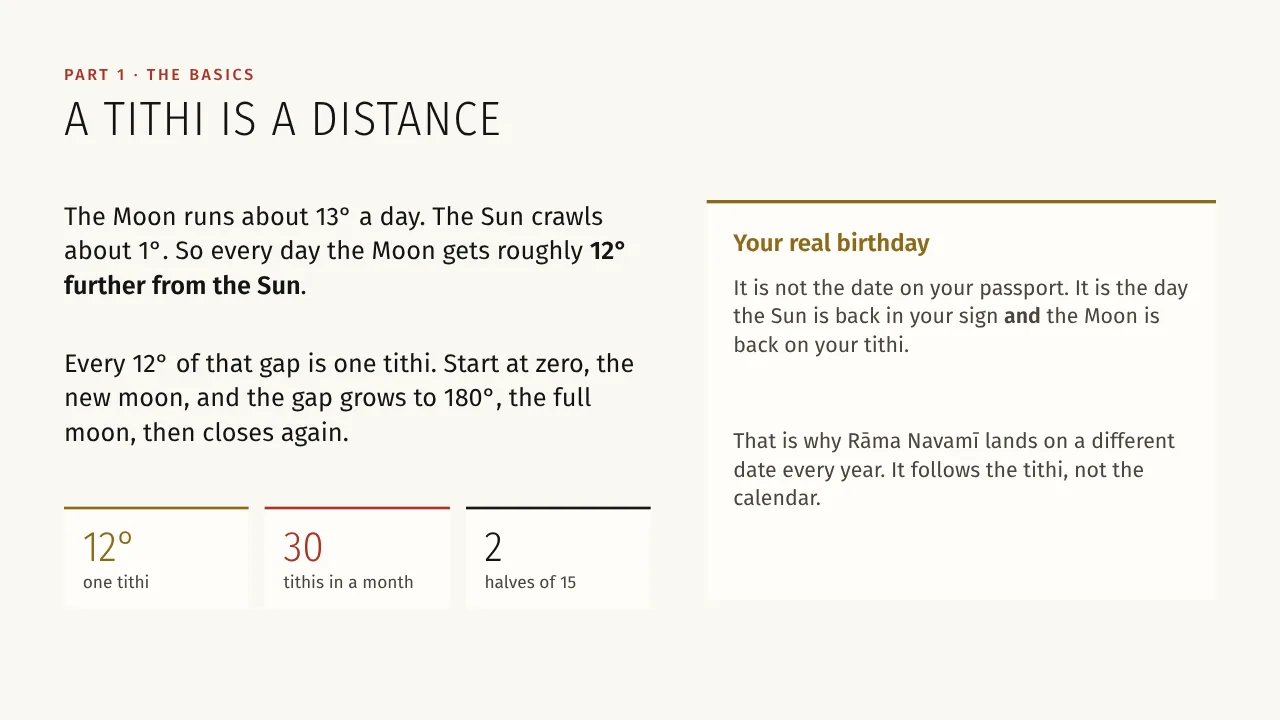
So what is a tithi, really? It is just a distance. The distance between the Sun and the Moon. The Moon is fast, it covers about thirteen degrees a day. The Sun is slow, about one degree a day. So every single day the Moon pulls roughly twelve degrees further away from the Sun. And every twelve degrees of that gap is one tithi.
When they sit together, zero degrees, that is the new moon. The gap keeps opening till 180 degrees, the full moon, and then it closes back. Thirty tithis. Two halves of fifteen. That is the whole idea. Simple, right? And one thing almost nobody tells you.
Your English birthday is not your real birthday. Your real birthday is the day the Sun is back in the sign it had when you were born, and the Moon is back on your tithi. That is why Rāma Navamī never falls on the same date. It follows the tithi, not the calendar.
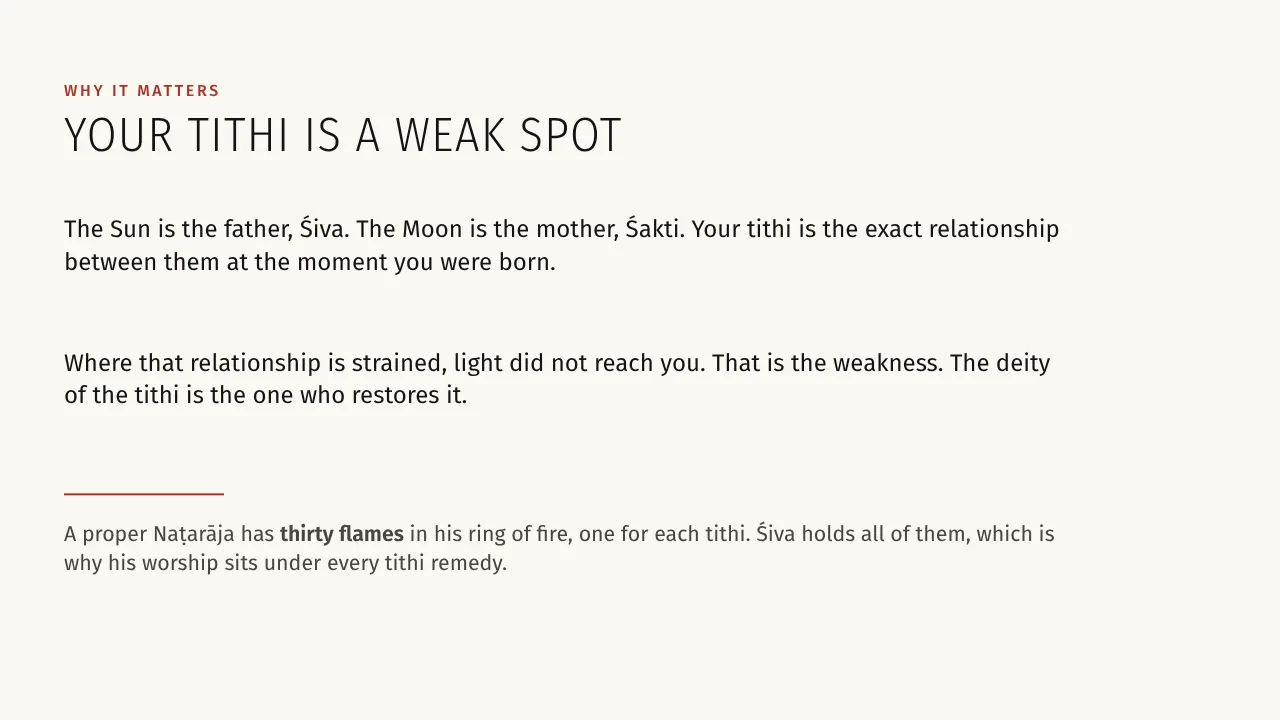
Why is the birth tithi a weakness? Think of it like this. The Sun is the father, Śiva. The Moon is the mother, Śakti. And the tithi is the relationship between your two divine parents at the exact moment you were born. Every relationship has a spot where it is strained, right? That is where the light did not reach you. Everybody else got light there, you did not. That is your weakness. And the deity who sits on that tithi is the one who brings that light back. And here is a nice detail.
Next time you see a good Naṭarāja, count the flames in his ring of fire. Thirty. One for every tithi. Śiva holds all thirty, and that is why Śiva sits underneath every tithi remedy you will hear today.
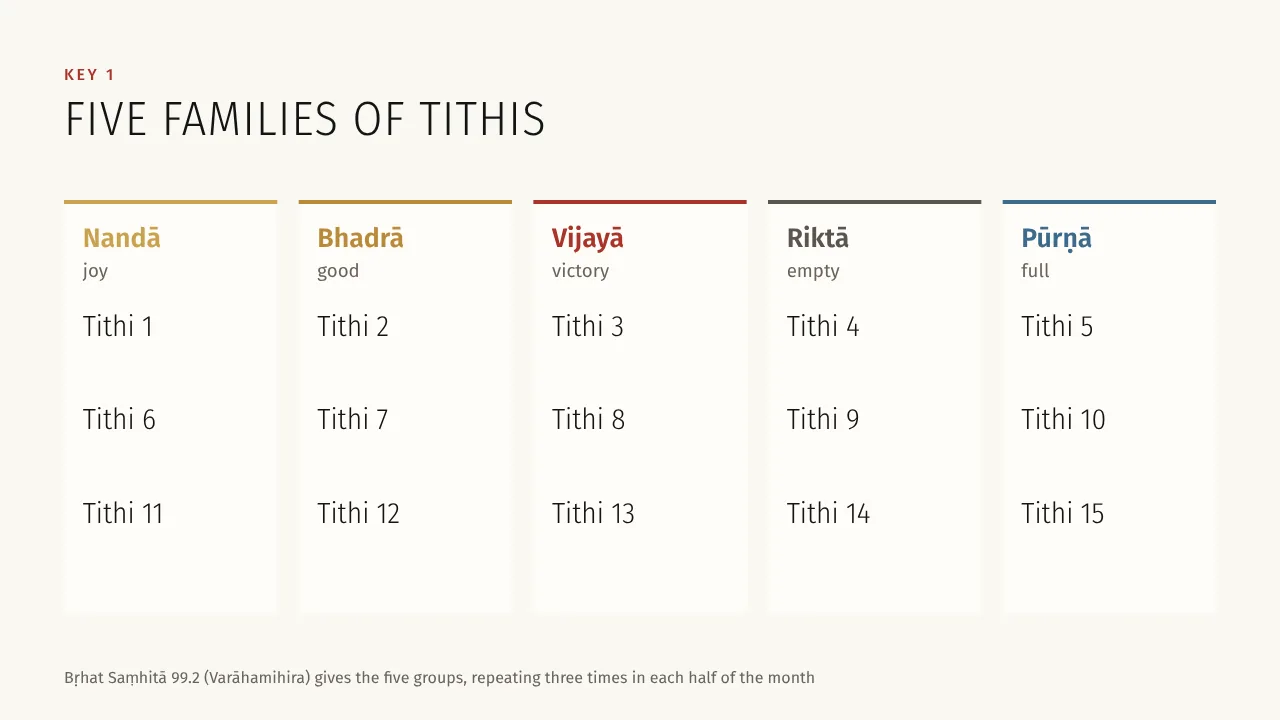
Three keys, and then we do every tithi one by one. Key number one, the family. Varāhamihira gives this in the Bṛhat Saṃhitā. The tithis come in five families, and the pattern repeats three times in each half of the month. Nandā, joy: the first, sixth and eleventh. Bhadrā, good: the second, seventh and twelfth. Vijayā, victory: the third, eighth and thirteenth.
Riktā, the empty ones: the fourth, ninth and fourteenth. And Pūrṇā, full: the fifth, tenth and fifteenth. Notice Riktā. Empty. Chaturthī is a Riktā tithi. Gaṇeśa’s day is an empty day. Keep that in mind.
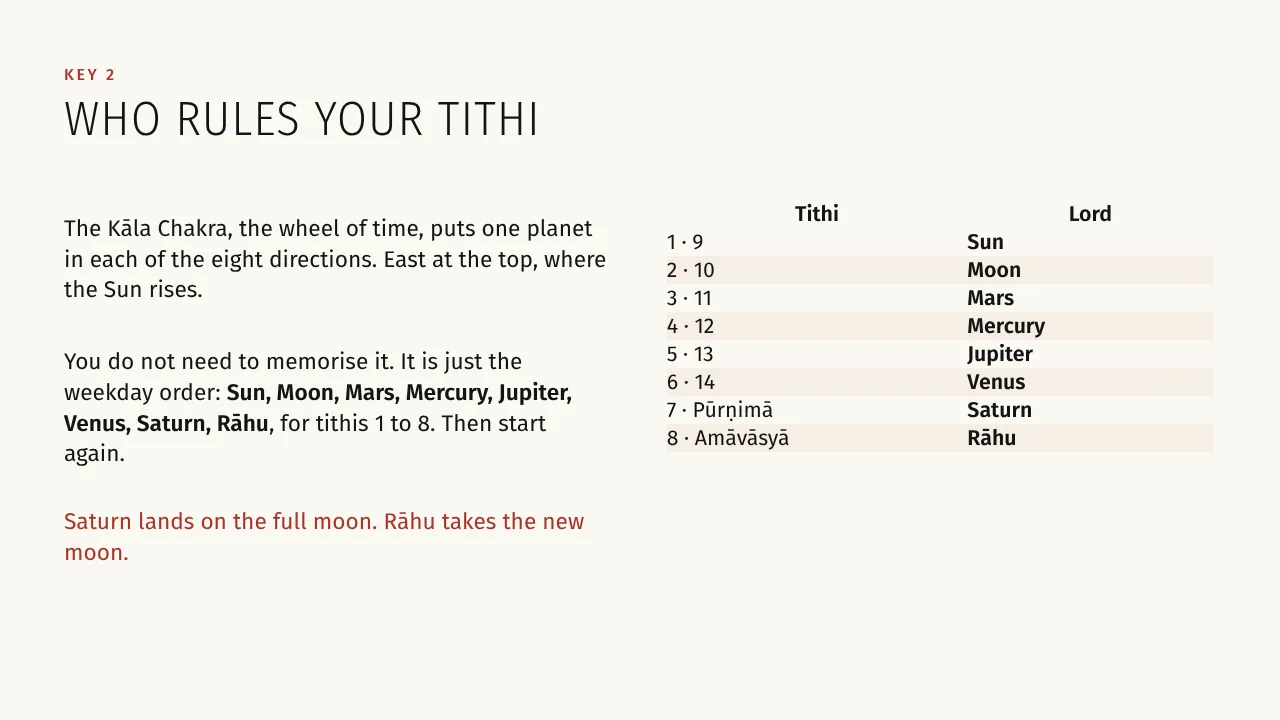
Key number two, the lord. This comes from the Kāla Chakra, the wheel of time. Eight directions, one planet sitting in each, and East goes on top because that is where the Sun rises. Sun in the East, Mars south-east, Jupiter south, Mercury south-west, Venus west, Saturn north-west, Moon north, Rāhu north-east.
Now please don’t memorise the wheel. There is a shortcut, and it is the table on the right. It is just the weekday order. Sun, Moon, Mars, Mercury, Jupiter, Venus, Saturn, and then Rāhu. Those rule tithis one to eight. At nine you start again from the Sun. And when you reach fifteen, Saturn takes the full moon and Rāhu takes the new moon. That’s it.
| Tithi | Lord |
|---|---|
| 1 · 9 | Sun |
| 2 · 10 | Moon |
| 3 · 11 | Mars |
| 4 · 12 | Mercury |
| 5 · 13 | Jupiter |
| 6 · 14 | Venus |
| 7 · Pūrṇimā | Saturn |
| 8 · Amāvāsyā | Rāhu |
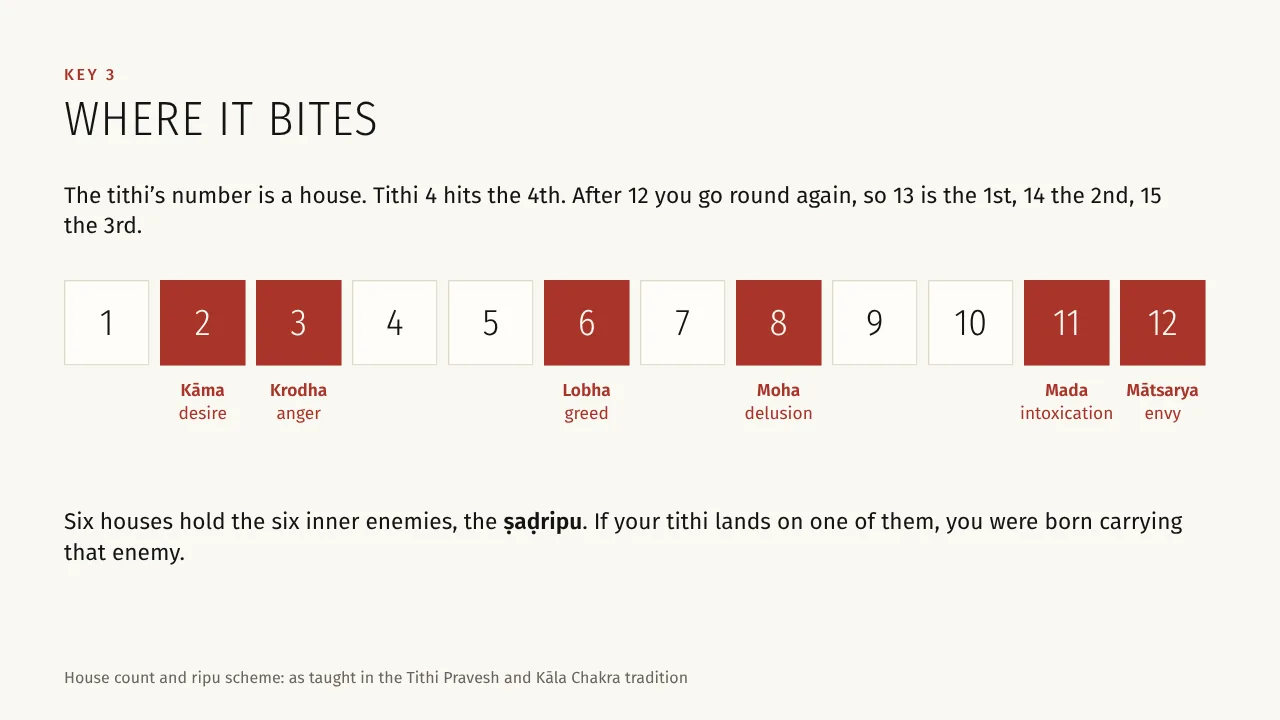
Key number three. Where does the weakness hit? Super simple. The number of the tithi is a house. Fourth tithi, fourth house. Ninth tithi, ninth house. After twelve, go round again, so the thirteenth is back on the first. And six of these houses hold the six inner enemies, the ṣaḍripu. Desire in the second. Anger in the third. Greed in the sixth. Delusion in the eighth. Intoxication in the eleventh. Envy in the twelfth.
If your tithi lands on one of these, you were born carrying that particular enemy. Okay. Those are the three keys. Now let us go through every tithi.
Every tithi, one by one
All fifteen tithis and the new moon: what each takes, what heals it, and its story.
Now, every tithi, one by one. Find yours and pay attention to that one.
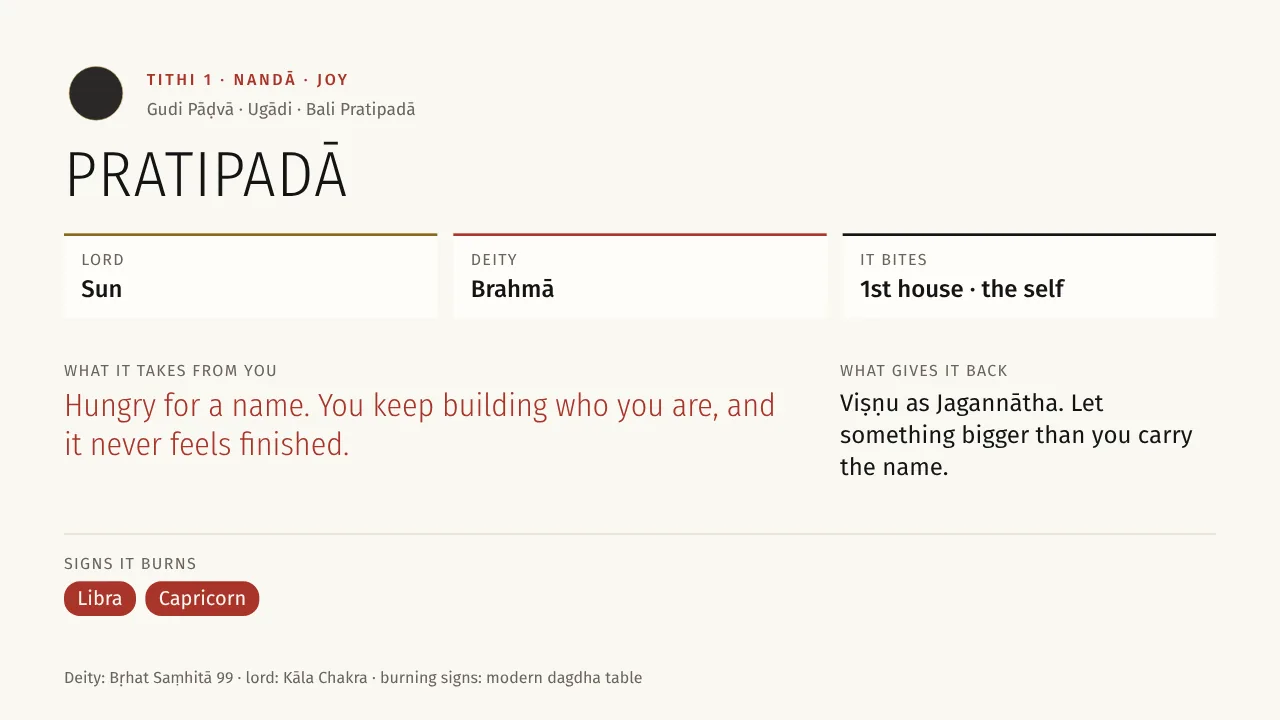
Pratipadā, the first. Family Nandā, joy. Ruled by the Sun. The Bṛhat Saṃhitā gives Brahmā as its deity, which makes sense, the first day, the creator. It hits the first house, the self. And the weakness is a hunger for a name. These people keep building an identity, a reputation, and it never feels finished.
What helps is Viṣṇu as Jagannātha. Let something bigger than you carry your name. And it burns Libra and Capricorn.
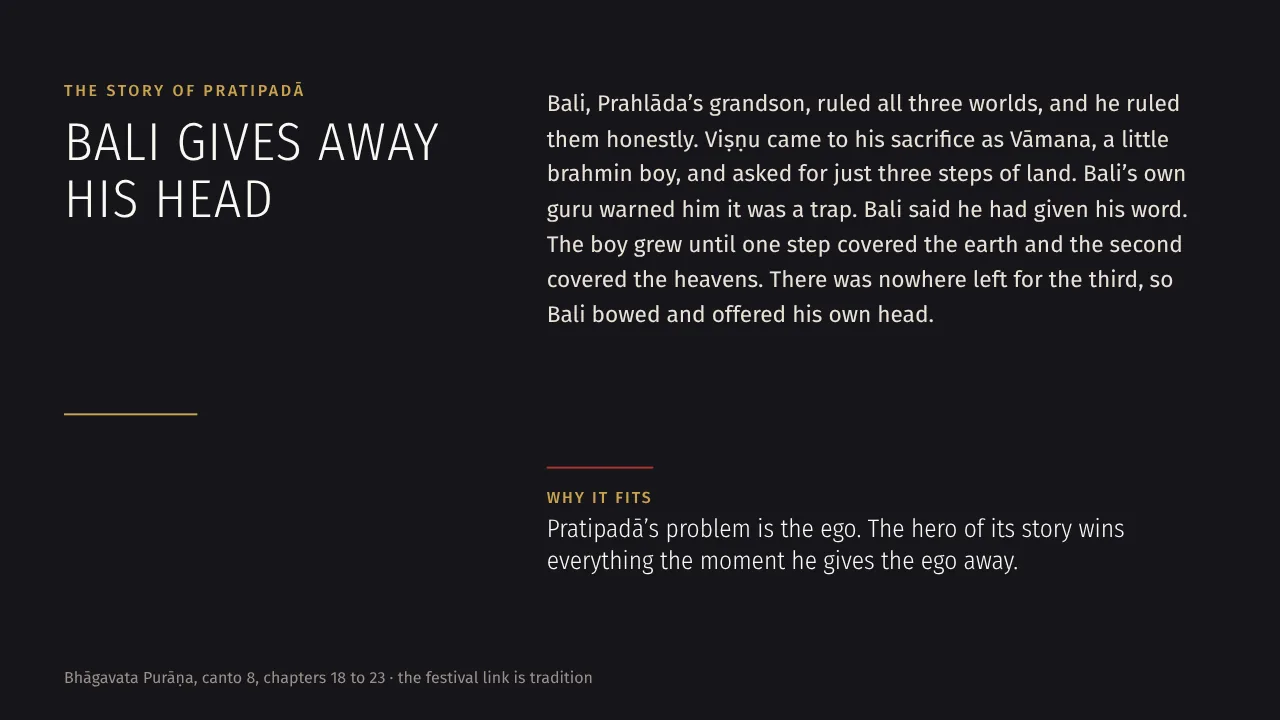
And the story. Bali, the grandson of Prahlāda, rules all three worlds, and he is a good king, honest, generous. The devas panic and go to Viṣṇu. And Viṣṇu does not bring an army. He comes to Bali’s yajña as Vāmana, a tiny brahmin boy, and he asks for three steps of land. That’s all. Śukrācārya, Bali’s guru, sees straight through it and warns him.
Bali says, I gave my word. And the boy grows, and grows, one step covers the earth, the second covers the heavens. Where is the third step going to go? Bali bows down and says, put it on my head. The Bhāgavatam tells this in the eighth canto, and Bali Pratipadā, the day after Dīwālī, remembers it.
Now think about the first tithi. Its problem is the ego. And the king in its story wins everything at the exact moment he gives the ego away.
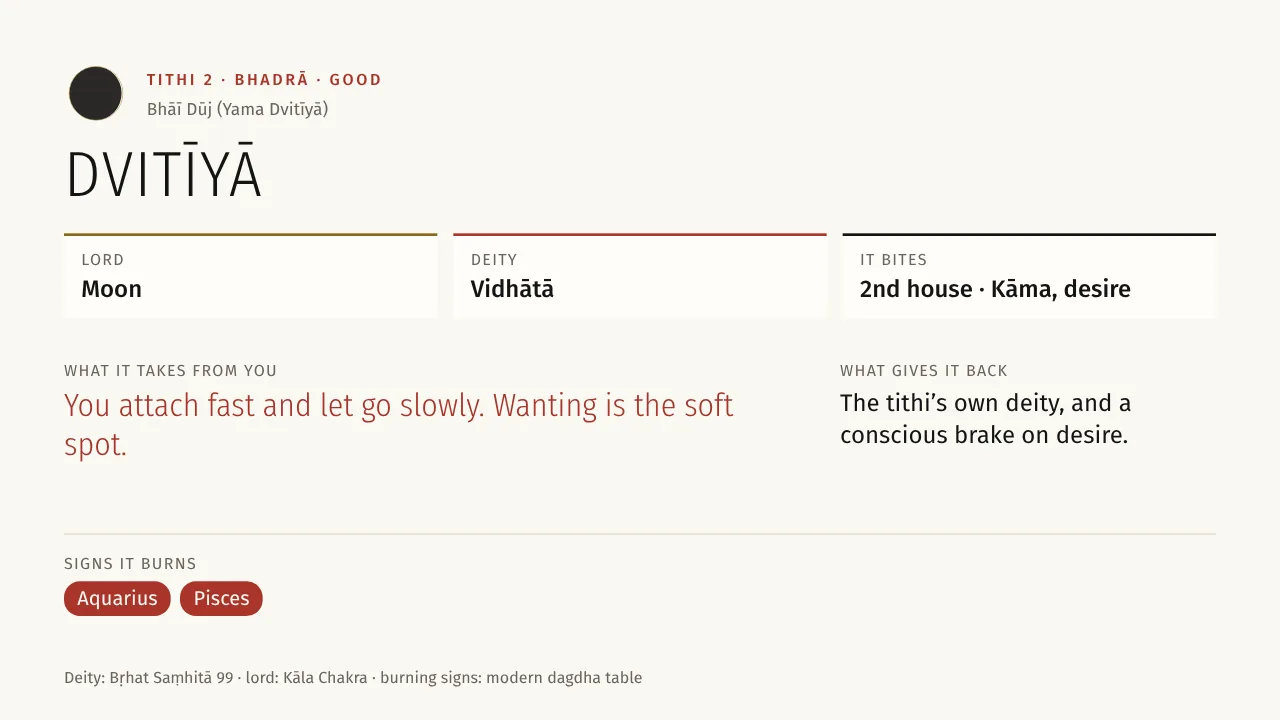
Dvitīyā, the second. Family Bhadrā. Ruled by the Moon. Deity Vidhātā, the one who sets destiny. It lands on the second house, and the second house holds Kāma, desire. So these people attach fast and let go slowly. Wanting is the soft spot. What helps: the tithi’s own deity, and a very conscious brake on desire. It burns Aquarius and Pisces.
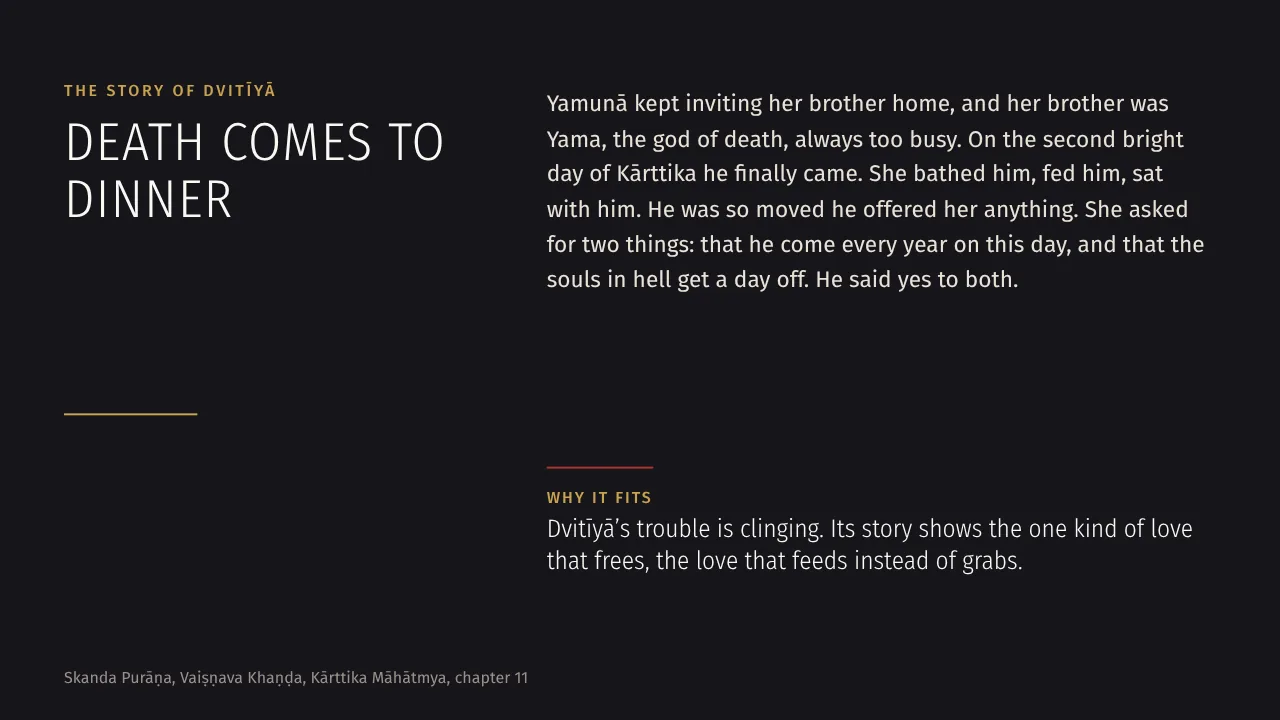
I love this story. Yamunā keeps inviting her brother home. And her brother happens to be Yama, the god of death, who is, obviously, always busy. One year, on the second day of the bright half of Kārttika, he finally comes. She bathes him, feeds him, sits with him. And Death is so moved that he says, ask me anything. She asks for two things.
Come to my house every year on this day. And on this day, let the souls in hell have a break. He gives her both, and more: whoever eats at his sister’s house on this day won’t see the door of Yama’s house. The Skanda Purāṇa tells it, and that is Bhāī Dūj.
Now, Dvitīyā’s trouble is clinging, wanting. And the story shows the one kind of love that doesn’t trap you. The love that feeds, not the love that grabs.
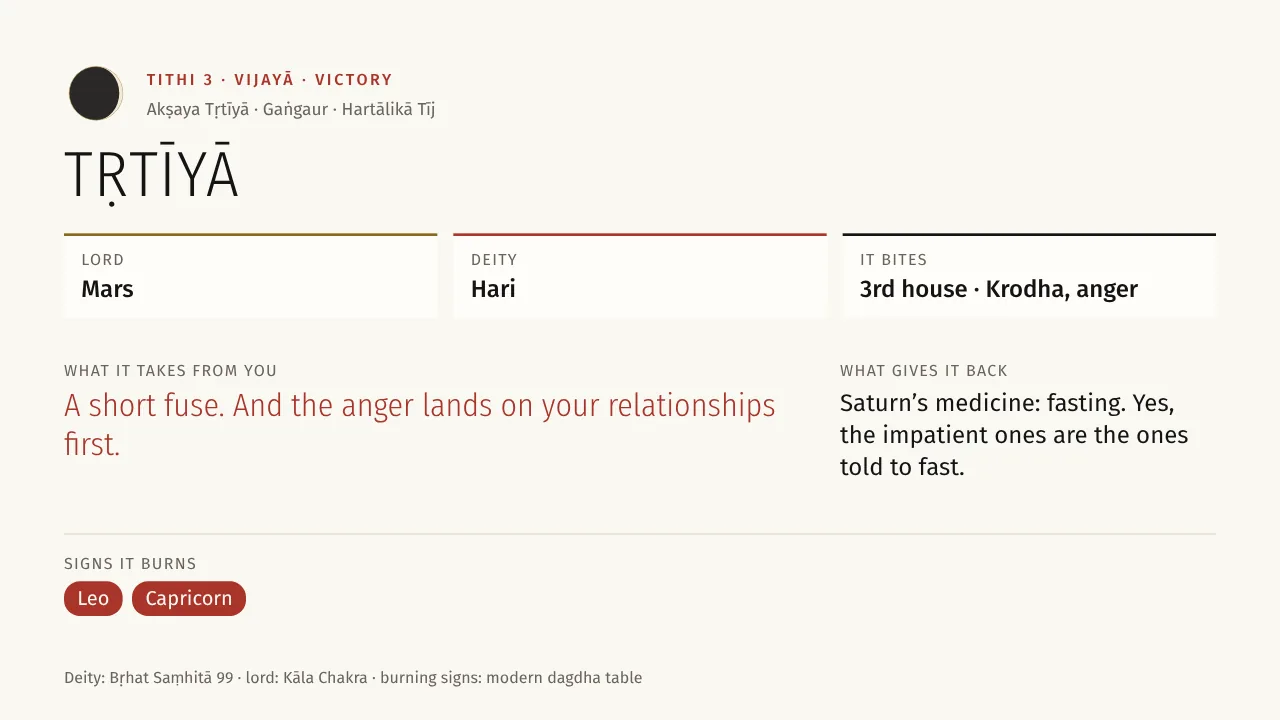
Tṛtīyā, the third. Family Vijayā, victory. Ruled by Mars. Deity Hari. It lands on the third house, which holds Krodha, anger. So, a short fuse. But here is the twist. On the Kāla Chakra, Mars sits in the south-east, and the south-east is Venus’s direction.
So this anger doesn’t stay in the head. It lands on your relationships. And the medicine is not Jupiter. It is Saturn, the opposite planet on the wheel, and Saturn’s medicine is fasting. I always laugh at this, because the most impatient people are exactly the ones being told to fast. It burns Leo and Capricorn.
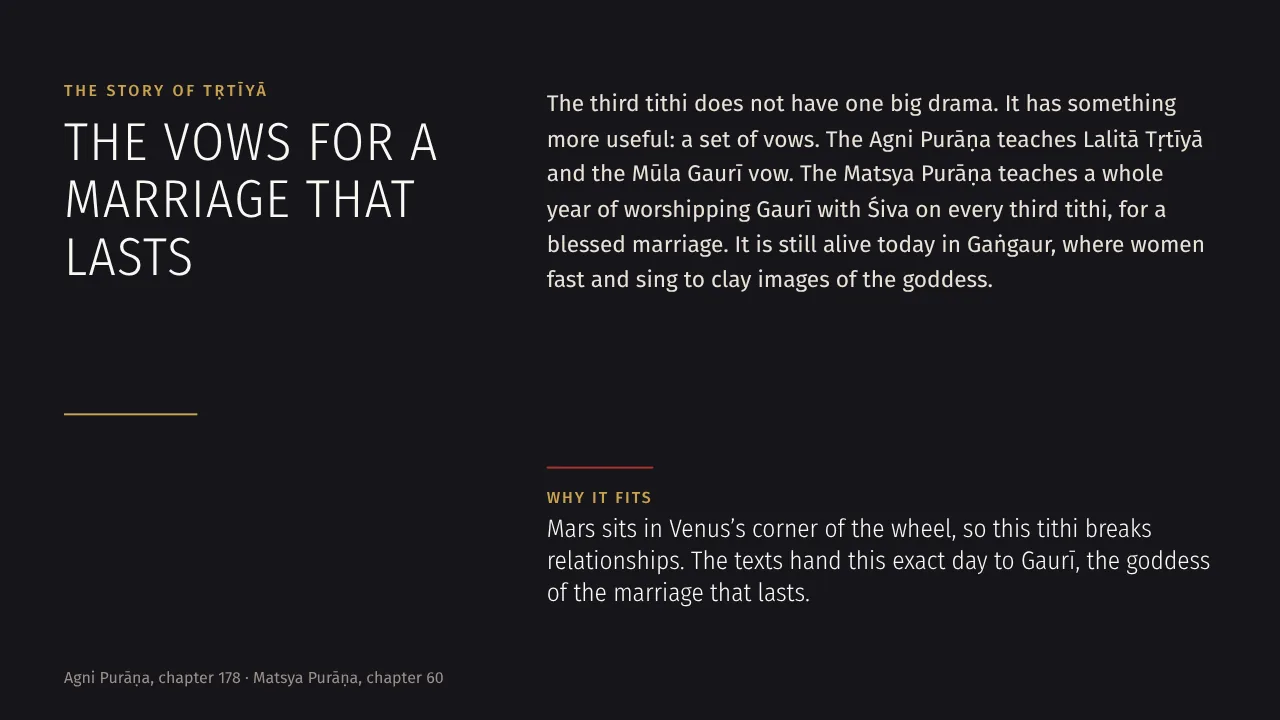
Tṛtīyā doesn’t have one big dramatic story. It has something more practical, a set of vows. The Agni Purāṇa has a full chapter on Tṛtīyā vows, Lalitā Tṛtīyā, the Mūla Gaurī vow. The Matsya Purāṇa describes a whole year of worshipping Gaurī with Śiva on the third tithi, for saubhāgya, a blessed marriage. And it never died. Gaṅgaur in Rajasthan and Gujarat, women fasting, singing, carrying clay Gaurīs.
So connect it. This is the tithi whose anger breaks relationships. And the tradition gives this very day to Gaurī, the goddess of the marriage that lasts. The medicine is sitting right on top of the wound.
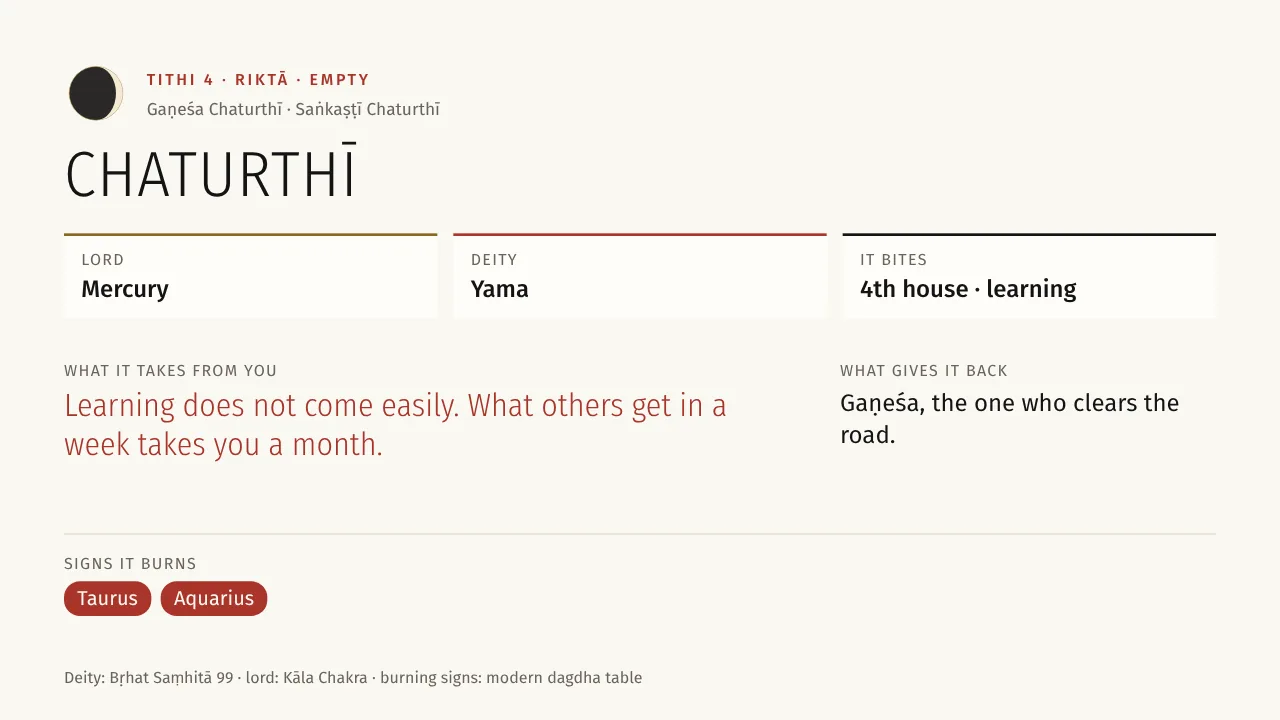
Chaturthī, the fourth. Family Riktā, empty. Ruled by Mercury, the planet of learning. Deity, Yama. It lands on the fourth house, education. So learning doesn’t come easy. What other kids pick up in a week takes you a month. And what helps, you already know: Gaṇeśa, the one who clears the road. It burns Taurus and Aquarius.
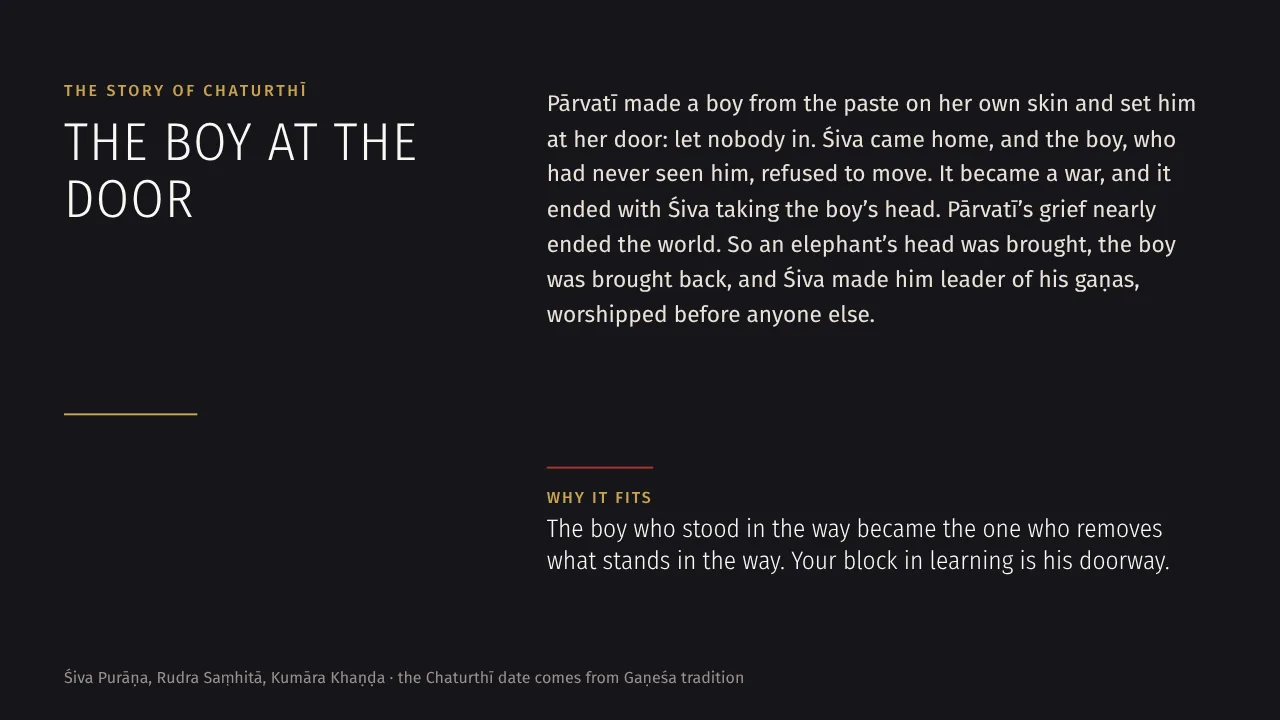
Everyone knows this story, but listen to it with the tithi in your head. Pārvatī wants a guard she can trust. She takes the paste off her own skin, makes a boy, gives him life, and puts him at her door. Let nobody in. Śiva comes home. The boy has never seen him, and he will not move. It turns into a full war, Śiva’s gaṇas can’t shift him, and it ends with Śiva cutting off the boy’s head. And Pārvatī’s grief almost ends the universe.
So an elephant’s head is brought, the boy comes back to life, and Śiva makes him Gaṇapati, the leader of the gaṇas, the one worshipped before anyone else. The Śiva Purāṇa tells it in the Kumāra Khaṇḍa. See what happened? The boy who stood in the way became the one who removes whatever stands in the way. For the Chaturthī born, the block in your learning is his doorway.
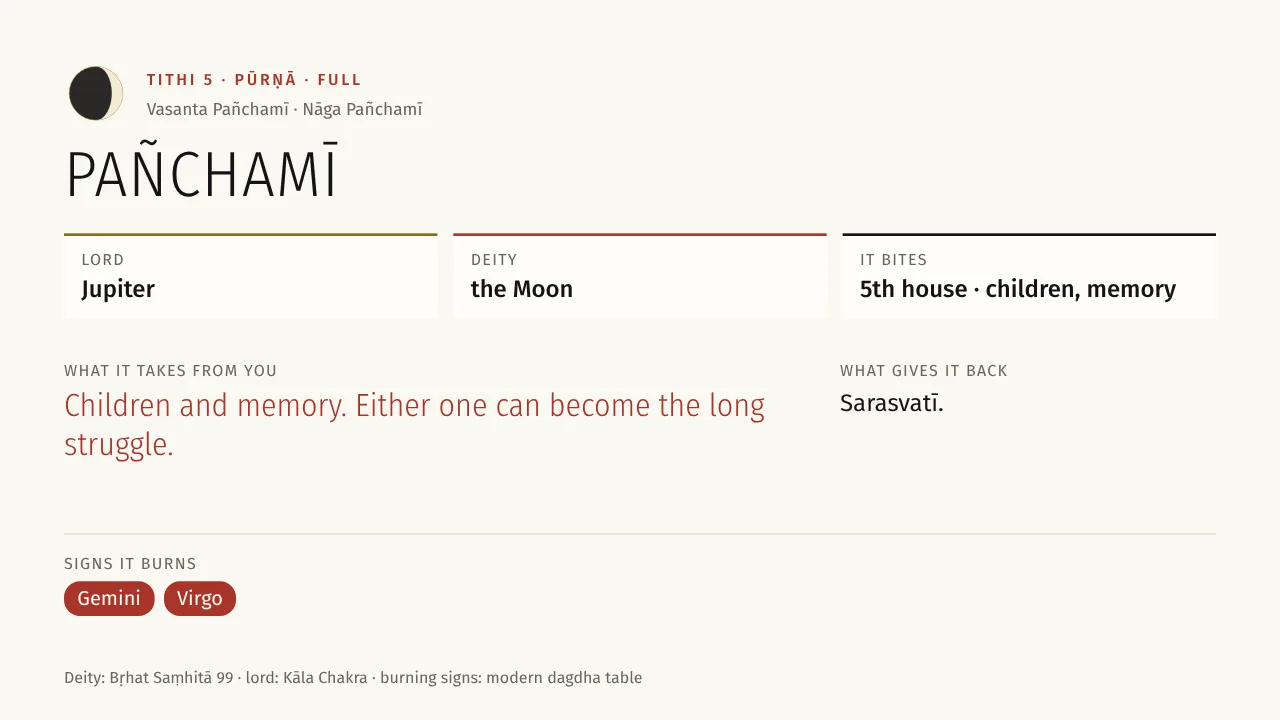
Pañchamī, the fifth. Family Pūrṇā, full. Ruled by Jupiter, the giver of children and wisdom. Deity, the Moon. It lands on the fifth house: children, and memory. So either can become the long struggle in this life. What helps is Sarasvatī. It burns Gemini and Virgo.
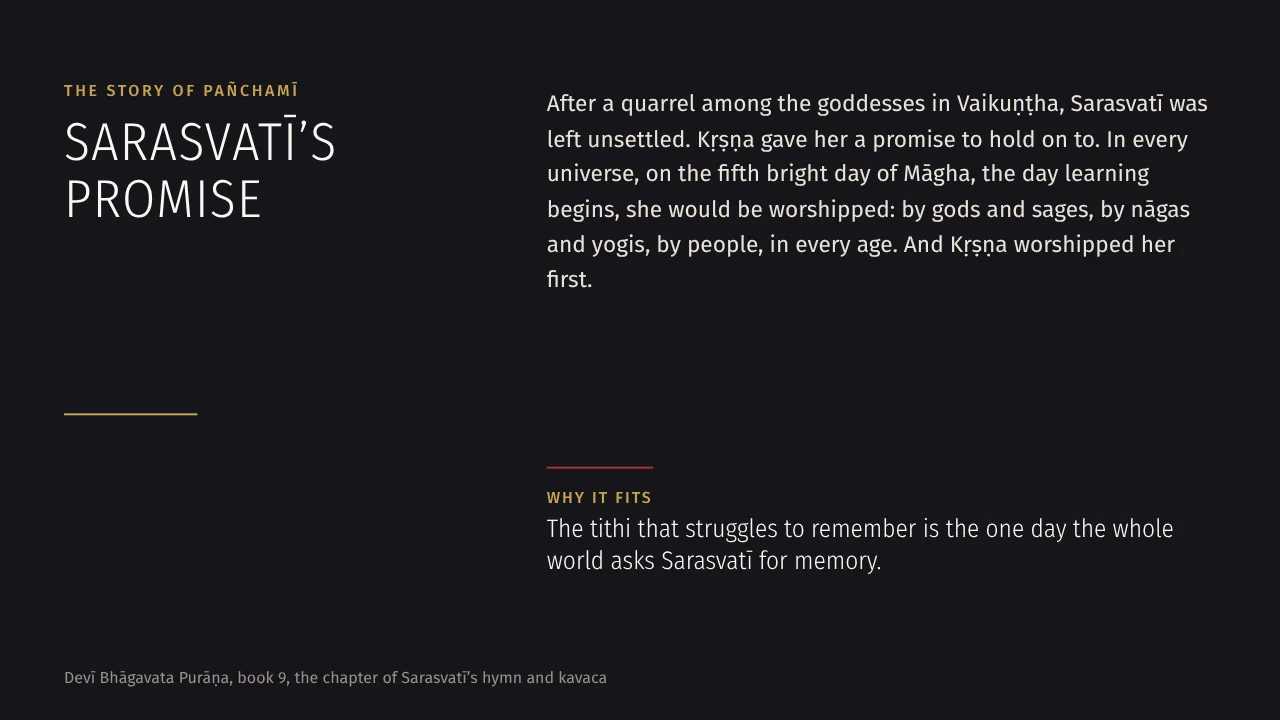
Pañchamī’s story is in the Devī Bhāgavatam, the ninth book. After a quarrel among the goddesses in Vaikuṇṭha, Sarasvatī is left unsettled. And Kṛṣṇa gives her a promise. In every universe, he says, on the fifth day of the bright half of Māgha, the day when learning begins, there will be a festival for you. Gods, sages, nāgas, yogis, people, all of them will worship you, in every age, till the very end.
And then Kṛṣṇa worships her himself, first. That is Vasanta Pañchamī, the day kids write their first letters and we put our books in front of the goddess.
Now the Pañchamī born struggle with memory. And their tithi is the one day in the year the whole world sits down and asks Sarasvatī for exactly that.
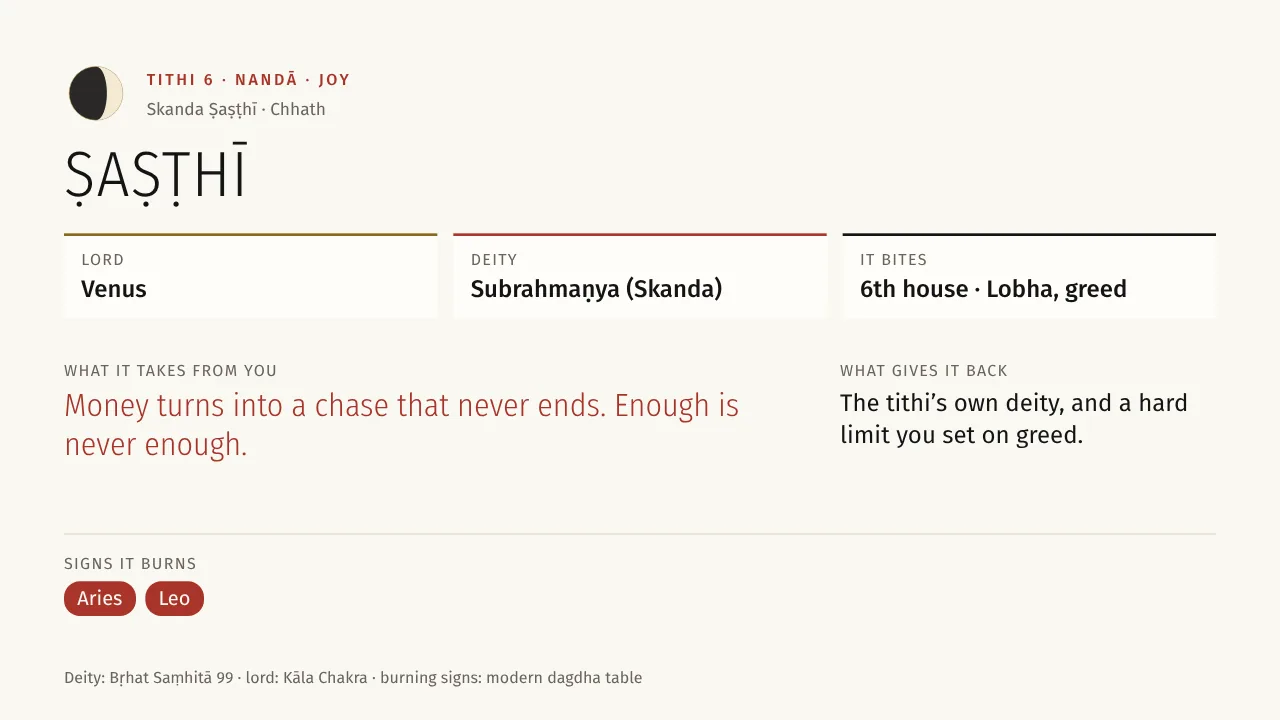
Ṣaṣṭhī, the sixth. Family Nandā. Ruled by Venus. And the Bṛhat Saṃhitā gives Subrahmaṇya, Skanda, as its deity. It lands on the sixth house, which holds Lobha, greed. So money becomes a chase that never ends. Enough is never enough. What helps: the tithi’s deity, and a hard limit that you set on greed yourself. It burns Aries and Leo.
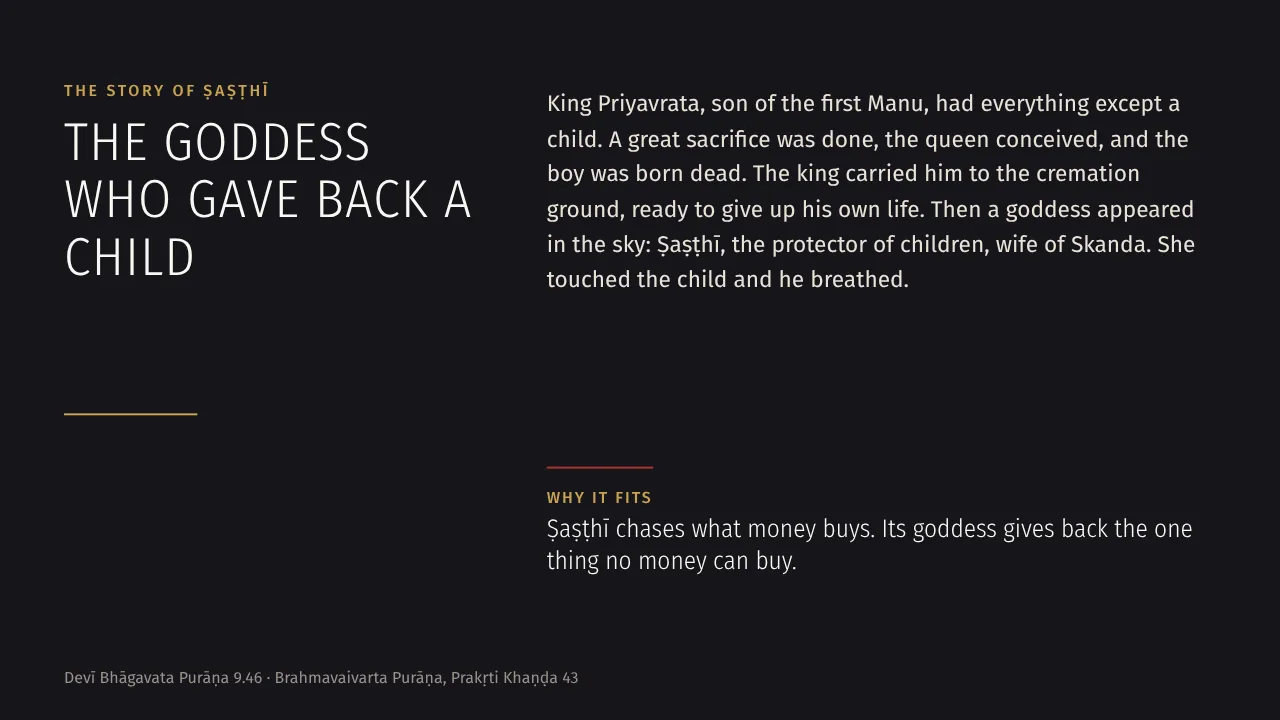
Skanda’s wife is Devasenā, and she is worshipped as Ṣaṣṭhī Devī. The Devī Bhāgavatam tells her story. King Priyavrata, the son of the first Manu, has everything a king can have, except a child. A great yajña is done, the queen conceives, and the boy is born dead. Can you imagine? The king carries that little body to the cremation ground and he is ready to give up his own life there. And a goddess appears in the sky.
Ṣaṣṭhī. She picks up the child, touches him, and he breathes. That is why the sixth day after a birth is protected, and why Chhath honours her. Now, Ṣaṣṭhī’s weakness is chasing what money can buy. And its goddess gives back the one thing no money can buy.
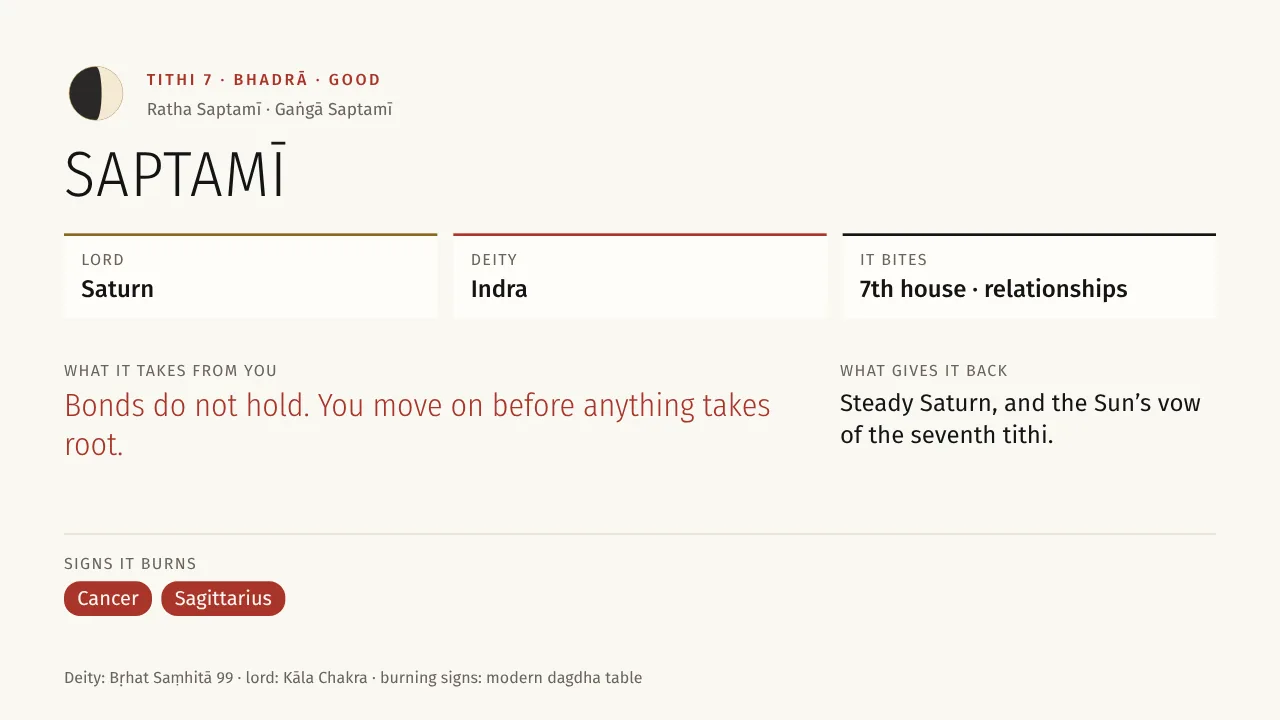
Saptamī, the seventh. Family Bhadrā. Ruled by Saturn. Deity Indra. It lands on the seventh, relationships. And the weakness is that bonds don’t hold. These people move on before anything can take root. What helps: steady Saturn, and the Sun’s own vow of the seventh tithi, which is the story. It burns Cancer and Sagittarius.
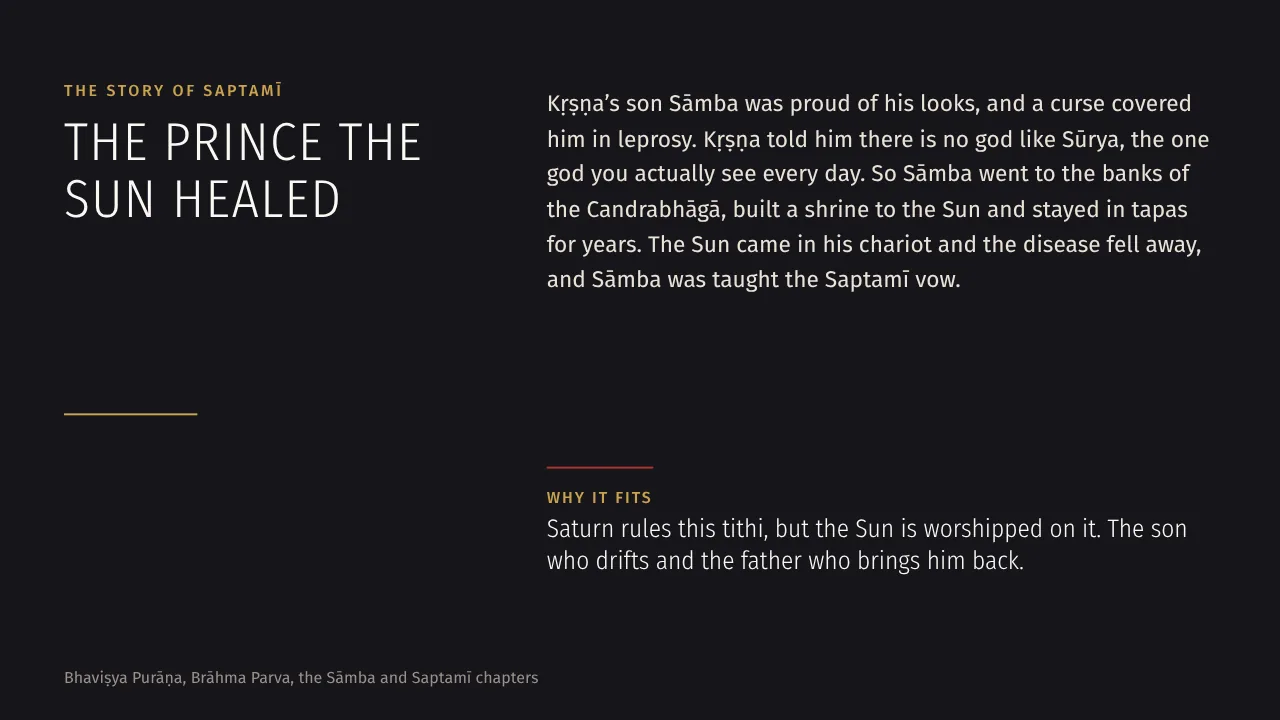
This one is from the Bhaviṣya Purāṇa. Sāmba, Kṛṣṇa’s son, is very proud of his looks, and a curse covers him in leprosy. And Kṛṣṇa tells him, there is no god like Sūrya, because he is the one god you can actually see with your eyes, every single day.
So Sāmba goes to the banks of the Candrabhāgā, builds a temple to the Sun, and sits in tapas for years. And the Sun comes in his chariot, and the disease just falls away. What he is taught is the Saptamī vow, and its biggest day is Ratha Saptamī, when the Sun’s chariot turns north.
Interesting, no? Saturn rules this tithi, but on it we worship the Sun. Saturn and the Sun, the son who drifts away and the father who brings him back. For people who keep drifting from bond to bond, that is the medicine.
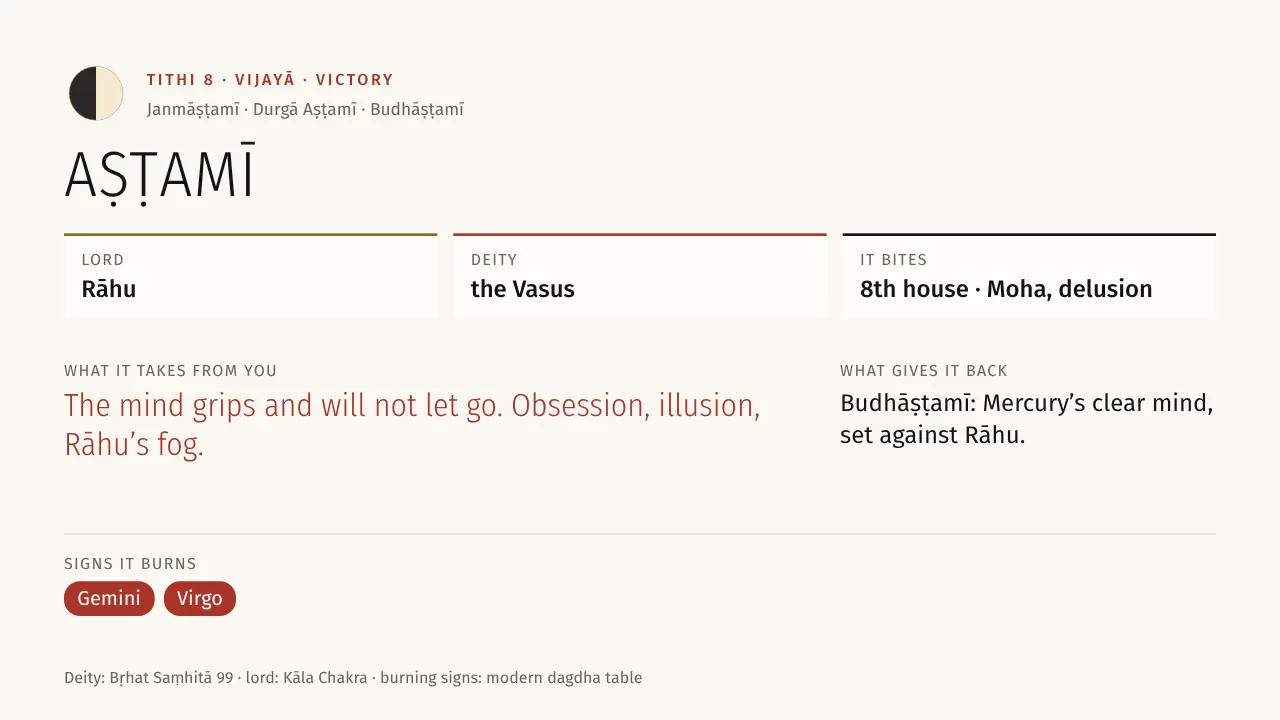
Aṣṭamī, the eighth. Family Vijayā. Ruled by Rāhu. Deity, the Vasus. It lands on the eighth house, which holds Moha, delusion. So the mind grips and won’t let go. Obsession, illusion, Rāhu’s fog. What helps is Budhāṣṭamī, Mercury’s Aṣṭamī: Mercury’s clear mind set against Rāhu. It burns Gemini and Virgo.
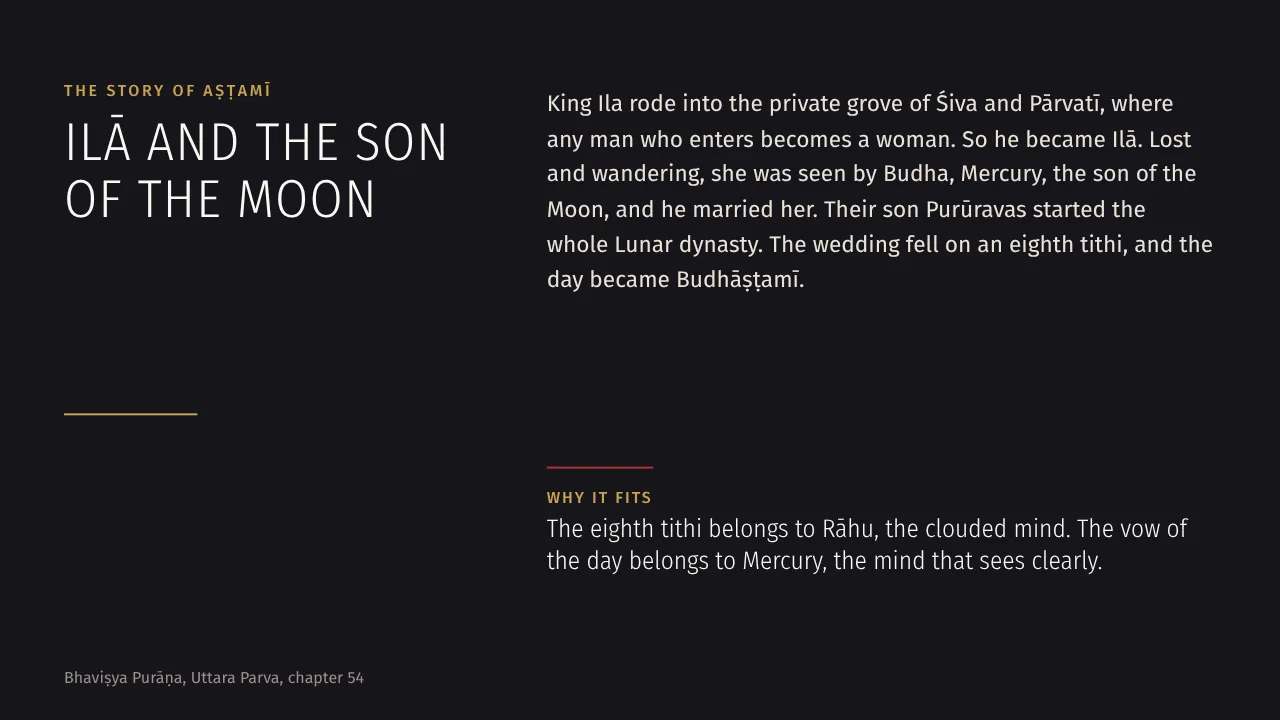
This is a strange and beautiful one, from the Bhaviṣya Purāṇa, Uttara Parva, chapter 54. King Ila goes hunting and rides into the private grove of Śiva and Pārvatī, and there is a rule in that grove: any man who walks in becomes a woman.
So King Ila becomes Ilā. Lost, wandering, she is seen by Budha, Mercury, the son of the Moon, and he marries her. Their son is Purūravas, the first king of the whole Lunar dynasty. And that wedding fell on an Aṣṭamī, which is why the day is called Budhāṣṭamī.
Now see it as an astrologer. The eighth tithi belongs to Rāhu, the clouded mind. And the vow of the day belongs to Mercury, the mind that sees clearly. That is exactly how you counter Rāhu.
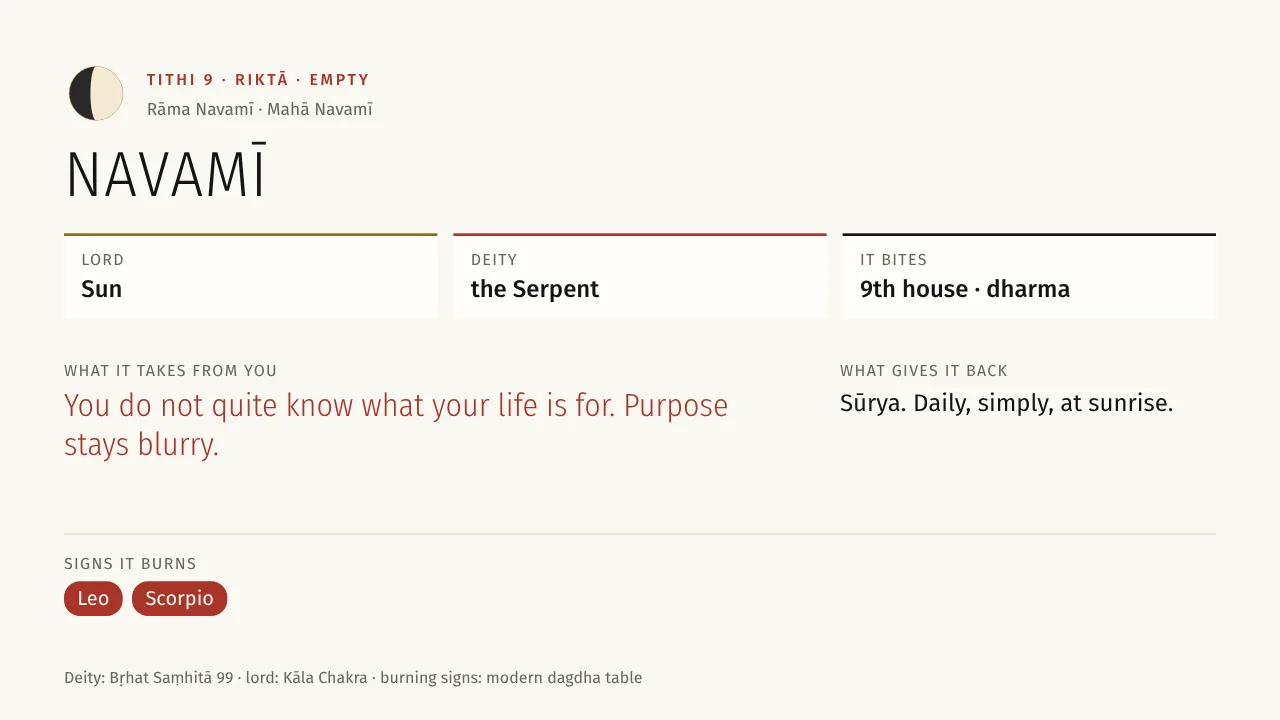
Navamī, the ninth. Family Riktā, empty again. Ruled by the Sun. And the Bṛhat Saṃhitā gives Sarpa, the serpent, as the deity. It lands on the ninth, the house of dharma. So the weakness: you don’t quite know what your life is for. The purpose stays blurry. What helps is Sūrya. Daily, simply, at sunrise. It burns Leo and Scorpio.
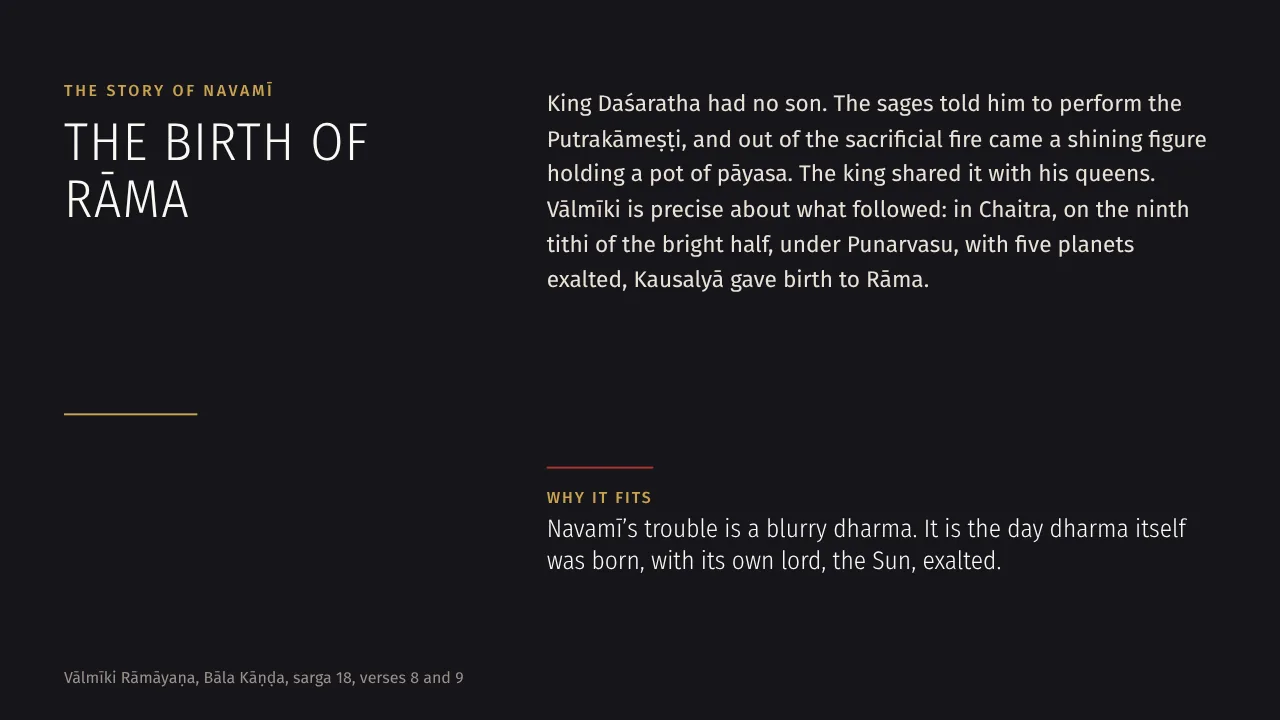
And Navamī has the most famous birthday in our whole tradition. King Daśaratha has no son. The sages tell him to do the Putrakāmeṣṭi, and out of the fire comes a shining figure holding a pot of pāyasa. The king shares it with his queens. And Vālmīki is very precise about what happens next. In Chaitra, on the ninth tithi of the bright half, under Punarvasu, with five planets exalted, Kausalyā gives birth to Rāma. Bāla Kāṇḍa, sarga eighteen.
So think about it. Navamī’s weakness is a blurry dharma, not knowing your purpose. And Navamī is the day dharma itself took birth, with the Sun, the lord of this tithi, exalted. If you are Navamī born, Rāma isn’t your trophy. He is what you came here to find.
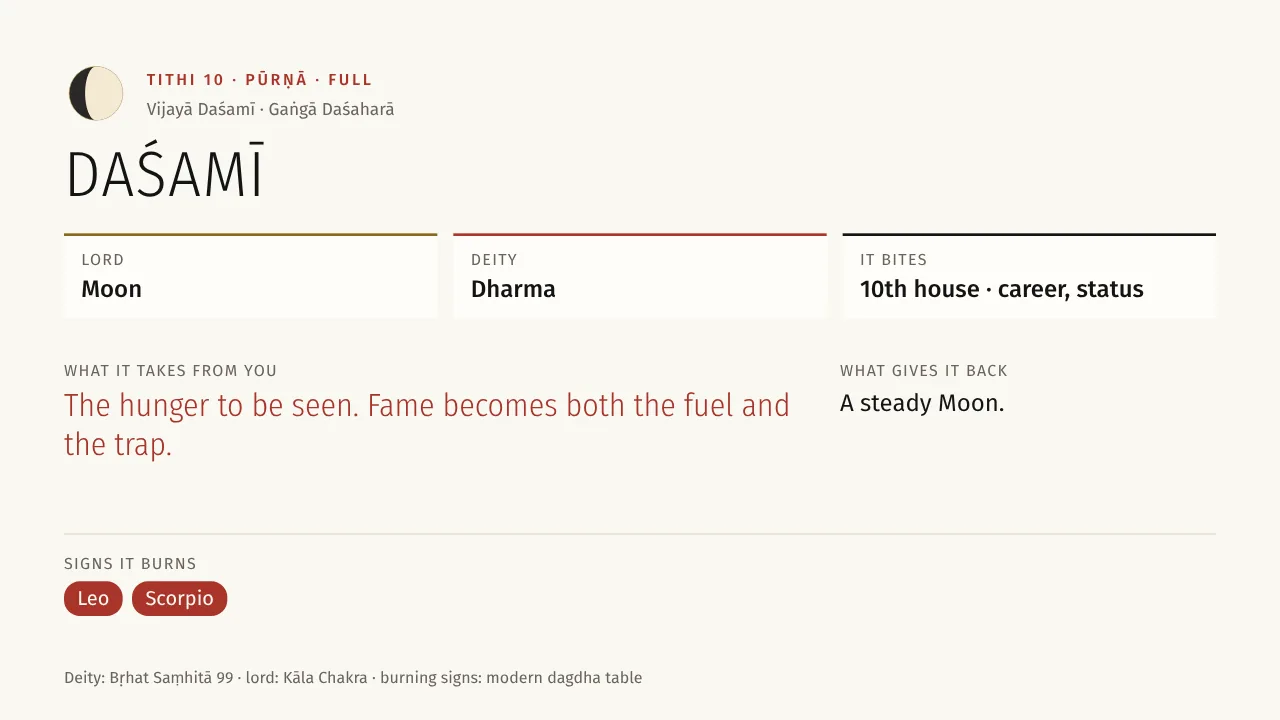
Daśamī, the tenth. Family Pūrṇā. Ruled by the Moon. And the deity is Dharma himself. It lands on the tenth: career, status, being seen. And that is the weakness, the hunger to be seen. Fame becomes both the fuel and the trap. What helps is a steady Moon. It burns Leo and Scorpio.
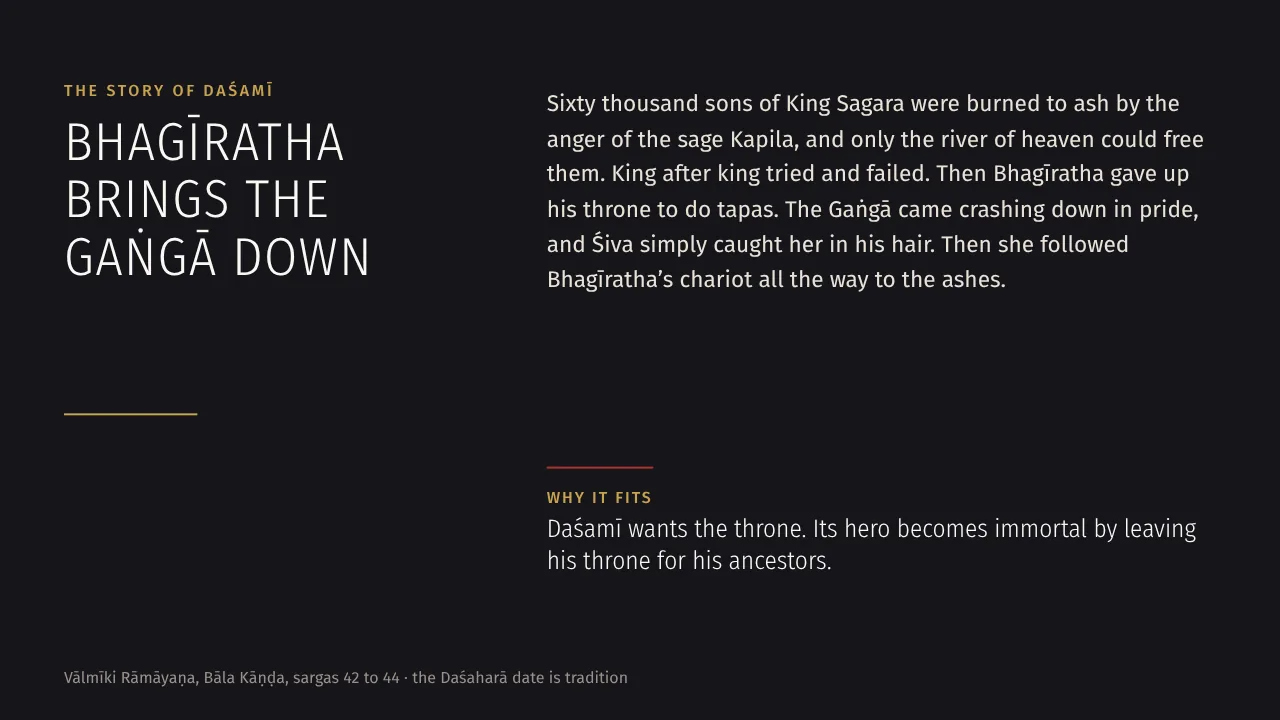
Daśamī’s story is the coming of the Gaṅgā. King Sagara’s sixty thousand sons are burned to ash by the anger of the sage Kapila, and only the river of heaven can free their souls. One king tries, fails. The next tries, fails.
Then Bhagīratha does something none of them did. He gives up his throne and goes to do tapas. Brahmā agrees to send the Gaṅgā, but the earth can’t take her fall, only Śiva can. So the Gaṅgā comes crashing down, full of pride, and Śiva just catches her in his hair. And then she follows Bhagīratha’s chariot all the way to those ashes, and the ancestors are free. Vālmīki tells it in the Bāla Kāṇḍa.
Daśamī wants the throne, the name, the spotlight. And its hero becomes immortal by walking away from the throne for his ancestors.
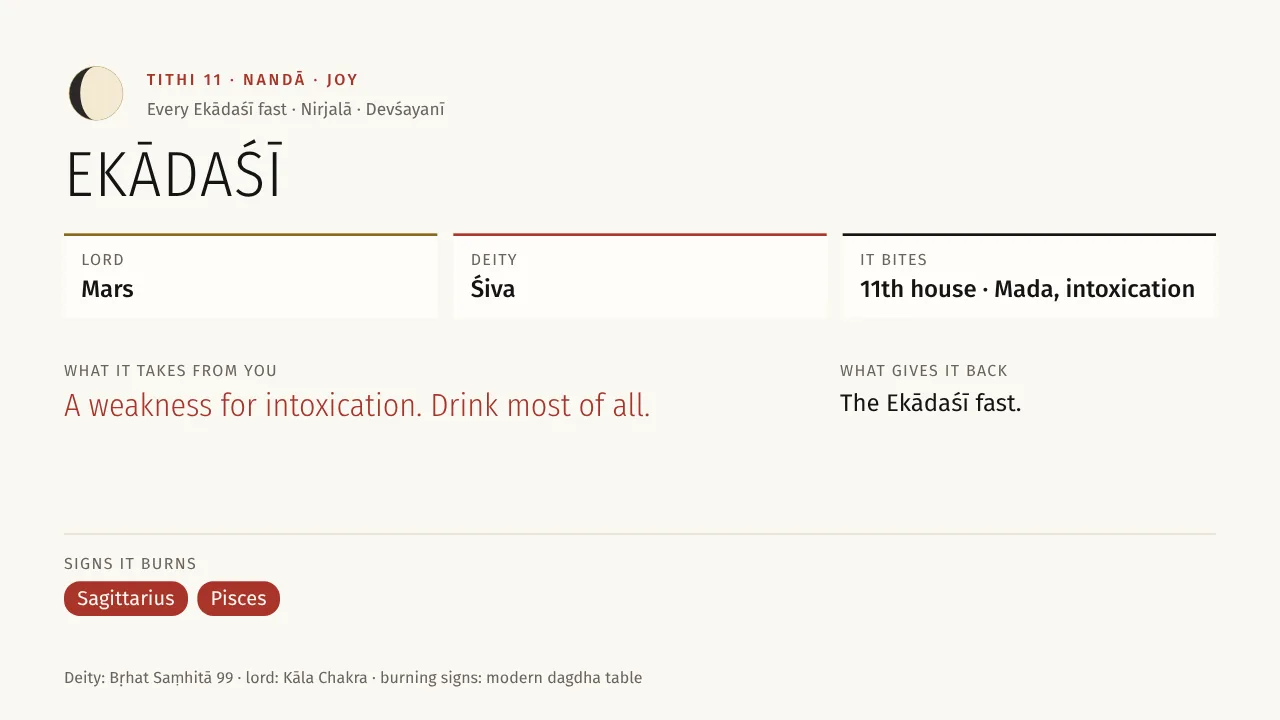
Ekādaśī, the eleventh. Family Nandā. Ruled by Mars. Deity Śiva. It lands on the eleventh, which holds Mada, intoxication. So a weakness for intoxication, drink most of all. And the medicine is the most famous fast we have: the Ekādaśī fast. It burns Sagittarius and Pisces.
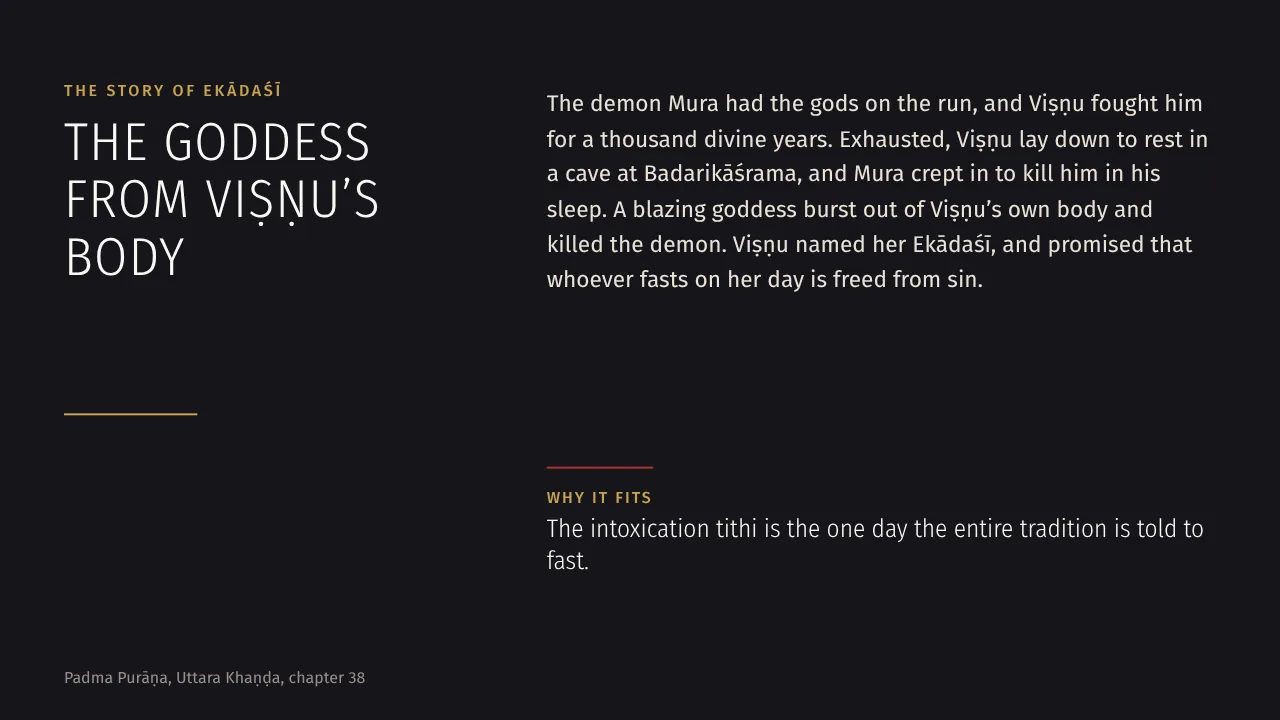
Where does Ekādaśī even come from? The Padma Purāṇa tells it. The demon Mura has the gods running, and Viṣṇu fights him for a thousand divine years. Tired, Viṣṇu goes into a cave at Badarikāśrama to rest, and Mura sneaks in to kill him while he sleeps. And a goddess bursts out of Viṣṇu’s own body, blazing, armed, and kills the demon.
Viṣṇu wakes up, sees Mura dead, and asks, who are you? She says, I am your own power. And he names her Ekādaśī, and promises that whoever fasts on her day is freed from sin. So here you have the tithi of intoxication, and it is the one day the entire tradition is told to fast.
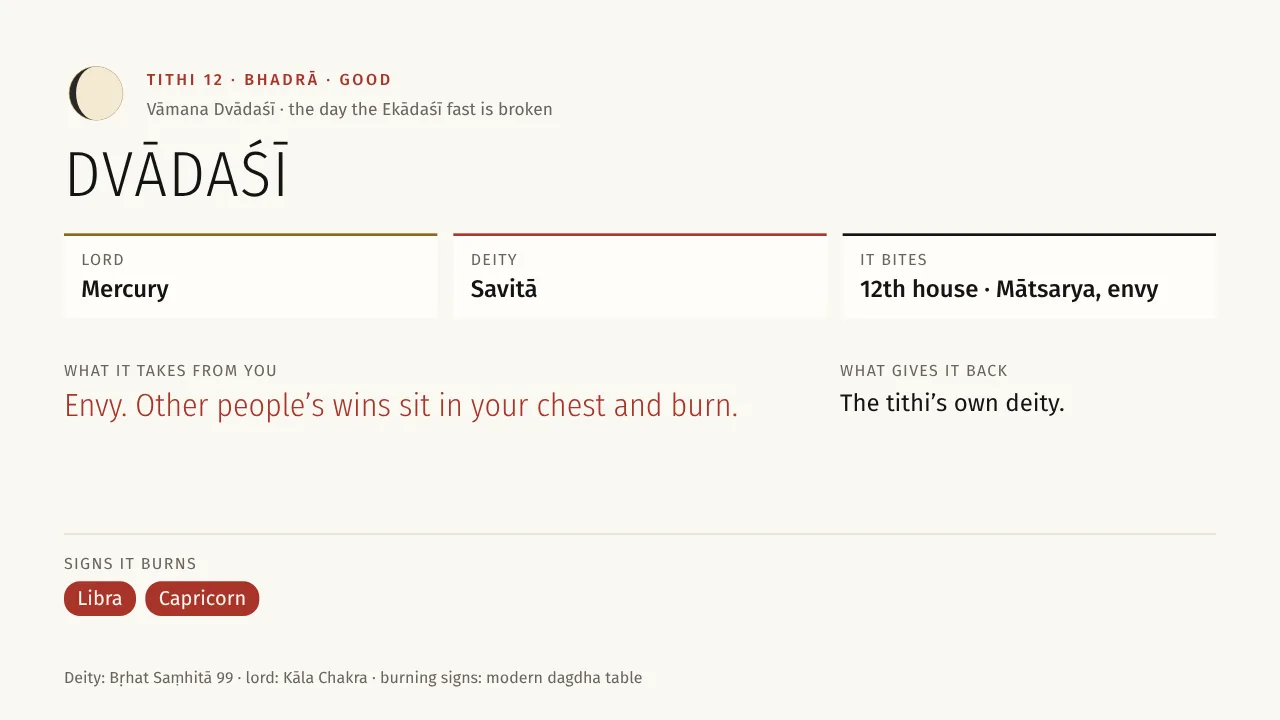
Dvādaśī, the twelfth. Family Bhadrā. Ruled by Mercury. Deity Savitā, the Sun as the one who sets things in motion. It lands on the twelfth, which holds Mātsarya, envy. So other people’s wins sit in your chest and burn. What helps is the tithi’s own deity. It burns Libra and Capricorn.
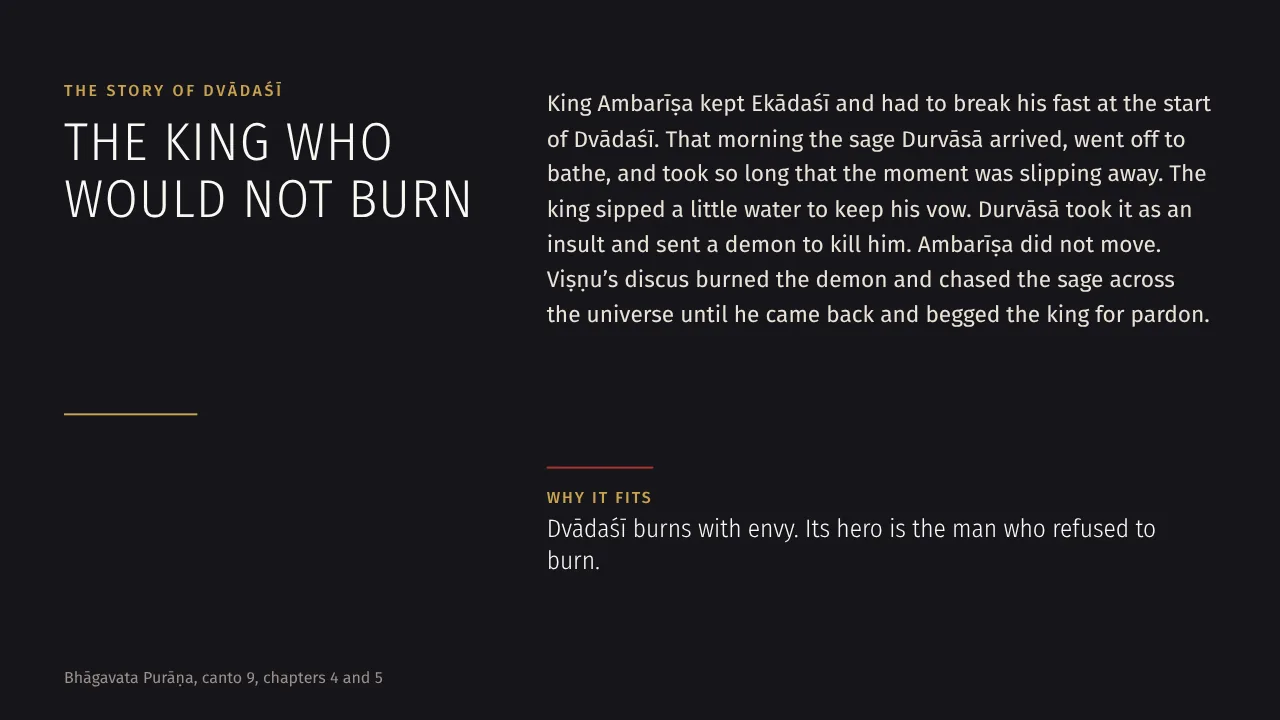
Dvādaśī has one of the great stories of the Bhāgavatam, the ninth canto. King Ambarīṣa keeps Ekādaśī and has to break the fast at the start of Dvādaśī. That morning the sage Durvāsā shows up as a guest. Wonderful, please eat with us. Durvāsā goes to bathe, and takes forever, and the moment to break the fast is about to pass.
So the king takes one sip of water, which counts as eating and not eating, and keeps waiting. Durvāsā sees it and explodes. He pulls out a lock of hair, makes a demon out of it and sends it to kill the king. And Ambarīṣa doesn’t move. Viṣṇu’s Sudarśana burns the demon and then chases Durvāsā across the entire universe, until the sage comes back and begs the king himself for forgiveness. Dvādaśī burns with envy. And its hero is the man who would not burn.
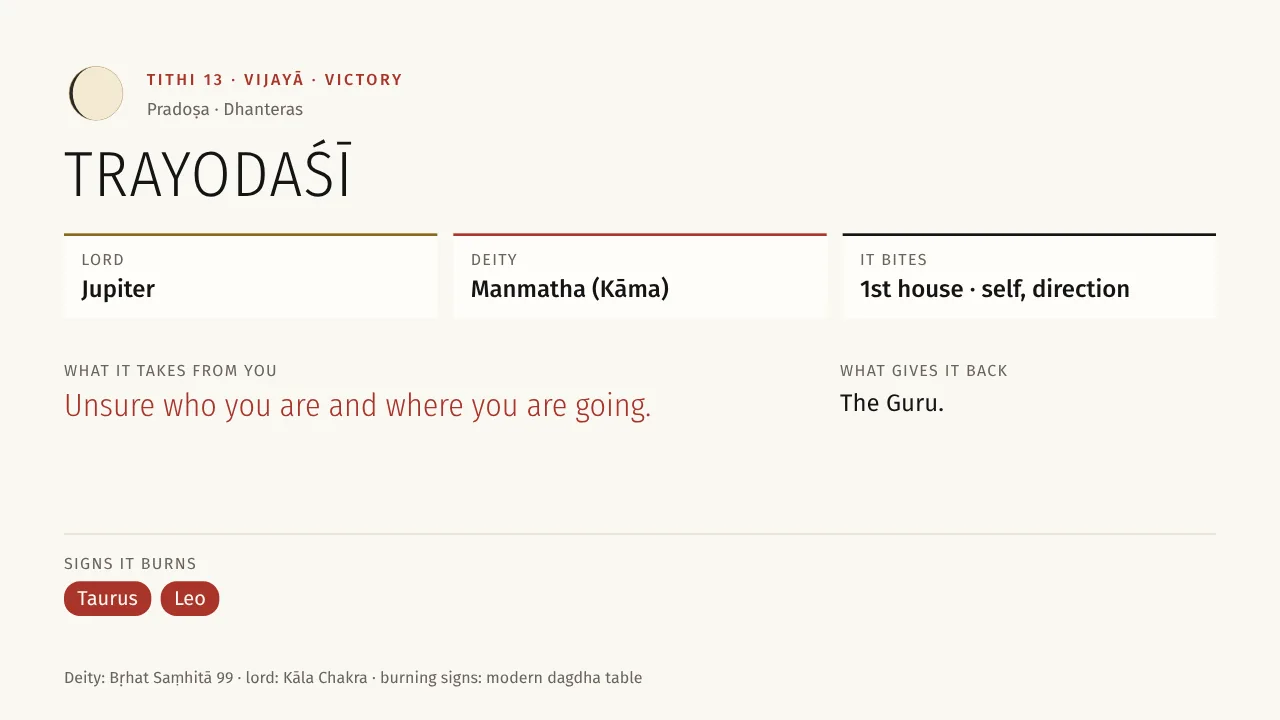
Trayodaśī, the thirteenth. Family Vijayā. Ruled by Jupiter. And look at the deity: Manmatha, Kāmadeva, desire himself. The count goes round, so it lands on the first house again, the self. The weakness: unsure who you are and where you are going. What helps is the Guru. It burns Taurus and Leo.
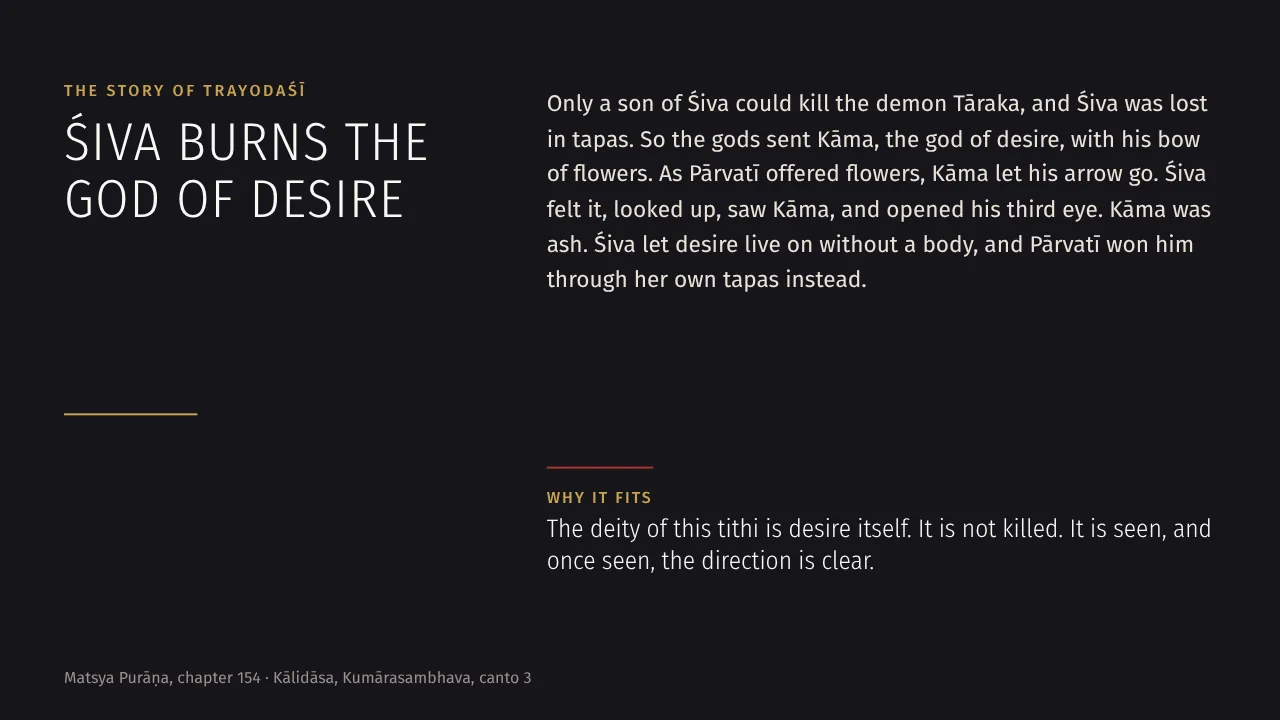
Since the deity is Kāmadeva, we tell his most famous story. The demon Tāraka can only be killed by a son of Śiva, and Śiva is sitting in deep tapas, no interest in anything. So the gods send Kāma with his bow of flowers. Spring comes, Pārvatī offers her flowers, and Kāma lets the arrow go.
Śiva feels it. He looks up, sees Pārvatī, and then sees Kāma hiding there. The third eye opens and Kāma is ash. His wife Rati breaks down, and Śiva promises that desire will live on, just without a body. And Pārvatī wins Śiva, not with desire, but with her own tapas. The Matsya Purāṇa tells it, and Kālidāsa made it famous.
For the Trayodaśī born, confused about direction: desire isn’t killed. It is seen. And once you see it, the direction is clear.
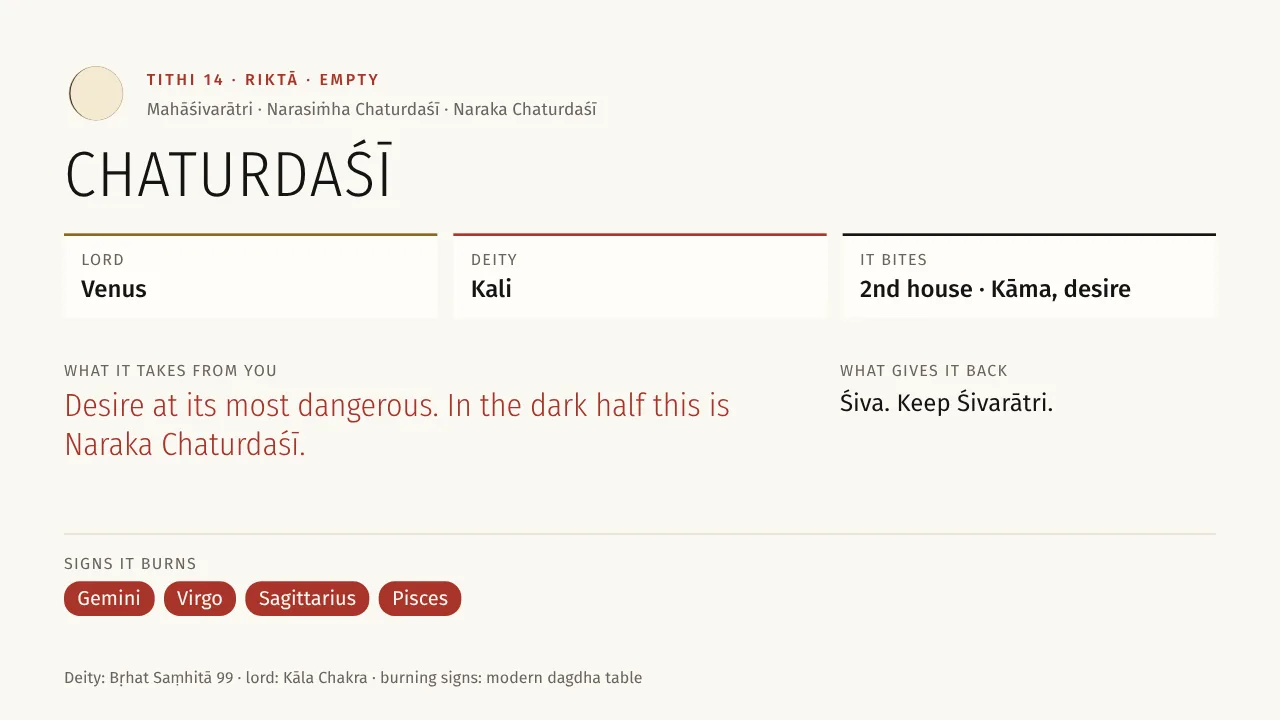
Chaturdaśī, the fourteenth. Family Riktā. Ruled by Venus. The Bṛhat Saṃhitā’s word for its deity is Kali. It lands on the second house again, Kāma, desire, and this is desire at its most dangerous. In the dark half it is Naraka Chaturdaśī. And look at the wheel. Not two signs. Four. All four dual signs burn. A third of the zodiac.
Parāśara gives a whole chapter just on the remedy for being born on Kṛṣṇa Chaturdaśī. And the remedy is Śiva. Keep Śivarātri.
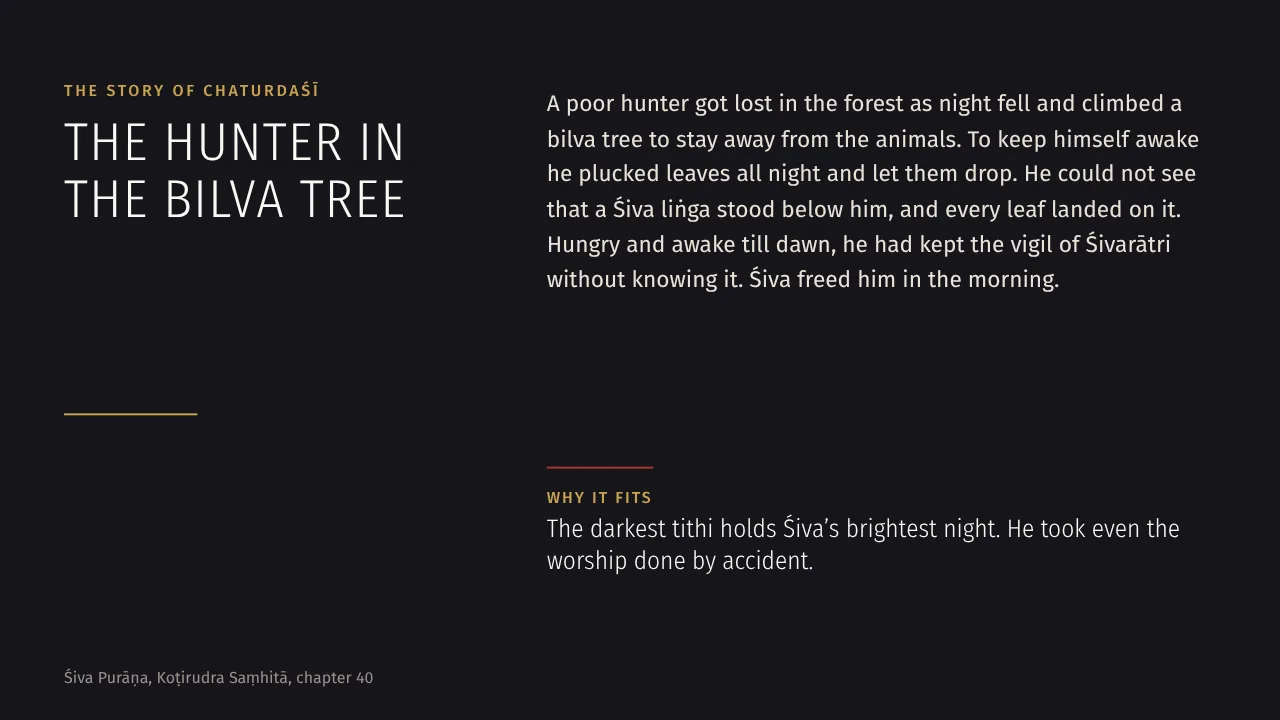
And the fourteenth of the dark half is Mahāśivarātri. The Śiva Purāṇa tells its story. A poor hunter goes into the forest and gets lost as the night falls. He is scared of the animals, so he climbs a bilva tree. And to keep himself awake, all night, he keeps plucking leaves and dropping them. He can’t see it in the dark, but below him there is a Śiva liṅga, and every single leaf lands on it. He hasn’t eaten, he hasn’t slept, and without knowing it, he has kept the whole vigil of Śivarātri. In the morning Śiva frees him.
So this is the darkest tithi of all, and it holds Śiva’s brightest night. He accepted worship that was done by accident. Imagine what he does with worship done on purpose.
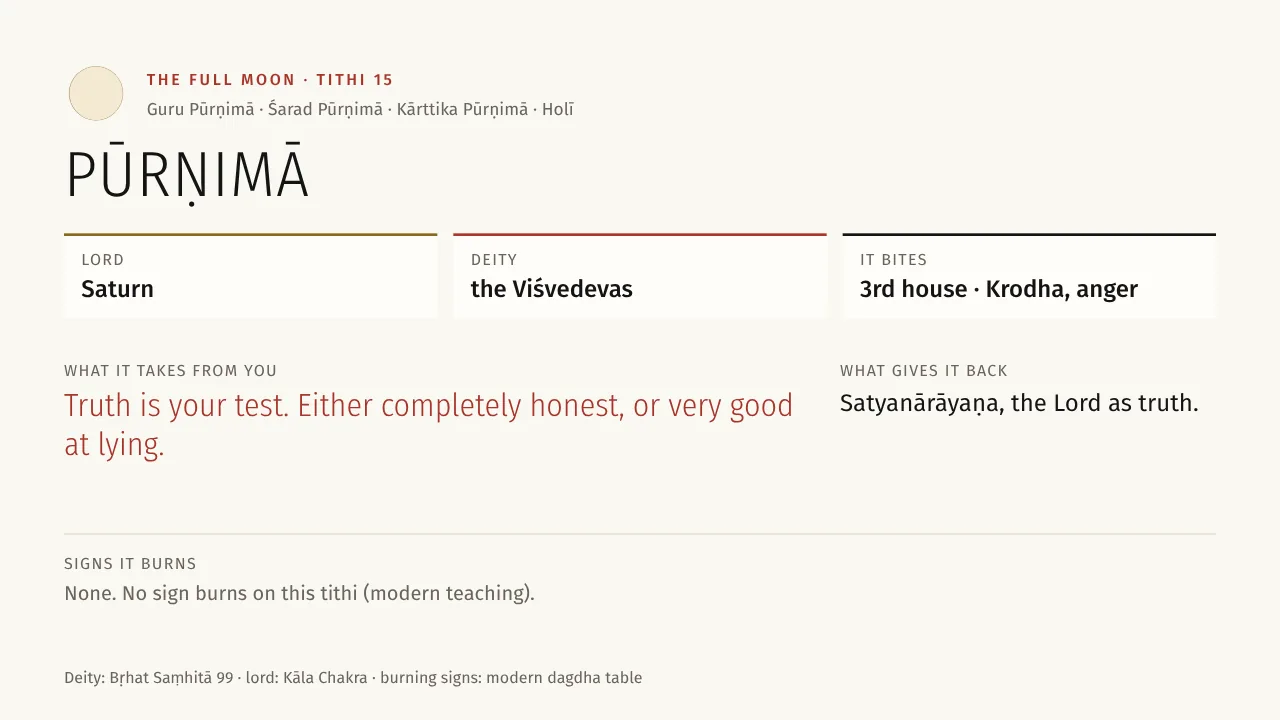
Pūrṇimā, the full moon. Family Pūrṇā. Ruled by Saturn. Deity, the Viśvedevas, all the gods together. It lands on the third, Krodha. And the Pūrṇimā born have one big test: truth. They are either completely honest or very, very good at lying. I take the harder reading unless a clean Jupiter sits in the first, second or fourth.
What helps is Satyanārāyaṇa, the Lord as truth. And no sign burns on the full moon. All the light goes straight back to the Sun. That one is a modern teaching, not a verse, and I want to be clear about that.
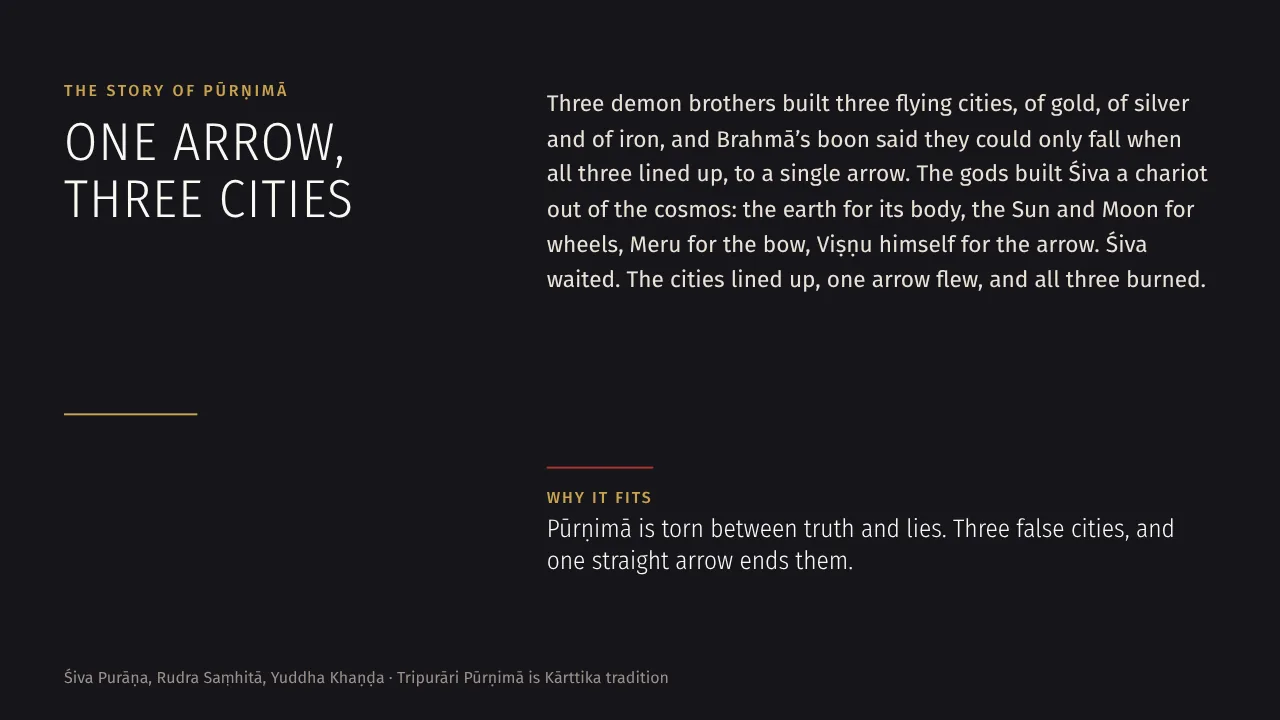
The full moon of Kārttika is Tripurāri Pūrṇimā. Three demon brothers build three flying cities, gold, silver and iron, floating through the sky. And Brahmā’s boon says these cities can only be destroyed when all three come into one line, and only by a single arrow.
So the gods build Śiva a chariot out of the whole cosmos. The earth is the chariot, the Sun and Moon are the wheels, Meru is the bow, Viṣṇu himself is the arrow. And Śiva just waits. The moment the three cities line up, one arrow, and all three are gone. The gods light lamps on the ghāṭs, and that is Dev Dīwālī. The Pūrṇimā born are torn between truth and lies. Three cities of a false self. One straight arrow of truth ends all three.
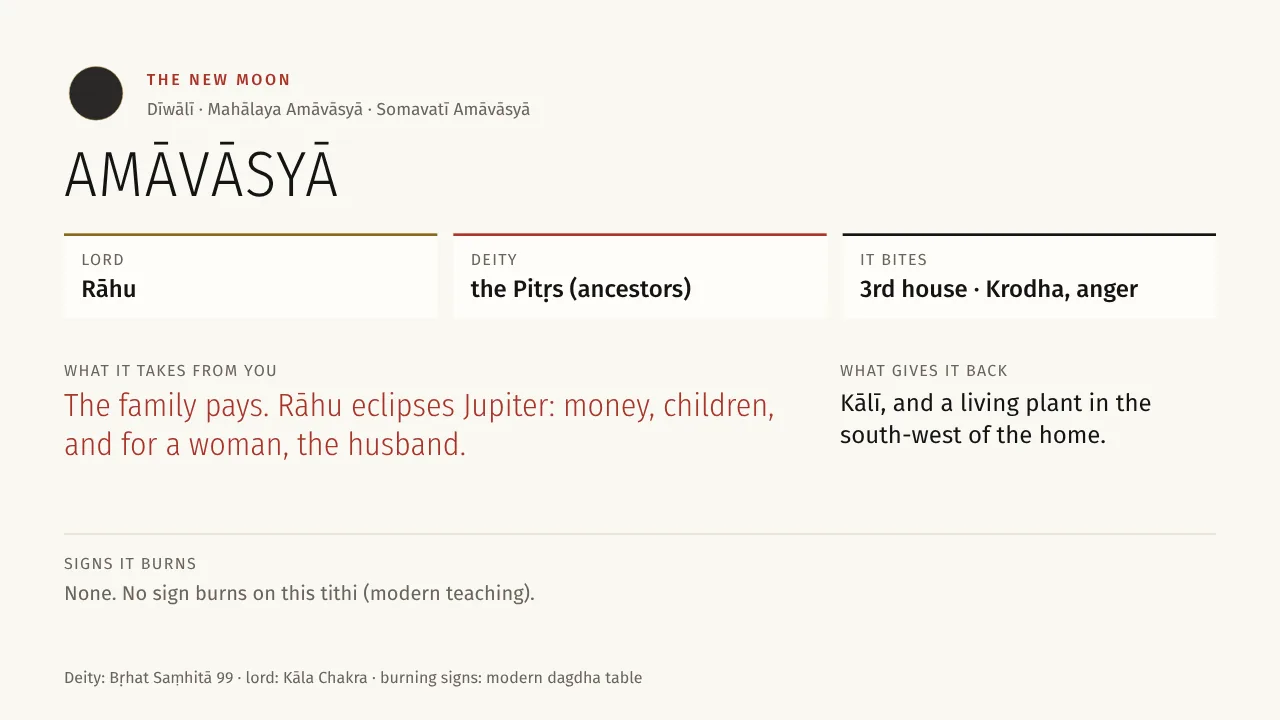
Amāvāsyā, the new moon. The Bṛhat Saṃhitā says the new moon belongs to the Pitṛs, the ancestors. Ruled by Rāhu. It lands on the third, Krodha. This is the rebirth tithi, and here the family pays. Look at the Kāla Chakra: Rāhu sits in the north-east, and the north-east belongs to Jupiter.
So a new moon birth eclipses Jupiter. Money, children, and for a woman, the husband. And there is a split: born in the first half of the tithi, the mother’s side feels it. Second half, the father and brothers. What helps is Kālī, and a living plant in the south-west of your home, for Mercury, Rāhu’s opposite. No sign burns, again by modern teaching.
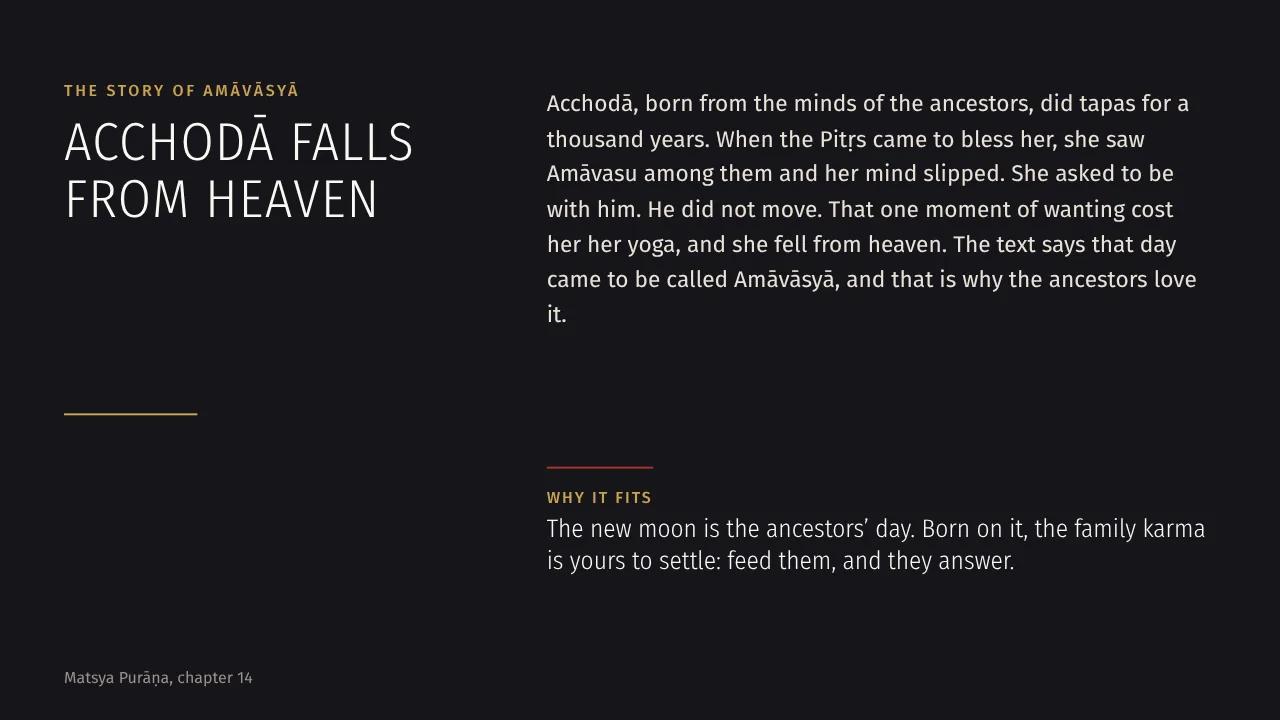
Why is the new moon the ancestors’ day? The Matsya Purāṇa, chapter fourteen. Acchodā, a girl born from the minds of the Pitṛs, does tapas for a thousand years. The Pitṛs are pleased and they come to bless her, glowing, garlanded, beautiful. And among them is Amāvasu. She looks at him and her mind slips. She asks to be with him. He doesn’t move.
And that one moment of wanting costs her everything, her yoga leaves her and she falls out of heaven. The text says that day came to be called Amāvāsyā, and that is why the ancestors love it and gladly accept what is offered on it.
So if you are born on Amāvāsyā, the family karma is yours to settle. Feed your ancestors on the new moon. They are listening that day.
The signs that burn
Dagdha rāśi: the signs each tithi burns, the rules, and four public charts.
And now the part I have been waiting for. The signs that burn.
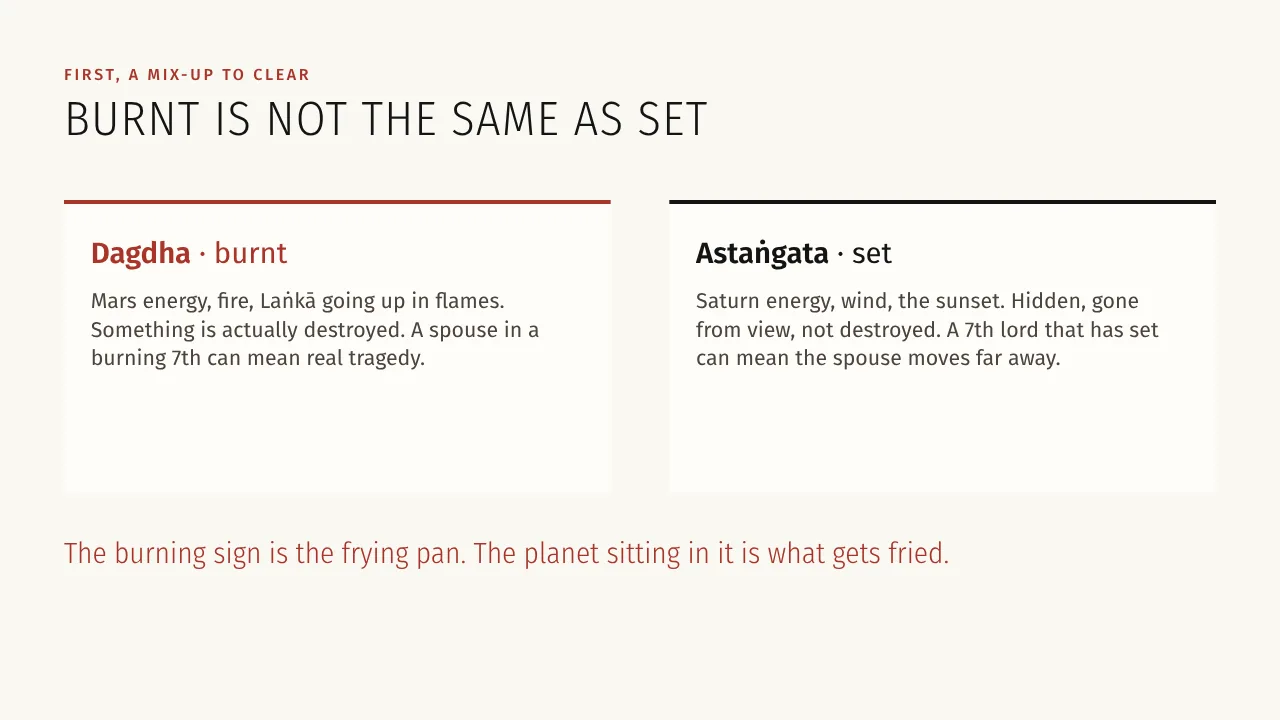
Before the table, I have to clear up one mix-up, because a lot of astrologers use these two words like they are the same. Astaṅgata is setting. Like a sunset. The Sun goes below the horizon, you can’t see it, but it isn’t destroyed. That is Saturn, wind. Something is blown away, taken out of sight. A seventh lord that has set, the spouse might move abroad.
Dagdha is burnt. Laṅkā-dagdha, Laṅkā on fire. That is Mars, fire, actual destruction. A spouse in a burning seventh can mean a real tragedy. And here is how I want you to picture it. The burning sign is the frying pan. The planet sitting in it is the vegetable being fried.
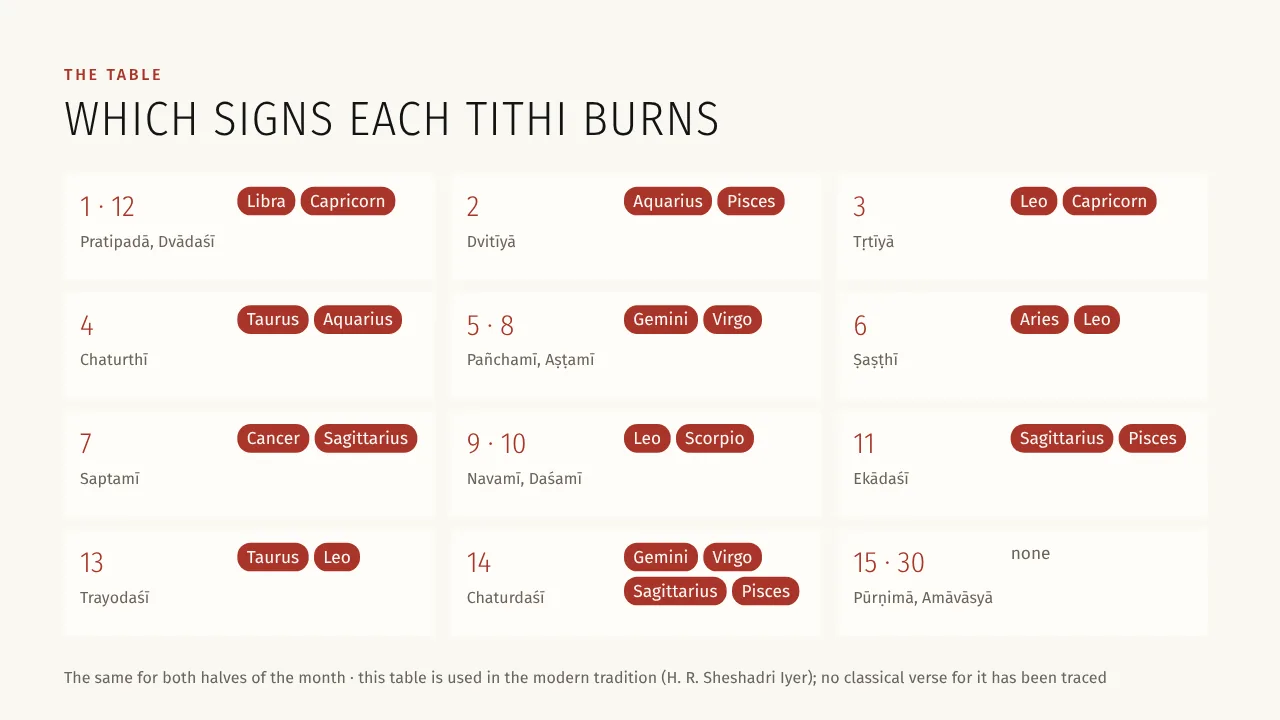
Here is the full table. It is the same for both halves of the month, you just go by the number. First and twelfth: Libra and Capricorn. Second: Aquarius and Pisces. Third: Leo and Capricorn. Fourth: Taurus and Aquarius. Fifth and eighth: Gemini and Virgo. Sixth: Aries and Leo. Seventh: Cancer and Sagittarius. Ninth and tenth: Leo and Scorpio. Eleventh: Sagittarius and Pisces. Thirteenth: Taurus and Leo. Fourteenth: all four dual signs. Full moon and new moon: nothing.
Now, I want to be straight with you about where this comes from. This table is used in the modern tradition, it is linked with H. R. Sheshadri Iyer, and I have not been able to trace it to a classical verse. Parāśara doesn’t give it.
So treat it as a working tool and test it. Which is exactly what we are going to do now, on real charts.
| Tithi | Signs that burn |
|---|---|
| 1 Pratipadā, 12 Dvādaśī | Libra, Capricorn |
| 2 Dvitīyā | Aquarius, Pisces |
| 3 Tṛtīyā | Leo, Capricorn |
| 4 Chaturthī | Taurus, Aquarius |
| 5 Pañchamī, 8 Aṣṭamī | Gemini, Virgo |
| 6 Ṣaṣṭhī | Aries, Leo |
| 7 Saptamī | Cancer, Sagittarius |
| 9 Navamī, 10 Daśamī | Leo, Scorpio |
| 11 Ekādaśī | Sagittarius, Pisces |
| 13 Trayodaśī | Taurus, Leo |
| 14 Chaturdaśī | Gemini, Virgo, Sagittarius, Pisces |
| 15 Pūrṇimā, 30 Amāvāsyā | None |
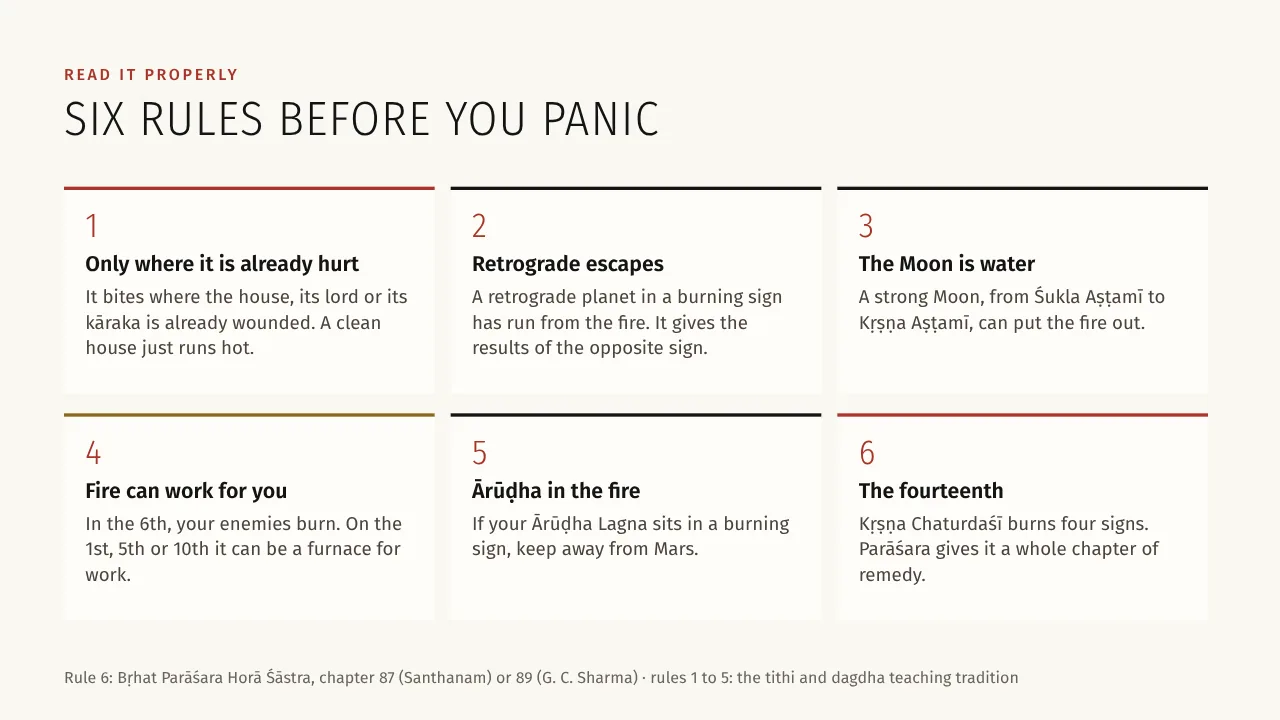
Before you open your chart and panic, six rules. One. It only bites where the house, its lord or its kāraka is already hurt. If all three are clean, it just runs hot, nothing more. Two. A retrograde planet in a burning sign has run away from the fire. It gives you the results of the opposite sign. He who runs away lives to fight another day.
Three. The Moon is water. A strong Moon, from Śukla Aṣṭamī to Kṛṣṇa Aṣṭamī, can put the fire out. Four. The fire can work for you. In the sixth house, your enemies burn.
On the first, fifth or tenth it can become a furnace for work. Five. If your Ārūḍha Lagna sits in a burning sign, keep away from Mars. And six. Kṛṣṇa Chaturdaśī burns four signs, and Parāśara takes it so seriously that the Horā Śāstra gives a whole chapter to its remedy. Okay. Now the charts.
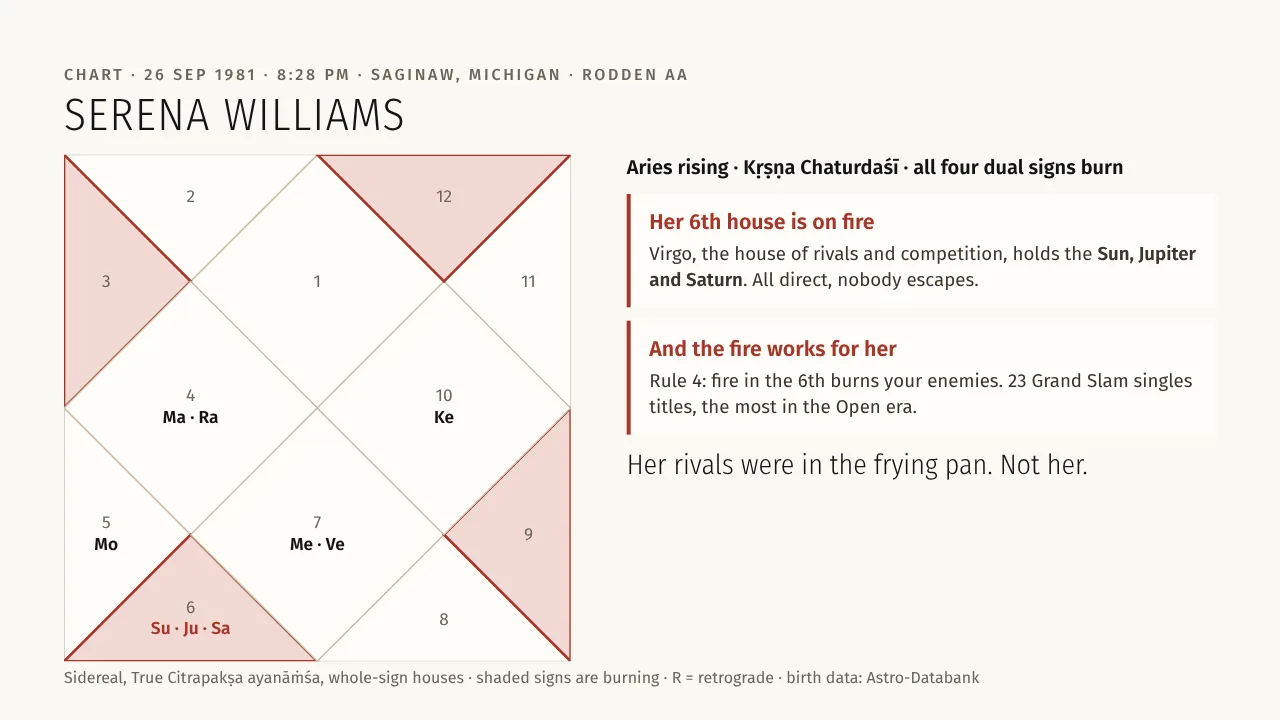
First chart. Serena Williams. Born 26 September 1981, 8:28 in the evening, Saginaw, Michigan, rated AA, from the birth certificate. Aries rising. And her tithi is Kṛṣṇa Chaturdaśī. So all four dual signs are burning. Gemini, her third. Virgo, her sixth. Sagittarius, her ninth. Pisces, her twelfth. Three of them are empty. But look at Virgo, the sixth house, the house of rivals and competition. The Sun, Jupiter and Saturn, all sitting there, all direct, no one running away.
So is that bad? Remember rule four. Fire in the sixth burns your enemies. And what did her opponents do for twenty years? They burned. Twenty three Grand Slam singles titles, the most anyone has won in the Open era. Her rivals were in the frying pan. Not her. Now hold this chart in your head, because the next person was born on the exact same tithi.
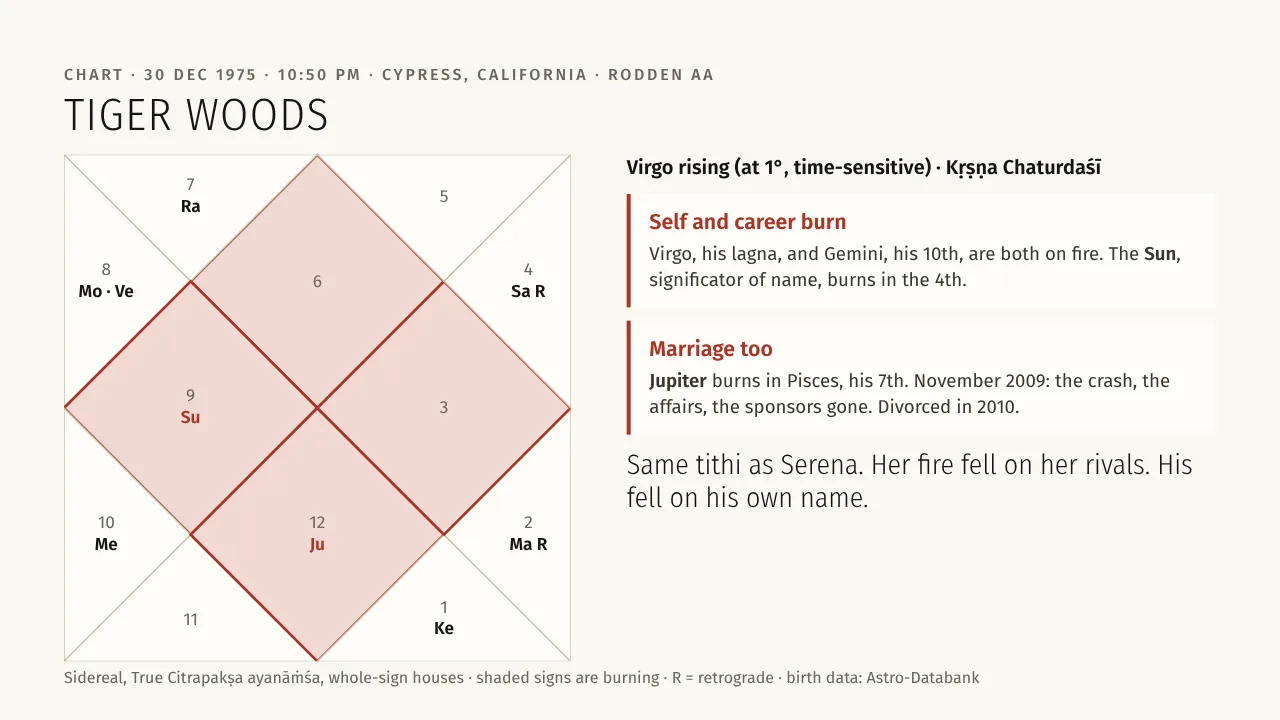
Tiger Woods. Born 30 December 1975, 10:50 at night, Cypress, California, rated AA. Virgo rising, and honestly it is at one degree, right at the start of the sign, so the lagna depends on the exact time. Keep that in mind.
Same tithi as Serena: Kṛṣṇa Chaturdaśī. Same four signs burning. But look where they land for him. Virgo is his lagna, himself. Gemini is his tenth, his career and his name. The Sun, the significator of name and status, is burning in Sagittarius in his fourth. And Jupiter is burning in Pisces, his seventh, marriage. And the Moon is a dark-half Moon, there is no water here to put anything out. November 2009. The car crash outside his house, then the stories, then the sponsors walking away. The divorce in 2010.
Same tithi as Serena. Her fire fell on her rivals. His fell on his own name and his own marriage. And that is why you never, ever read the tithi alone. You read where the fire lands.
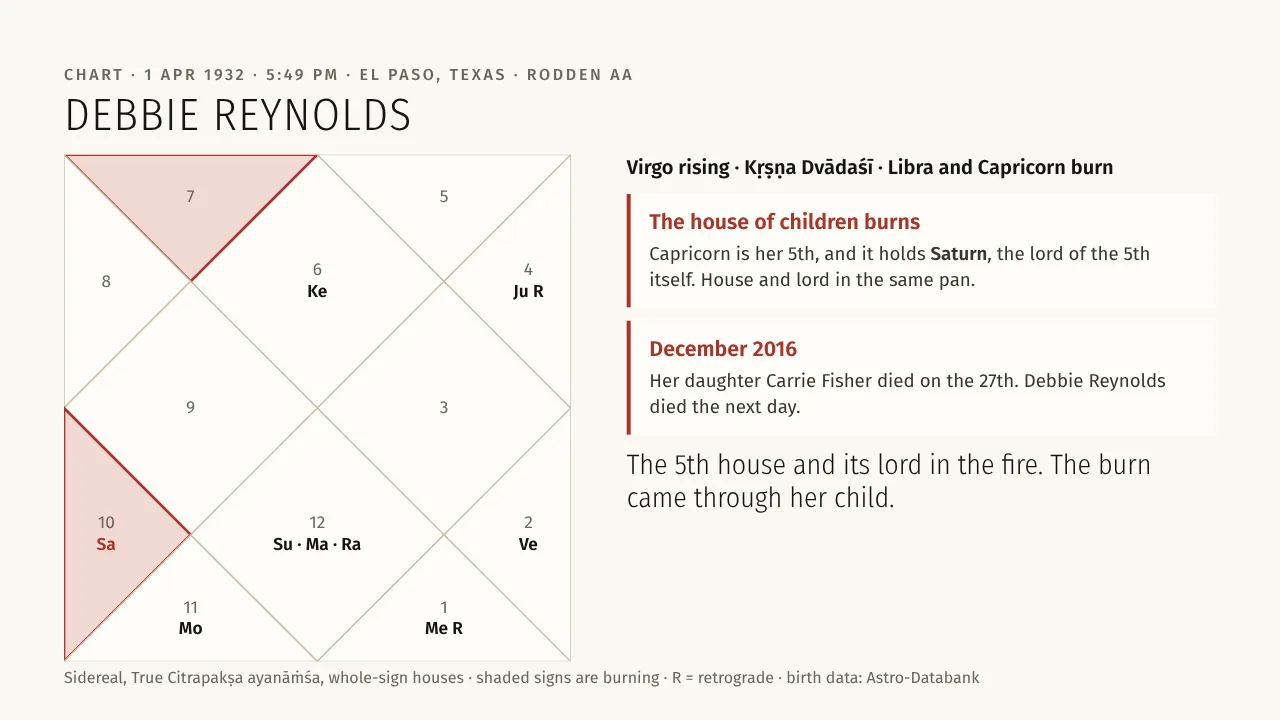
Debbie Reynolds. Born 1 April 1932, 5:49 in the evening, El Paso, Texas, rated AA. Virgo rising. Her tithi is Kṛṣṇa Dvādaśī, so Libra and Capricorn burn. Libra is her second house, nothing there. But Capricorn is her fifth, the house of children. And who is sitting in it? Saturn, the lord of the fifth itself, in its own sign.
So the house of children and its lord are in the same frying pan. Rule one: it bites where the house or its lord is touched, and here it’s both. On 27 December 2016 her daughter, Carrie Fisher, Princess Leia, died at sixty. The very next day, Debbie Reynolds died. Her son said she wanted to be with Carrie. The fire came through her child.
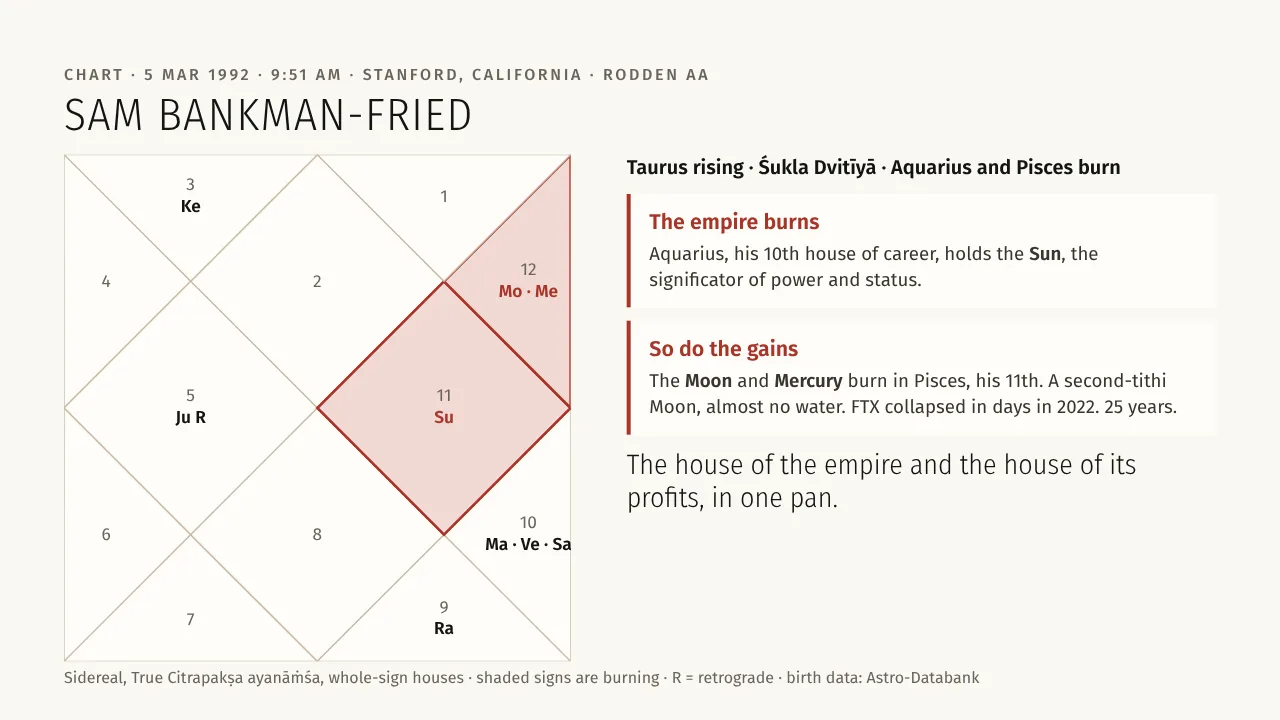
And a modern one. Sam Bankman-Fried, the FTX founder. Born 5 March 1992, 9:51 in the morning, Stanford, California, rated AA. Taurus rising. Tithi Śukla Dvitīyā, so Aquarius and Pisces burn. Aquarius is his tenth, career, the empire he built. And the Sun, the significator of power and status, sits right in it. Pisces is his eleventh, gains, profit, and the Moon and Mercury are burning there. And it is a second-tithi Moon, barely any light, barely any water to put a fire out. November 2022, FTX collapses in a matter of days.
Then the arrest, conviction on all seven counts, twenty five years. One honest note: his tenth lord and his Ārūḍha Lagna are clean, so this is the house and the planets inside it burning. And that turned out to be enough.
Three layers of remedy
What to do about it, and how to find your own tithi.
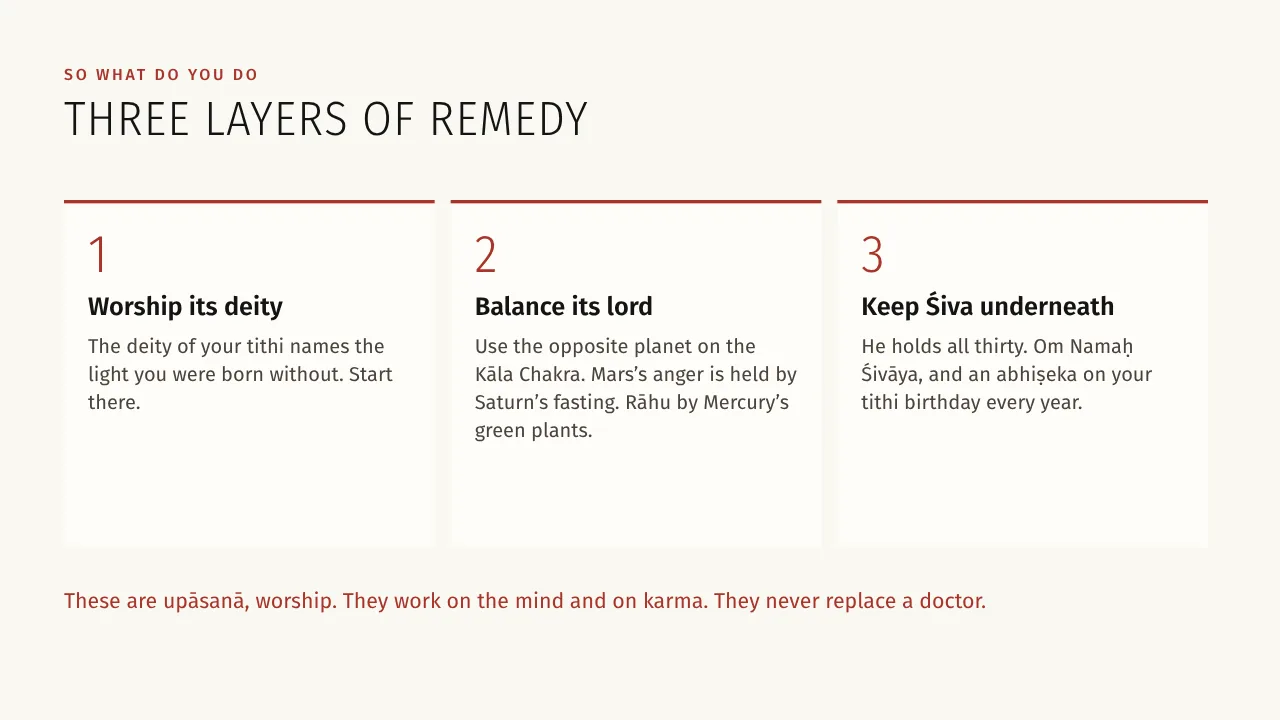
So what do you actually do with all this? Three layers. One, worship the deity of your tithi. It names the exact light you were born without, so start there. Two, balance the lord of your tithi with its opposite on the Kāla Chakra.
If you are a Mars tithi, the anger is held by Saturn, by fasting. If you are Rāhu’s new moon, Mercury holds it, a living green plant in the south-west of the house. And three, underneath everything, Śiva. He holds all thirty tithis. Om Namaḥ Śivāya. And once a year, on your real birthday, your tithi birthday, go and offer abhiṣeka. One thing I always say: this is upāsanā, worship. It works on the mind and on karma. It never replaces a doctor.
Now go and find yours. Open the free Panchang calculator, put in your birth date, time and place, and it gives you your tithi and whether it is the bright or the dark half. Then open your chart and see which houses its burning signs fall on, and use the six rules. And if you want your tithi, your iṣṭa devatā and your remedies read properly with your whole chart, I do live consultations on Zoom.

Om Namaḥ Śivāya.
Questions people ask
What is a tithi?
A lunar day. The Moon pulls about twelve degrees further from the Sun each day, and every twelve degrees of that distance is one tithi: fifteen in the bright half from the new moon to the full, fifteen in the dark half back to the new moon. Your birth tithi is the one the Moon was in at the moment you were born, so it needs your birth time.
How do I find my birth tithi?
Put your date, time and place of birth into the birth panchang calculator. It gives the tithi with its bright or dark half, the nakṣatra, the yoga and the karaṇa, in True Citrapakṣa, and stores nothing.
Is being born on Ganesha Chhaturthi lucky?
Not in this teaching. The tithi you were born on is where the light did not reach you, so a Chaturthī birth carries the weakness of the fourth house, and Gaṇeśa, the deity of that tithi, is not a lucky charm but the medicine. The same holds for every tithi: the deity of the day is the remedy for the day.
Who rules my tithi?
The lords run in weekday order round the Kāla Chakra: Sun, Moon, Mars, Mercury, Jupiter, Venus, Saturn, then Rāhu for tithis one to eight, then again from the Sun at nine. Saturn takes the full moon and Rāhu the new moon. The number of the tithi is also the house it lands on, counted round again after the twelfth.
What is dagdha rashi, a burning sign?
Each tithi sets certain signs on fire, and the matters of the houses those signs fall in run hot. Six rules before anyone panics: it only bites where the house, its lord or its kāraka is already hurt; a retrograde planet there gives the opposite sign’s results; a strong Moon puts the fire out; fire in the sixth burns your rivals; keep away from Mars when the Ārūḍha Lagna sits in a burning sign; and Kṛṣṇa Chaturdaśī, which burns four signs, has its own chapter of remedy in Parāśara.
What is the remedy for my birth tithi?
Three layers, all worship. Worship the deity of your tithi, because it names the exact light you were born without. Balance the lord of your tithi with its opposite on the Kāla Chakra. And under everything, Śiva, who holds all thirty tithis: Om Namaḥ Śivāya, and an abhiṣeka once a year on your tithi birthday. This is upāsanā. It works on the mind and on karma, and it never replaces a doctor.
If you want your tithi, your iṣṭa devatā and your remedies read together with your whole chart, that is what a Spiritual Guidance consultation is for.
Sources: Bṛhat Saṃhitā of Varāhamihira for the tithi families and deities; the Purāṇas named on each slide and the Vālmīki Rāmāyaṇa for the stories; Bṛhat Parāśara Horā Śāstra for the Chaturdaśī remedy. Birth data from Astro-Databank, Rodden AA, as stated on each chart slide. Sidereal, True Citrapakṣa ayanāṁśa, whole-sign houses.
Tantric Astro · Tirth Doshi · AhmedabadWhatsApp +91 63531 92253tirthdos@gmail.com
Want it read for you?
The masterclass gives the method. What your tithi does in your life depends on the whole chart, and on the daśā you are in.