Parāśarī · Aṣṭakavarga · a free course · 88 slides
Eight judges score all twelve signs, and we add up the verdicts. This is the whole of ashtakavarga (aṣṭakavarga) as I teach it, every slide of the course with my commentary under it: the eight voters, the three sheets, the two reductions and the pinda, transits and kakshya, dashas, returns and the timing of sorrow and joy, worked on the charts of Ross Perot, Rajiv Gandhi, Leonardo DiCaprio, Donald Trump, Shah Rukh Khan, Ted Turner and John F. Kennedy.
तावद्गोचरमन्वेष्यं यावन्न प्राप्यतेऽष्टकम् ।
अष्टवर्गे तु सम्प्राप्ते गोचरं विफलं भवेत् ॥३१॥tāvadgocaramanveṣyaṁ yāvanna prāpyate’ṣṭakam | aṣṭavarge tu samprāpte gocaraṁ viphalaṁ bhavet ||31||
“Look at transits only until the aṣṭakavarga is known. Once the aṣṭakavarga is in hand, transit alone gives no result.”
Bṛhat Parāśara Horā Śāstra 72.31 · Devanagari as printed in the enjoylearningsanskrit edition, the English mine after its translation
How to use this page
The course is eight modules and eighty-eight slides. Each slide is shown as it is taught, and the paragraph under it is what I say over it in class. The tables on the slides are repeated as text below them, so you can copy them. Read it top to bottom once, then come back to the module you need.
Keep your own chart open beside it. The ashtakavarga calculator prints the prastāra, all seven bhinnāṣṭakavargas and the sarvāṣṭakavarga for the rāśi chart and for any divisional chart, in True Citrapakṣa, with the same Parāśara tables this course uses.
Ashtakavarga
The cover, and what you will be able to do by the end.
Namaste everyone. This is the start of the complete aṣṭakavarga course. Not a quick overview, the whole system, from zero. In these first two modules we lay the foundation: what aṣṭakavarga actually is, who the eight voters are, how the marks work, and then we build every sheet by hand on one chart, so nothing on your software screen is ever a mystery again. Later modules take this all the way to transits, timing to the week, śodhana, piṇḍa, and every area of life. Grab a pen and paper. Let’s start.
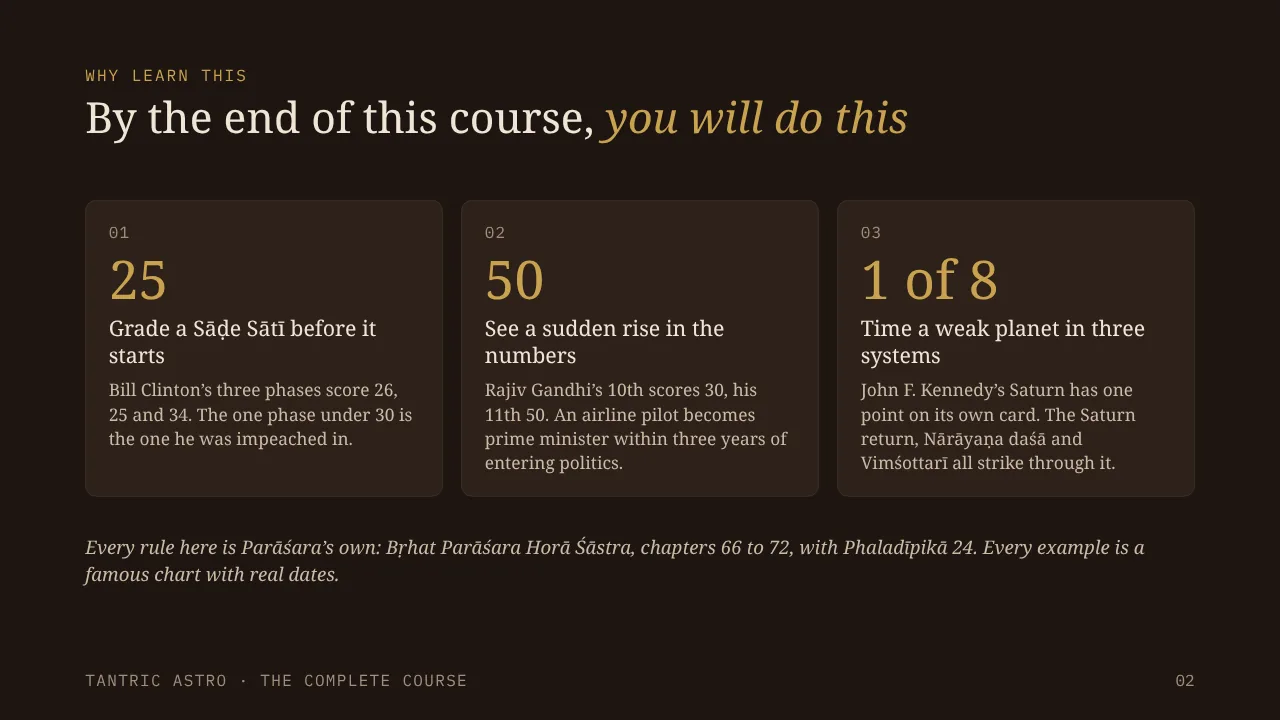
Before we start, three things you will be able to do by the end of this course. One: grade a Sāḍe Sātī before it begins. Bill Clinton’s Sāḍe Sātī had three phases, scoring 26, 25 and 34. The one phase under thirty was the one he was impeached in.
Two: see a sudden rise in the numbers. Rajiv Gandhi’s 10th house scores 30 and his 11th scores 50. An airline pilot became prime minister within three years of entering politics. Three: time a weak planet in three systems.
John F. Kennedy’s Saturn has one point on its own card, and that one planet is struck by the Saturn return, by Nārāyaṇa daśā and by Vimśottarī. Every rule in this course comes from Parāśara’s own chapters, 66 to 72 of the Bṛhat Parāśara Horā Śāstra, with Phaladīpikā’s chapter 24, and every example is a famous chart with real dates. Let’s begin.
The foundations
Module 1: what aṣṭakavarga is, the eight voters, the marks and the scales.
Module one. The foundations. No calculation yet, just the ideas you need so that everything later makes sense.
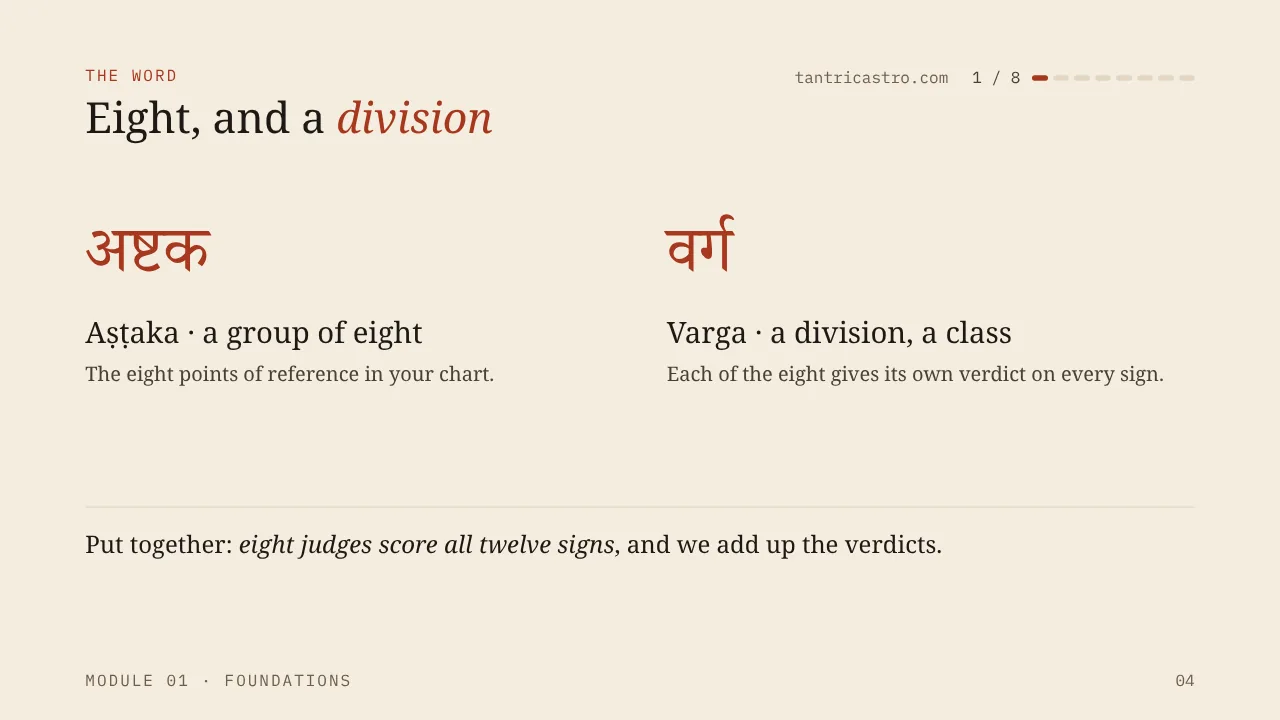
Start with the word itself. Aṣṭaka means a group of eight. Varga means a division, a class, a group. So aṣṭakavarga is the eightfold division. What are the eight? Eight points of reference in your chart, which we will name in a moment. And each of those eight gives its own verdict, sign by sign, on all twelve signs of the zodiac.
So picture eight judges sitting at a table. Each sign of your chart walks in front of them one by one, and each judge either approves it or does not. Then we simply count. That counting is the whole system. Everything else in this course is how to count properly and how to read what you counted.
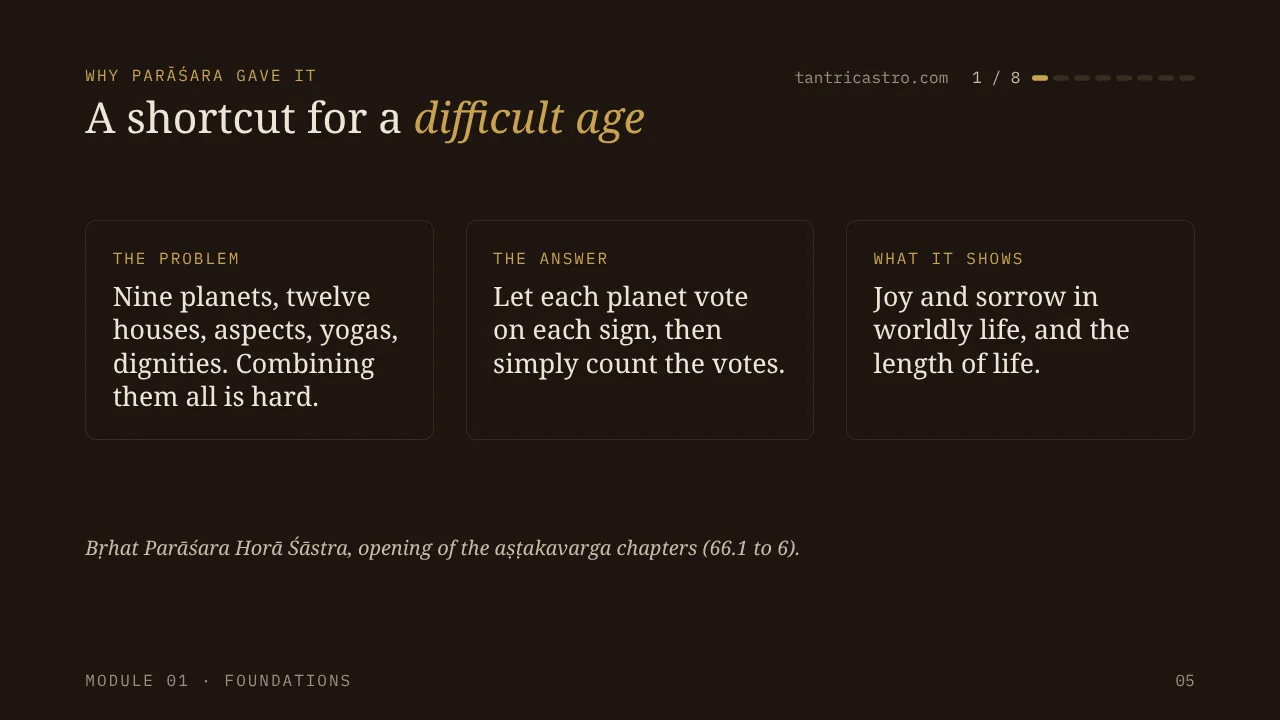
Why does this system even exist? Parāśara tells us at the very start of the aṣṭakavarga chapters. His student Maitreya asks for a method for people of this age, Kali Yuga, because putting together the results of all the planets, all their placements, aspects and combinations, is genuinely hard. And Parāśara’s answer is aṣṭakavarga. Instead of weighing every factor in your head, each planet casts a vote on each sign, and we count the votes.
Parāśara says this shows two things: the happiness and suffering of worldly life, and the length of life. Keep that in mind. Aṣṭakavarga is not a side tool. It was given as the practical method, the one that turns a complicated chart into numbers anyone can work with.
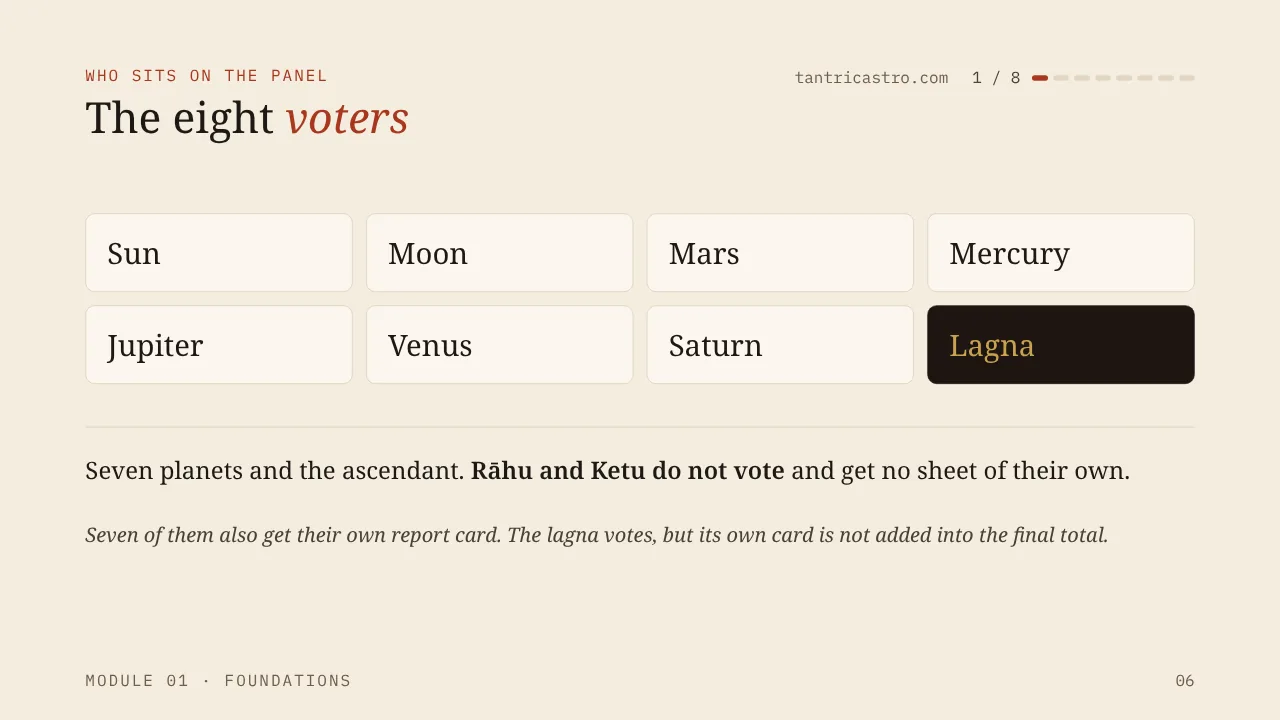
So who are the eight voters? The seven visible planets, Sun, Moon, Mars, Mercury, Jupiter, Venus and Saturn, plus the lagna, the ascendant. That is the panel. Notice who is missing. Rāhu and Ketu. They do not vote in Parāśara’s aṣṭakavarga and they do not get their own sheet. Some later writers try to add them; we stay with the classical eight.
One more detail that will matter later. The seven planets each get their own report card, which we will call the BAV. The lagna votes too, and it even has its own card, but when we add everything into the final total, the lagna’s own card is left out. Remember that, because it is why the grand total is always the same number.
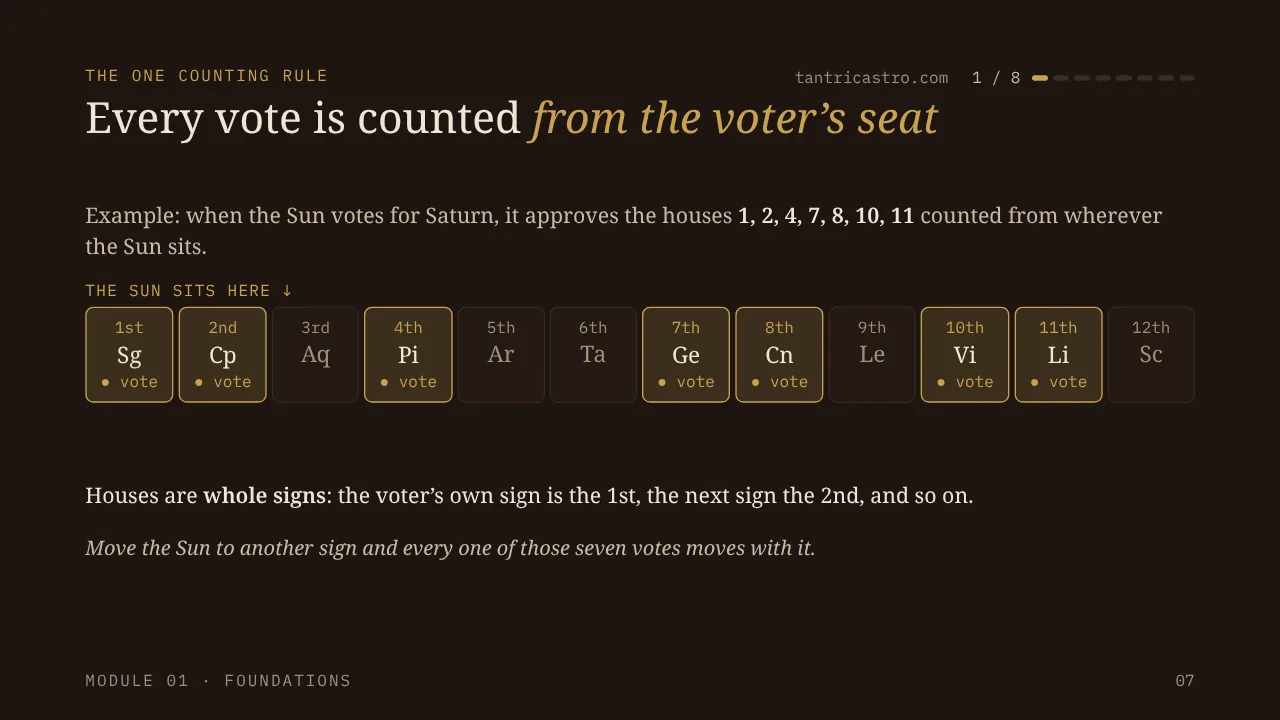
Now the most important rule of the construction. Every vote is counted from where the voter sits. Take one example. When the Sun casts its votes for Saturn’s report card, the classical rule says the Sun approves the 1st, 2nd, 4th, 7th, 8th, 10th and 11th houses. Houses from what? From the Sun itself.
In our teaching chart the Sun is in Sagittarius. So the 1st from the Sun is Sagittarius, the 2nd is Capricorn, the 4th is Pisces, the 7th is Gemini, the 8th is Cancer, the 10th is Virgo and the 11th is Libra. Those seven signs get a vote from the Sun. And these are whole sign houses. No degrees, no house cusps. The sign the voter sits in is the 1st, the next sign is the 2nd, and you keep going.
If the Sun were in a different sign, all seven of those votes would land somewhere else. That is why two people born on the same day but at different times can have different aṣṭakavarga: the lagna moves, and the lagna is one of the voters.
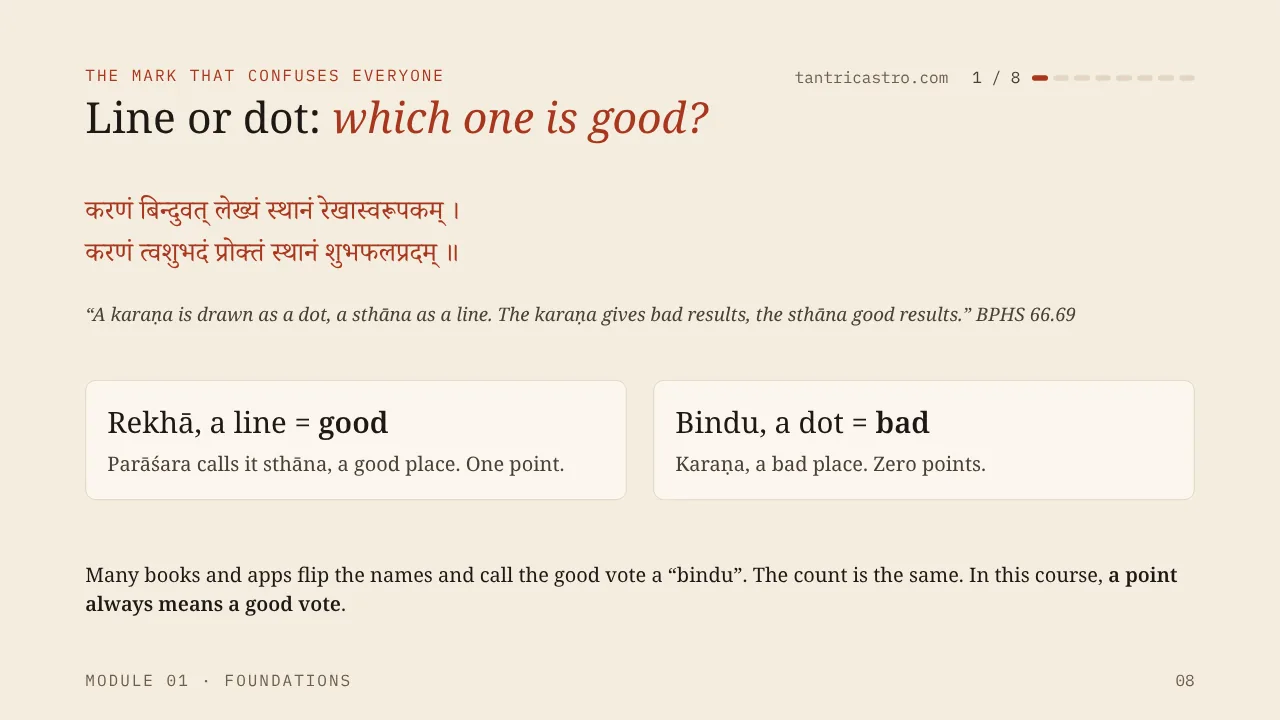
Now the mark that confuses every student. When a voter approves a sign, how do we mark it? With a line or with a dot? Parāśara answers this himself in chapter 66, verse 69. Karaṇaṁ binduvat lekhyaṁ, sthānaṁ rekhāsvarūpakam. Karaṇaṁ tvaśubhadaṁ proktaṁ, sthānaṁ śubhaphalapradam. A karaṇa is drawn like a dot, a sthāna is drawn like a line. The karaṇa gives bad results, the sthāna gives good results.
So in Parāśara, the line, the rekhā, is the good vote, and the dot, the bindu, is the bad vote. Now here is the catch. A lot of books, especially from the South Indian tradition, and a lot of software, use the opposite names. They call the good vote a bindu. The number they print is still the count of good votes, so the maths is identical, it is only the name that flips.
So never panic when one book says bindus and another says rekhās. Just ask one question: is this number counting the good votes? In this course I will simply say a point, and a point always means a good vote.
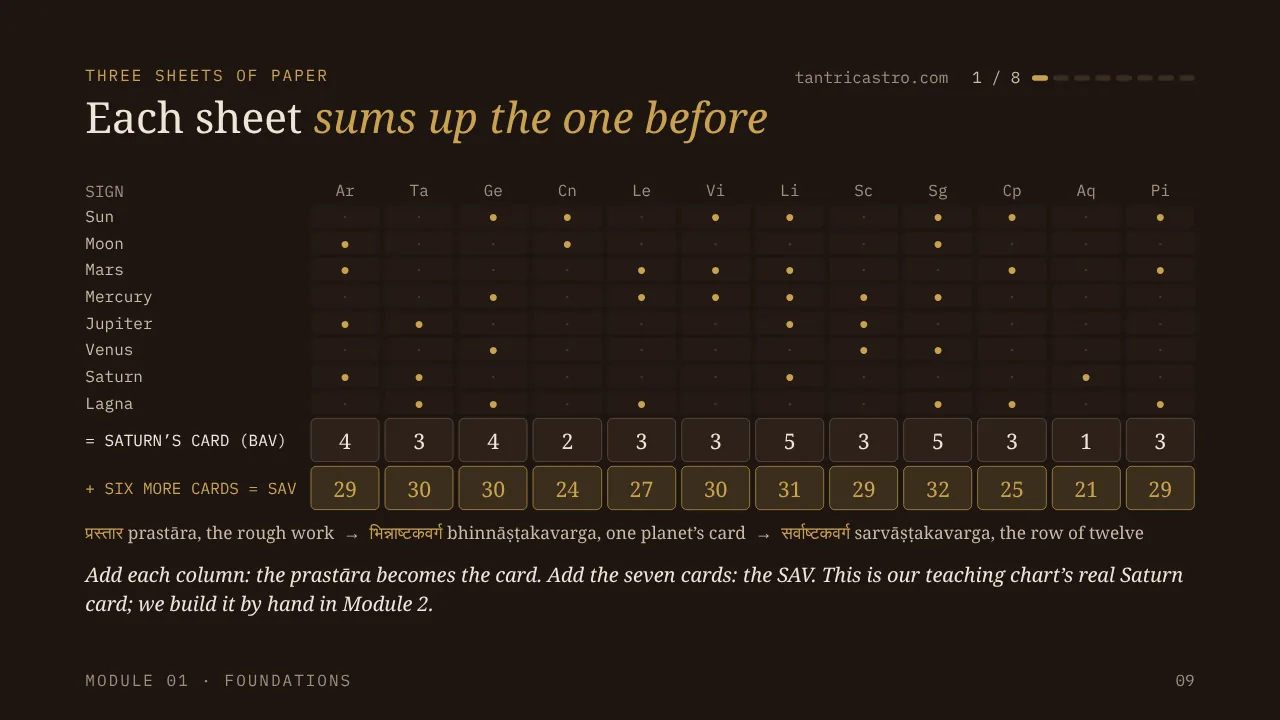
The whole system lives on three kinds of sheet, and each one is just a summary of the one before. First, the prastāra. This is the rough work for one planet: eight rows for the eight voters, twelve columns for the signs, and every vote marked in its box.
Parāśara actually describes drawing this grid with lines. Second, add up each column of that prastāra and you get the planet’s report card, the bhinnāṣṭakavarga, the BAV. Every sign gets a score from zero to eight, because there are eight voters. You do this for each of the seven planets, so there are seven BAVs.
Third, stack those seven BAVs and add them sign by sign, and you get the sarvāṣṭakavarga, the SAV. One row of twelve numbers. That is the row you saw at the start. So, seven prastāras make seven BAVs, and seven BAVs make one SAV. In Module 2 we will build all three by hand.
What you see is the real Saturn card of our teaching chart: eight voters down, twelve signs across, every vote a dot; add the columns and you have Saturn’s card; add six more cards and you have the SAV. We build exactly this by hand in Module 2.
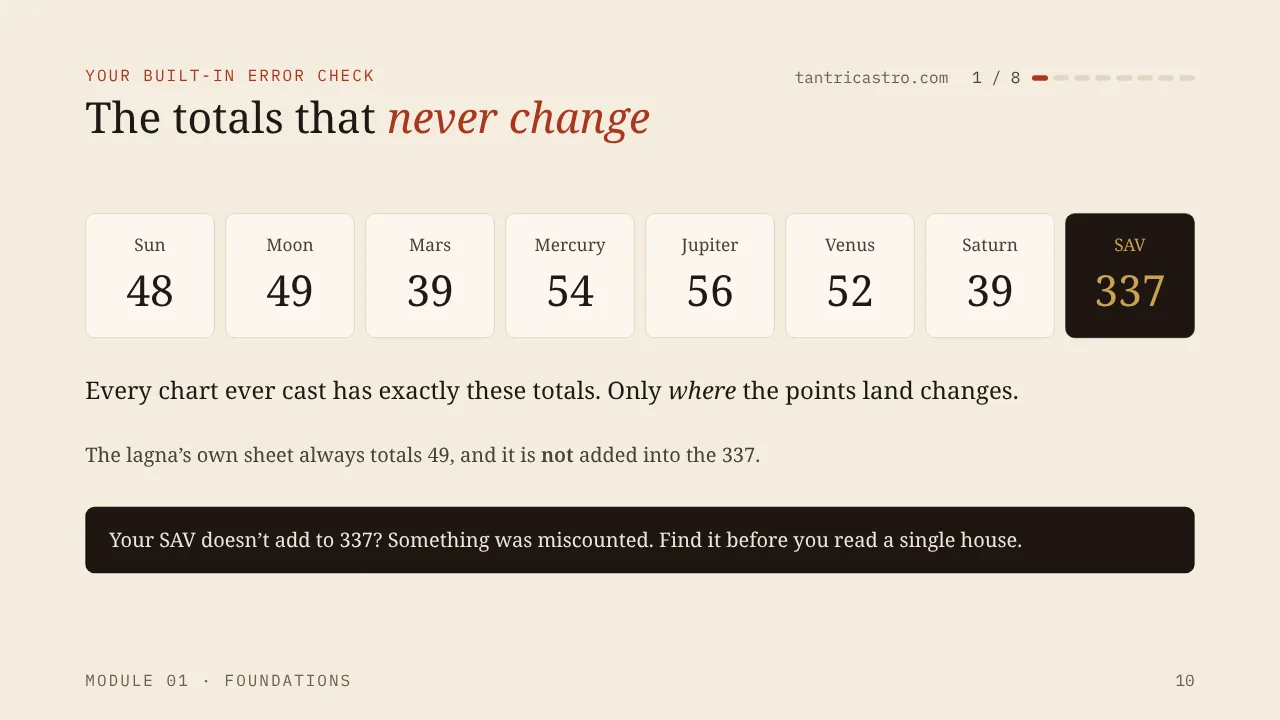
Now the fixed totals. Each planet always gets the same number of points in total, in every chart that has ever been cast. The Sun always gets 48. The Moon 49. Mars 39. Mercury 54. Jupiter 56. Venus 52. Saturn 39. Add those seven together and you get 337, the total of the SAV, every single time. Why? Because each voter always gives a fixed number of votes; the chart only decides which signs those votes land in.
So the totals never change, only the distribution does. The lagna also has its own sheet, and it always totals 49, but it is not added into the 337. This gives you a free error check. If you ever build an SAV by hand, or you see one in some software, and it does not add up to 337, something has been miscounted. Stop and find the mistake before you read a single house.
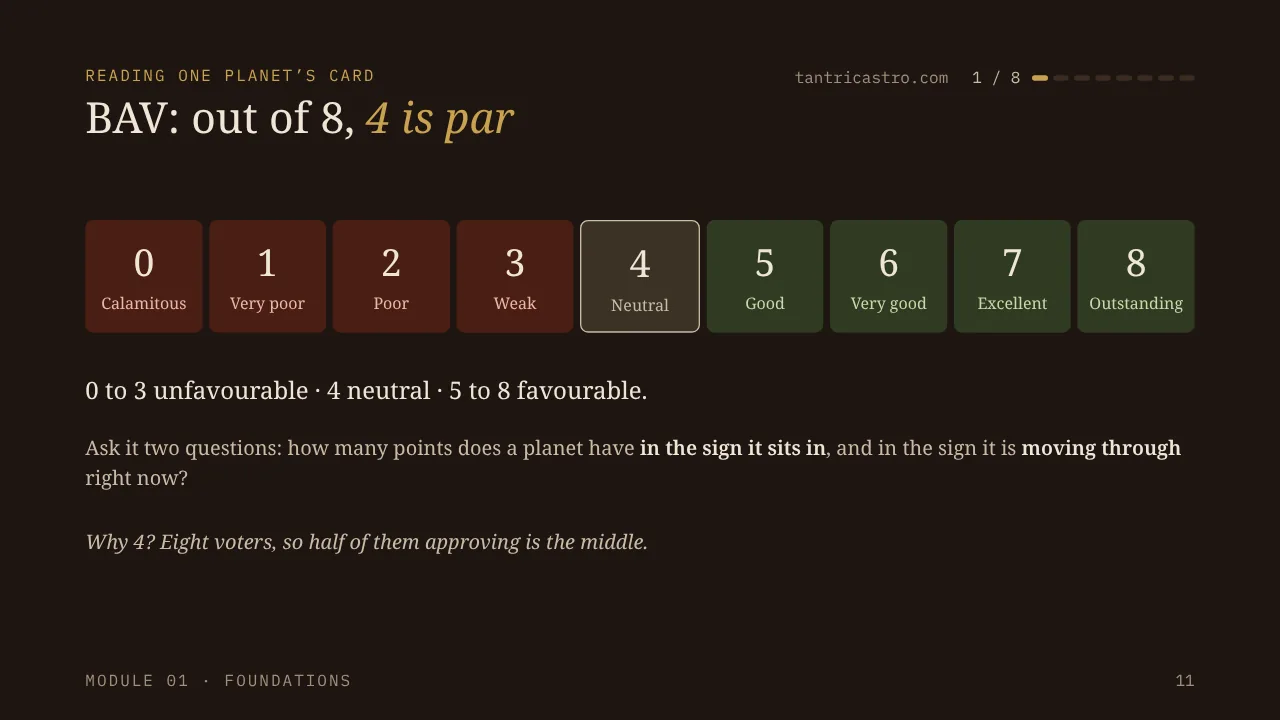
How do you read one planet’s card, its BAV? Every sign scores between zero and eight, because there are eight voters. Four is the middle, half the panel approving, so four is neutral. Zero to three is unfavourable, five to eight is favourable. You can grade it in words too: eight is outstanding, seven excellent, six very good, five good, four average, three weak, two poor, one very poor, and zero, no voter approving at all, is calamitous. You will use this scale in two ways for the rest of the course.
First, natal: how many points does a planet have in the very sign it sits in? A Jupiter sitting in a sign where its own card shows six is a Jupiter that can deliver. Second, transit: when a planet moves through a sign, how many points does its own card give that sign? Saturn crossing a sign where Saturn’s card shows one is a hard transit. Saturn crossing a five is a much easier one. Hold on to that, it is the heart of Module 6.
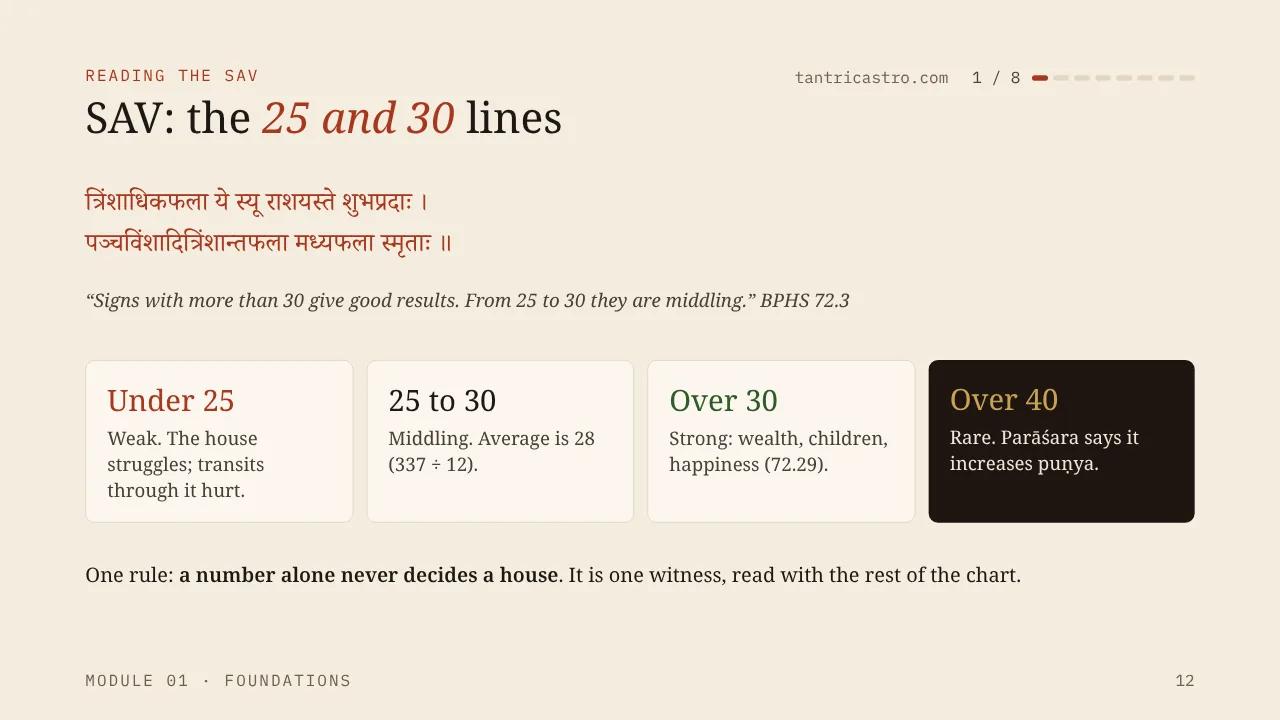
Now the SAV, the one row of twelve numbers. Parāśara gives the scale himself, in chapter 72, verse 3. Triṁśādhikaphalā ye syū rāśayaste śubhapradāḥ. Pañcaviṁśāditriṁśāntaphalā madhyaphalā smṛtāḥ. Signs with more than thirty give good results, from twenty-five to thirty they are middling. And a few verses later he says signs with few points bring trouble.
So: under twenty-five is weak, the matters of that house struggle and transits through that sign hurt. Twenty-five to thirty is middling. And by simple maths, 337 divided by twelve, the average sign holds about twenty-eight. Over thirty is strong, and Parāśara in verse 29 says it gives wealth, children and happiness. Over forty is rare, and he says it increases puṇya, merit.
One warning before we go further, and I will repeat it all course long. A number alone never decides a house. A low score with a strong lord and good yogas can still deliver. The SAV is a witness. It is not the judge.
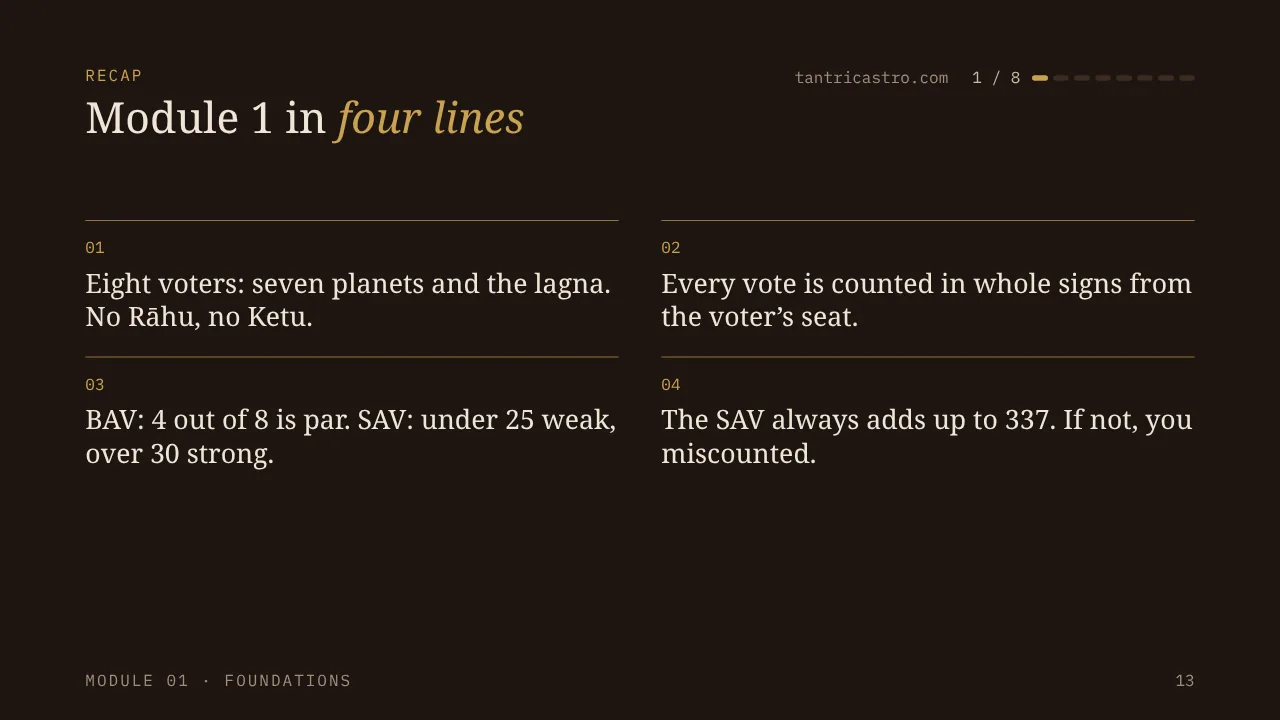
Quick recap of Module 1. One: there are eight voters, the seven planets and the lagna, and Rāhu and Ketu sit out. Two: every vote is counted in whole signs from where the voter sits. Three: on one planet’s card, the BAV, four out of eight is par; on the SAV, under twenty-five is weak, twenty-five to thirty middling, over thirty strong.
Four: the SAV always adds up to 337, and if yours does not, you miscounted. That is the foundation. Now let’s actually build one, by hand.
Building it by hand
Module 2: building every sheet by hand on one teaching chart.
Module two. We build the whole thing by hand on our teaching chart. You will never need to do this for every client, software does it in a second, but doing it once means you will understand exactly what every number on that screen means.
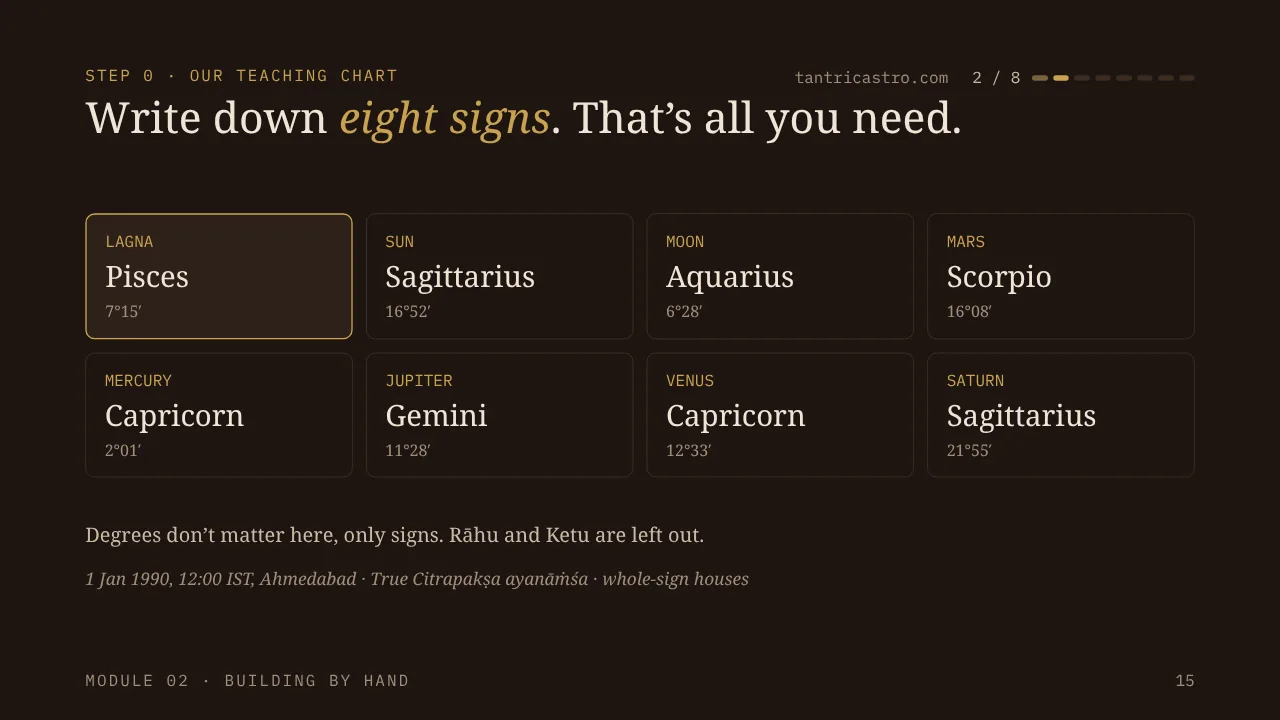
Step zero. Here is our teaching chart, 1 January 1990, 12 noon in Ahmedabad, calculated with the True Citrapakṣa ayanāṁśa. To build aṣṭakavarga you need exactly eight pieces of information: the sign of the lagna and the sign of each of the seven planets. Lagna in Pisces. Sun in Sagittarius. Moon in Aquarius. Mars in Scorpio. Mercury in Capricorn.
Jupiter in Gemini. Venus in Capricorn. Saturn in Sagittarius. That is it. The degrees do not change anything at this stage, only the signs. Rāhu and Ketu we leave out. Write these eight down on your paper, because we are going to build Saturn’s card from them right now.
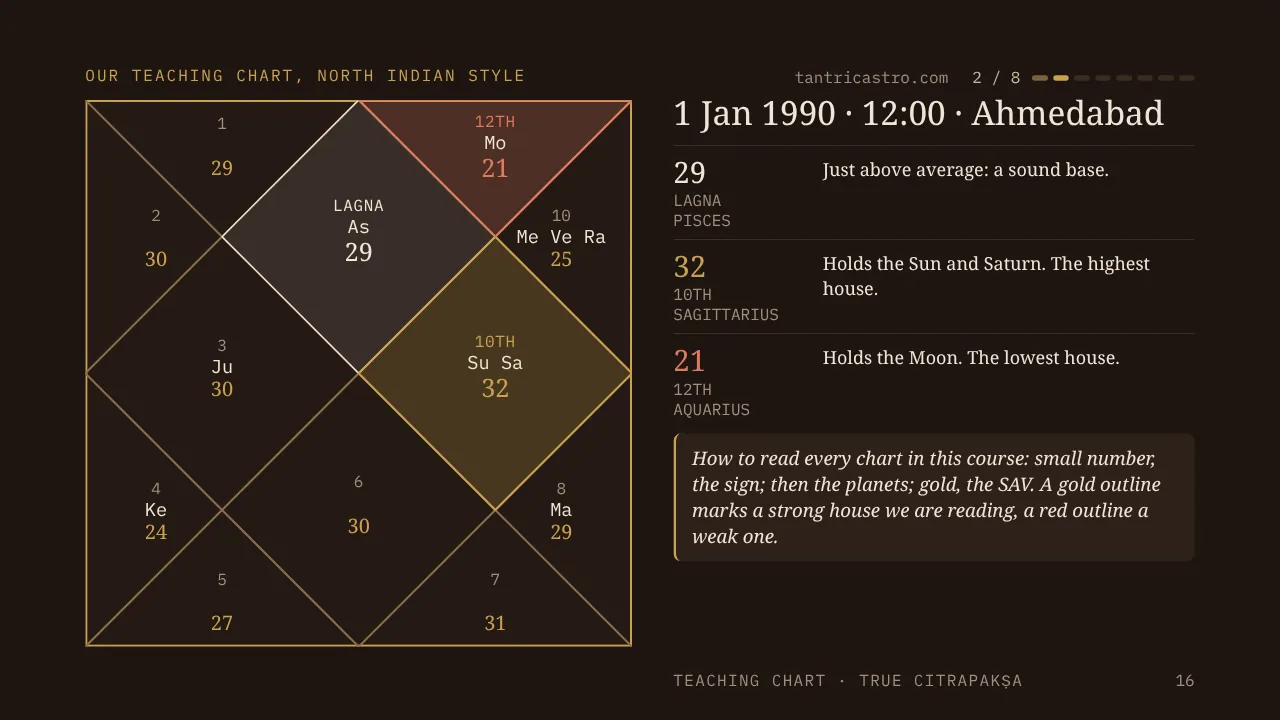
Here is our teaching chart drawn the North Indian way. The lagna is the top diamond, Pisces, sign 12, and the houses run anticlockwise from there. In every house you see the sign number, the planets, and in gold the SAV. Pisces lagna with 29. The 10th, Sagittarius, holds the Sun and Saturn and scores 32, the highest in the chart: outlined in gold. The 12th, Aquarius, holds the Moon and scores 21, the lowest: outlined in red.
Every chart in this course uses this convention. When I read a house, it is outlined: gold for strong, red for weak, so you never have to hunt for it.
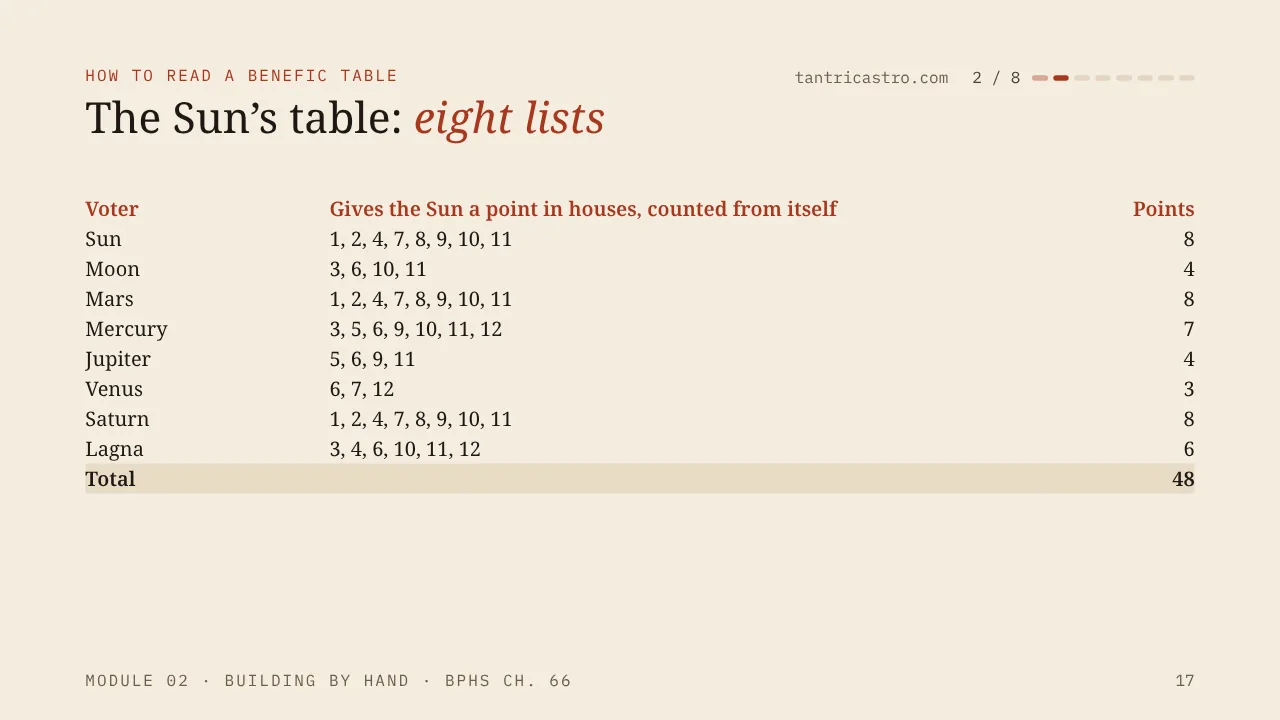
Every planet has a classical table like this one, given by Parāśara in chapter 66. This is the Sun’s table. Read it row by row. The first row says: the Sun gives a point to its own card in the 1st, 2nd, 4th, 7th, 8th, 9th, 10th and 11th houses counted from the Sun itself. The second row: the Moon gives the Sun a point in the 3rd, 6th, 10th and 11th counted from the Moon. And so on down to the lagna, which gives the Sun points in the 3rd, 4th, 6th, 10th, 11th and 12th from the lagna.
Count the points in the last column: 8, 4, 8, 7, 4, 3, 8, 6. Total 48. There it is, the Sun’s fixed total. Notice something about the Sun’s favourite houses: 10 and 11 appear in almost every row. That is not an accident, and we will come back to it when we read the houses. You do not need to memorise these tables. Your software has them. You need to understand what one row means.
| Voter | Gives the Sun a point in houses, counted from itself | Points |
|---|---|---|
| Sun | 1, 2, 4, 7, 8, 9, 10, 11 | 8 |
| Moon | 3, 6, 10, 11 | 4 |
| Mars | 1, 2, 4, 7, 8, 9, 10, 11 | 8 |
| Mercury | 3, 5, 6, 9, 10, 11, 12 | 7 |
| Jupiter | 5, 6, 9, 11 | 4 |
| Venus | 6, 7, 12 | 3 |
| Saturn | 1, 2, 4, 7, 8, 9, 10, 11 | 8 |
| Lagna | 3, 4, 6, 10, 11, 12 | 6 |
| Total | 48 |
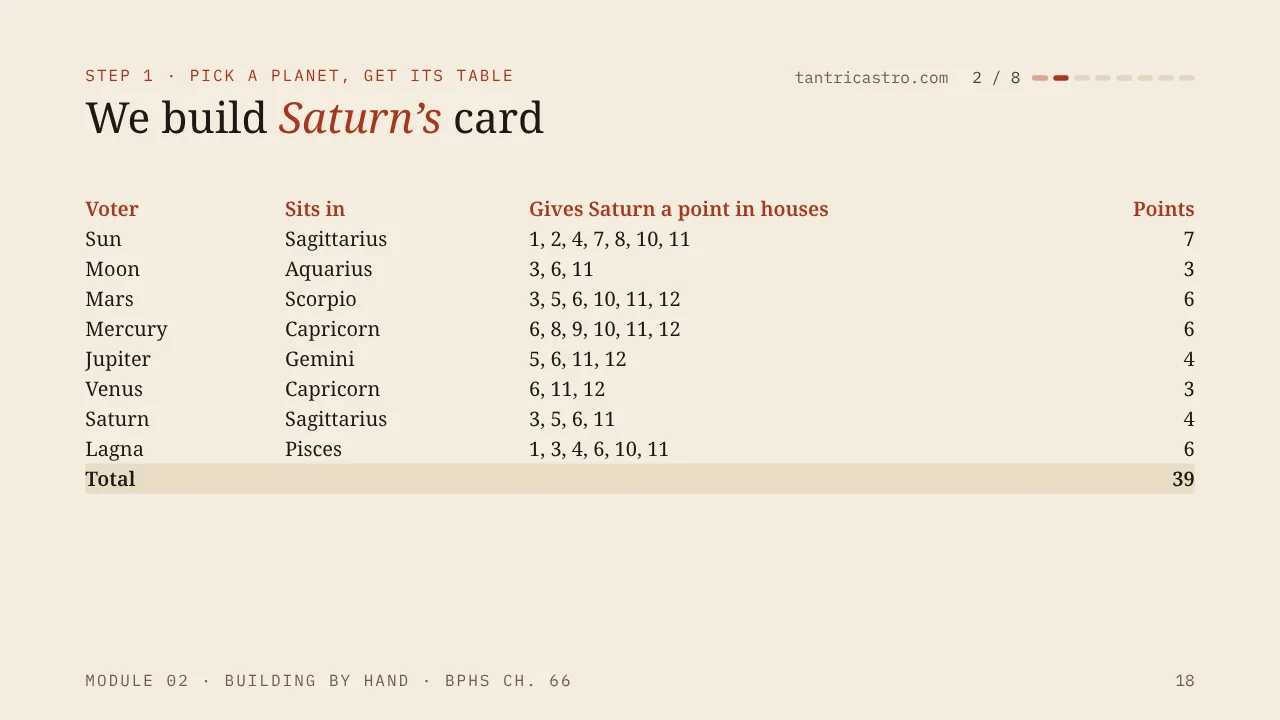
Step one. Pick the planet whose card you are building. We will build Saturn’s, because Saturn has only 39 points, so it is the quickest to do by hand. Here is Saturn’s classical table, and next to each voter I have written the sign it sits in, in our chart. The Sun, sitting in Sagittarius, gives Saturn points in the 1st, 2nd, 4th, 7th, 8th, 10th and 11th from itself.
The Moon, in Aquarius, gives Saturn points in the 3rd, 6th and 11th from the Moon. Mars in Scorpio: 3, 5, 6, 10, 11, 12. Mercury in Capricorn: 6, 8, 9, 10, 11, 12. Jupiter in Gemini: 5, 6, 11, 12. Venus in Capricorn: 6, 11, 12. Saturn itself in Sagittarius: 3, 5, 6, 11. And the lagna, Pisces: 1, 3, 4, 6, 10, 11. Count them: 39 points. Now we place every one of them on the grid.
| Voter | Sits in | Gives Saturn a point in houses | Points |
|---|---|---|---|
| Sun | Sagittarius | 1, 2, 4, 7, 8, 10, 11 | 7 |
| Moon | Aquarius | 3, 6, 11 | 3 |
| Mars | Scorpio | 3, 5, 6, 10, 11, 12 | 6 |
| Mercury | Capricorn | 6, 8, 9, 10, 11, 12 | 6 |
| Jupiter | Gemini | 5, 6, 11, 12 | 4 |
| Venus | Capricorn | 6, 11, 12 | 3 |
| Saturn | Sagittarius | 3, 5, 6, 11 | 4 |
| Lagna | Pisces | 1, 3, 4, 6, 10, 11 | 6 |
| Total | 39 |
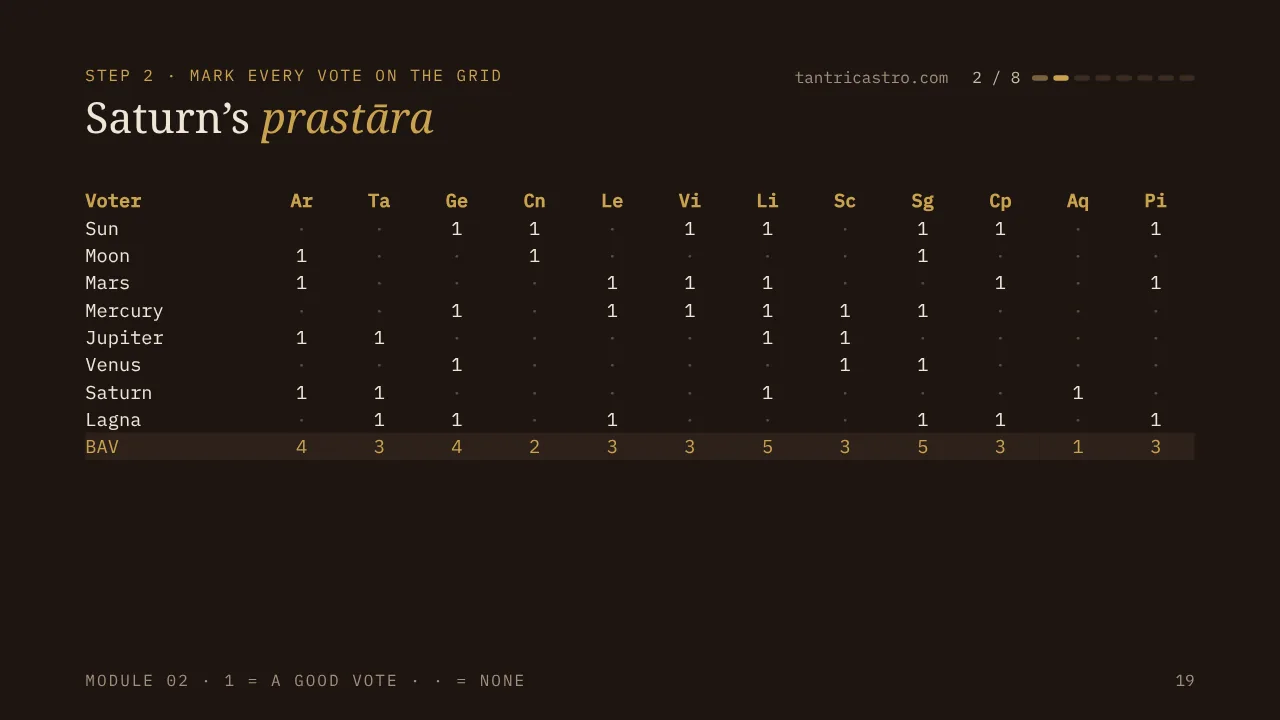
Step two, the prastāra. Eight rows for the eight voters, twelve columns for the signs. Now take each voter’s list and turn the house numbers into signs, counting from where the voter sits. Let’s do the Moon’s row together. The Moon sits in Aquarius and gives Saturn points in the 3rd, 6th and 11th from itself. Aquarius is the 1st, so the 3rd is Aries, the 6th is Cancer and the 11th is Sagittarius.
So in the Moon’s row we mark Aries, Cancer and Sagittarius. Check the grid: there they are. Now the lagna’s row. Lagna is Pisces, and it gives 1, 3, 4, 6, 10, 11. The 1st from Pisces is Pisces, the 3rd Taurus, the 4th Gemini, the 6th Leo, the 10th Sagittarius, the 11th Capricorn. Six marks.
When every row is done, add each column. That bottom row is Saturn’s card, his BAV: Aries 4, Taurus 3, Gemini 4, Cancer 2, Leo 3, Virgo 3, Libra 5, Scorpio 3, Sagittarius 5, Capricorn 3, Aquarius 1, Pisces 3.
| Voter | Ar | Ta | Ge | Cn | Le | Vi | Li | Sc | Sg | Cp | Aq | Pi |
|---|---|---|---|---|---|---|---|---|---|---|---|---|
| Sun | · | · | 1 | 1 | · | 1 | 1 | · | 1 | 1 | · | 1 |
| Moon | 1 | · | · | 1 | · | · | · | · | 1 | · | · | · |
| Mars | 1 | · | · | · | 1 | 1 | 1 | · | · | 1 | · | 1 |
| Mercury | · | · | 1 | · | 1 | 1 | 1 | 1 | 1 | · | · | · |
| Jupiter | 1 | 1 | · | · | · | · | 1 | 1 | · | · | · | · |
| Venus | · | · | 1 | · | · | · | · | 1 | 1 | · | · | · |
| Saturn | 1 | 1 | · | · | · | · | 1 | · | · | · | 1 | · |
| Lagna | · | 1 | 1 | · | 1 | · | · | · | 1 | 1 | · | 1 |
| BAV | 4 | 3 | 4 | 2 | 3 | 3 | 5 | 3 | 5 | 3 | 1 | 3 |
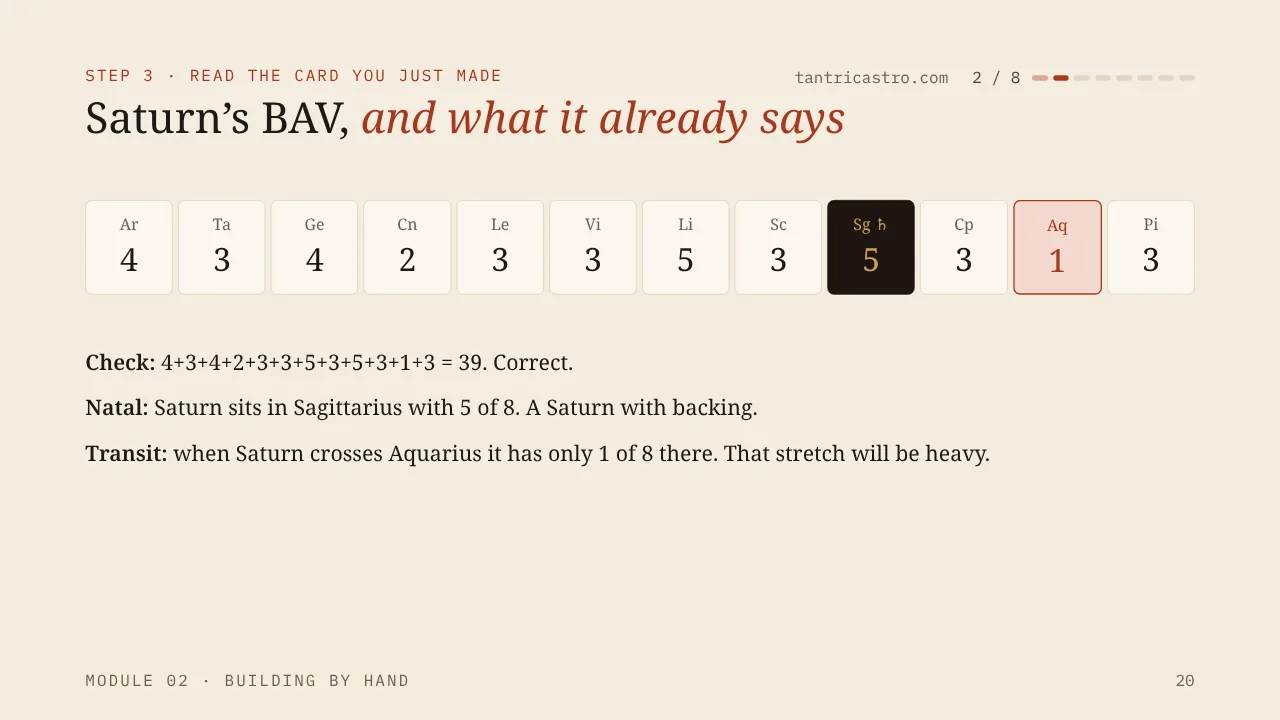
Step three. You have built Saturn’s card. First, always check the total: 4, 3, 4, 2, 3, 3, 5, 3, 5, 3, 1, 3. That is 39, Saturn’s fixed total, so our work is right. And look how much this one card already tells us, before we have learned any reading rules.
Natal Saturn sits in Sagittarius, and Saturn’s own card gives Sagittarius 5 out of 8. That is a Saturn with support behind it, able to deliver its results. Now look at Aquarius, the 12th house in this chart: Saturn gives it only 1 out of 8.
So when Saturn transits Aquarius, it is walking through a sign where almost no voter backs it. In this person’s life that stretch will be heavy. And notice this is a sign Saturn owns, Aquarius. Owning a sign does not mean scoring well in it. That is exactly the kind of thing ordinary reading misses and aṣṭakavarga catches.
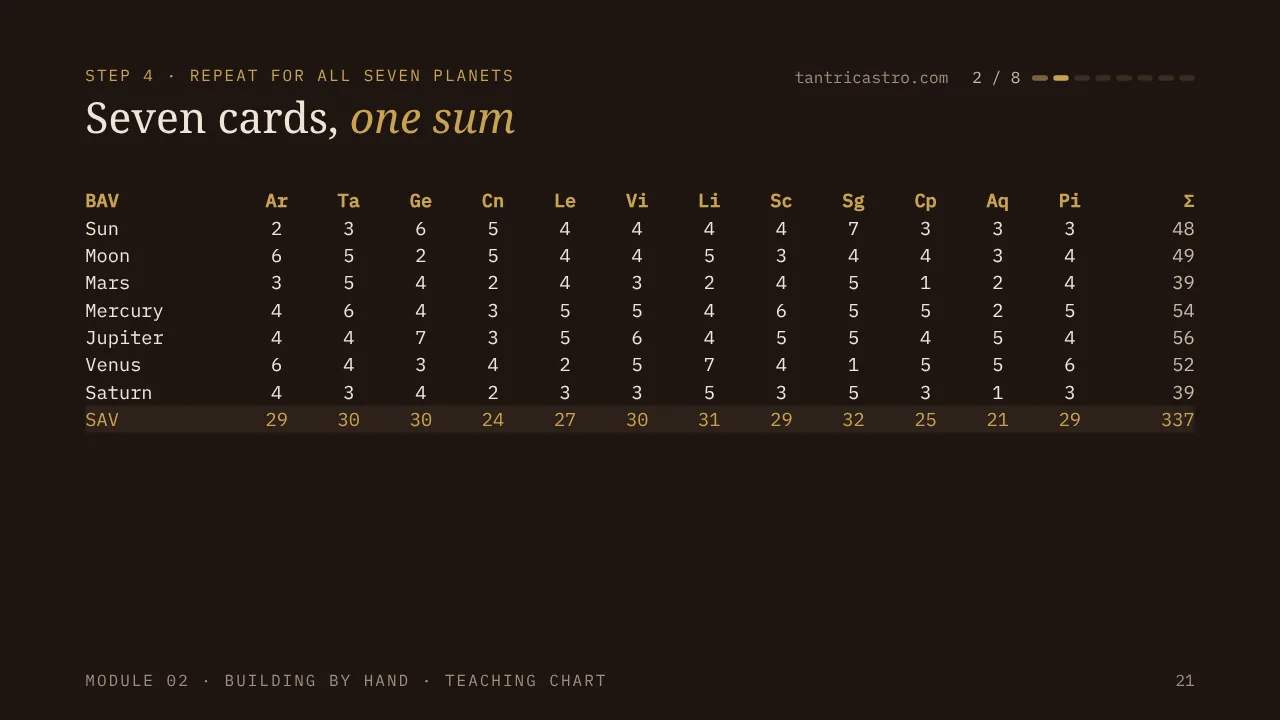
Step four. Do exactly what we did for Saturn six more times, once for each planet, each with its own table. Here are all seven cards for our teaching chart. Check the right-hand column: 48, 49, 39, 54, 56, 52, 39. Every planet hits its fixed total, so every card is right.
Now add each column top to bottom. Aries: 2 plus 6 plus 3 plus 4 plus 4 plus 6 plus 4, that is 29. Do the same for every sign and you get the bottom row, the SAV: 29, 30, 30, 24, 27, 30, 31, 29, 32, 25, 21, 29. And those twelve add up to 337. Verify a column or two yourself if you like. This bottom row is the most read line in all of aṣṭakavarga.
| BAV | Ar | Ta | Ge | Cn | Le | Vi | Li | Sc | Sg | Cp | Aq | Pi | Σ |
|---|---|---|---|---|---|---|---|---|---|---|---|---|---|
| Sun | 2 | 3 | 6 | 5 | 4 | 4 | 4 | 4 | 7 | 3 | 3 | 3 | 48 |
| Moon | 6 | 5 | 2 | 5 | 4 | 4 | 5 | 3 | 4 | 4 | 3 | 4 | 49 |
| Mars | 3 | 5 | 4 | 2 | 4 | 3 | 2 | 4 | 5 | 1 | 2 | 4 | 39 |
| Mercury | 4 | 6 | 4 | 3 | 5 | 5 | 4 | 6 | 5 | 5 | 2 | 5 | 54 |
| Jupiter | 4 | 4 | 7 | 3 | 5 | 6 | 4 | 5 | 5 | 4 | 5 | 4 | 56 |
| Venus | 6 | 4 | 3 | 4 | 2 | 5 | 7 | 4 | 1 | 5 | 5 | 6 | 52 |
| Saturn | 4 | 3 | 4 | 2 | 3 | 3 | 5 | 3 | 5 | 3 | 1 | 3 | 39 |
| SAV | 29 | 30 | 30 | 24 | 27 | 30 | 31 | 29 | 32 | 25 | 21 | 29 | 337 |
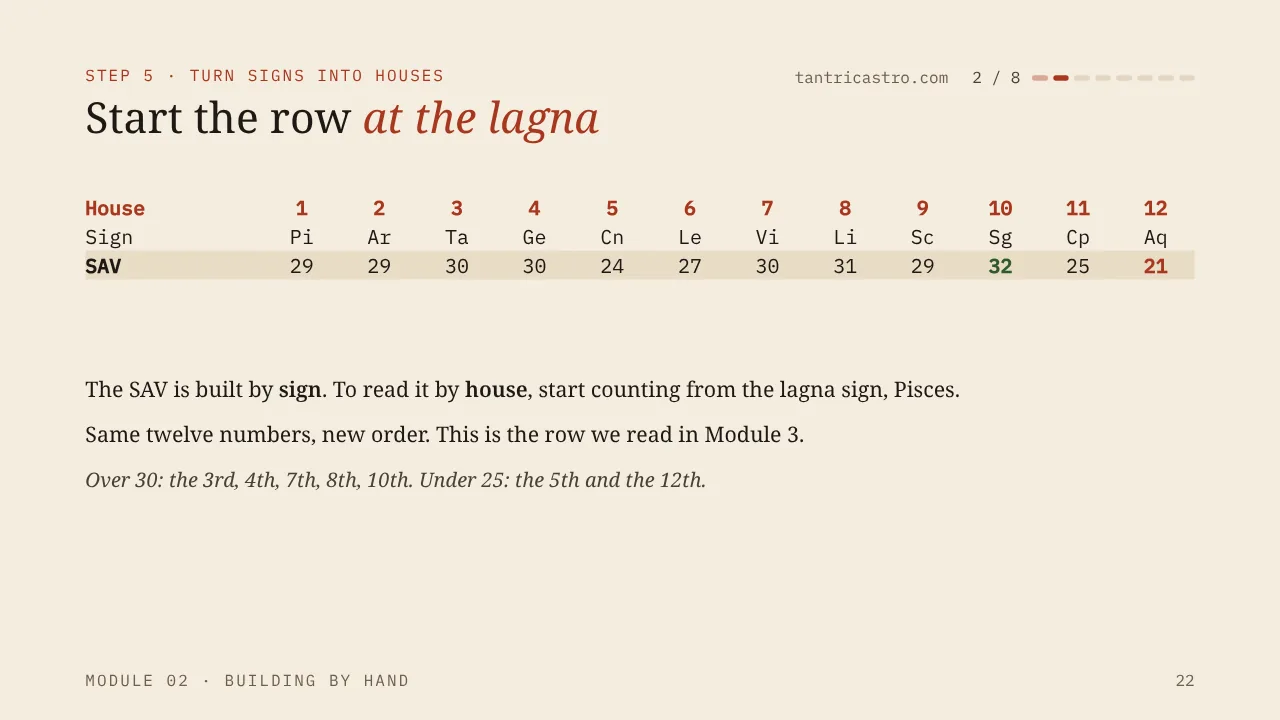
Step five. The SAV is built sign by sign, Aries to Pisces. But we read charts house by house. So we simply start the row at the lagna sign. Our lagna is Pisces. So Pisces is the 1st house with 29, Aries the 2nd with 29, Taurus the 3rd with 30, Gemini the 4th with 30, Cancer the 5th with 24, Leo the 6th with 27, Virgo the 7th with 30, Libra the 8th with 31, Scorpio the 9th with 29, Sagittarius the 10th with 32, Capricorn the 11th with 25, and Aquarius the 12th with 21.
Same twelve numbers, just reordered. Notice the extremes: the 10th at 32 is the strongest, the 12th at 21 the weakest, and the 5th at 24 is also under the line. In Module 3 we will learn what these patterns mean.
| House | 1 | 2 | 3 | 4 | 5 | 6 | 7 | 8 | 9 | 10 | 11 | 12 |
|---|---|---|---|---|---|---|---|---|---|---|---|---|
| Sign | Pi | Ar | Ta | Ge | Cn | Le | Vi | Li | Sc | Sg | Cp | Aq |
| SAV | 29 | 29 | 30 | 30 | 24 | 27 | 30 | 31 | 29 | 32 | 25 | 21 |
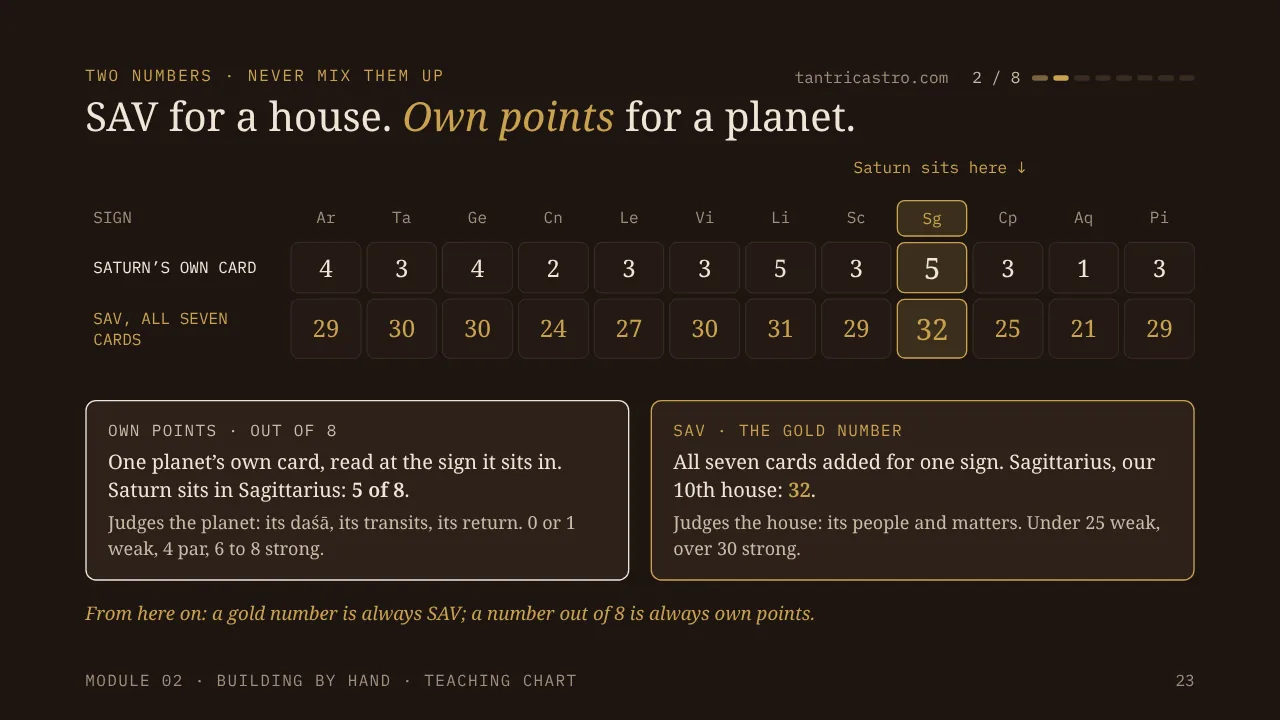
Before we go on, two numbers you will use for the rest of this course, and you must never mix them up. The first is the SAV, the gold number: all seven cards added together for one sign. It judges a house. Sagittarius, our 10th house, has 32. The second is a planet’s own points: open that planet’s own card and read the sign it sits in. It is out of 8, and it judges the planet itself: its daśā, its transits, its return.
Our Saturn sits in Sagittarius, and on Saturn’s own card Sagittarius has 5. Same sign, two numbers: 32 for the house, 5 for Saturn. From here on, a gold number is always SAV, and a number out of 8 is always own points.
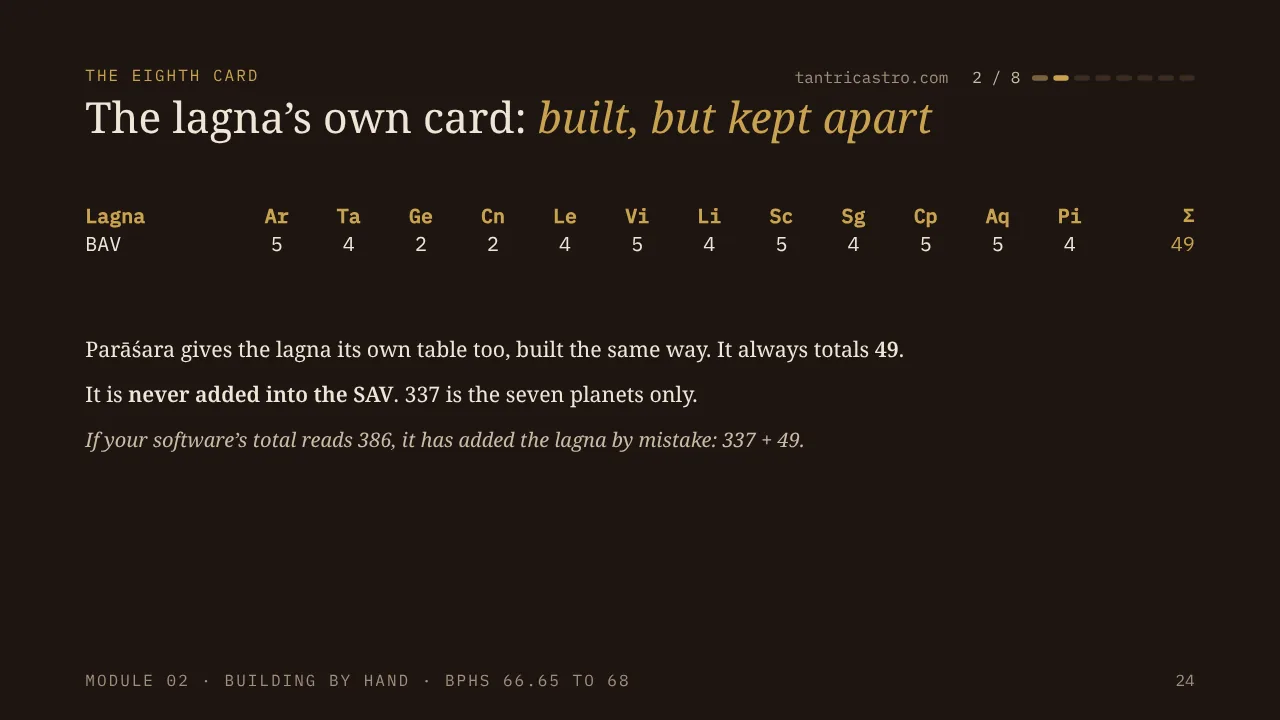
One more card exists. Parāśara also gives the lagna its own benefic table, and you build it exactly the same way, eight voters, one grid. For our teaching chart it comes out as 5, 4, 2, 2, 4, 5, 4, 5, 4, 5, 5, 4, and it always totals 49. But remember the rule from Module 1. This card is kept apart. It is never added into the SAV. The 337 is the seven planets only.
Here is a quick way to catch a software mistake: if some program shows you a grand total of 386, it has added the lagna’s card in by mistake, because 337 plus 49 is 386.
| Lagna | Ar | Ta | Ge | Cn | Le | Vi | Li | Sc | Sg | Cp | Aq | Pi | Σ |
|---|---|---|---|---|---|---|---|---|---|---|---|---|---|
| BAV | 5 | 4 | 2 | 2 | 4 | 5 | 4 | 5 | 4 | 5 | 5 | 4 | 49 |
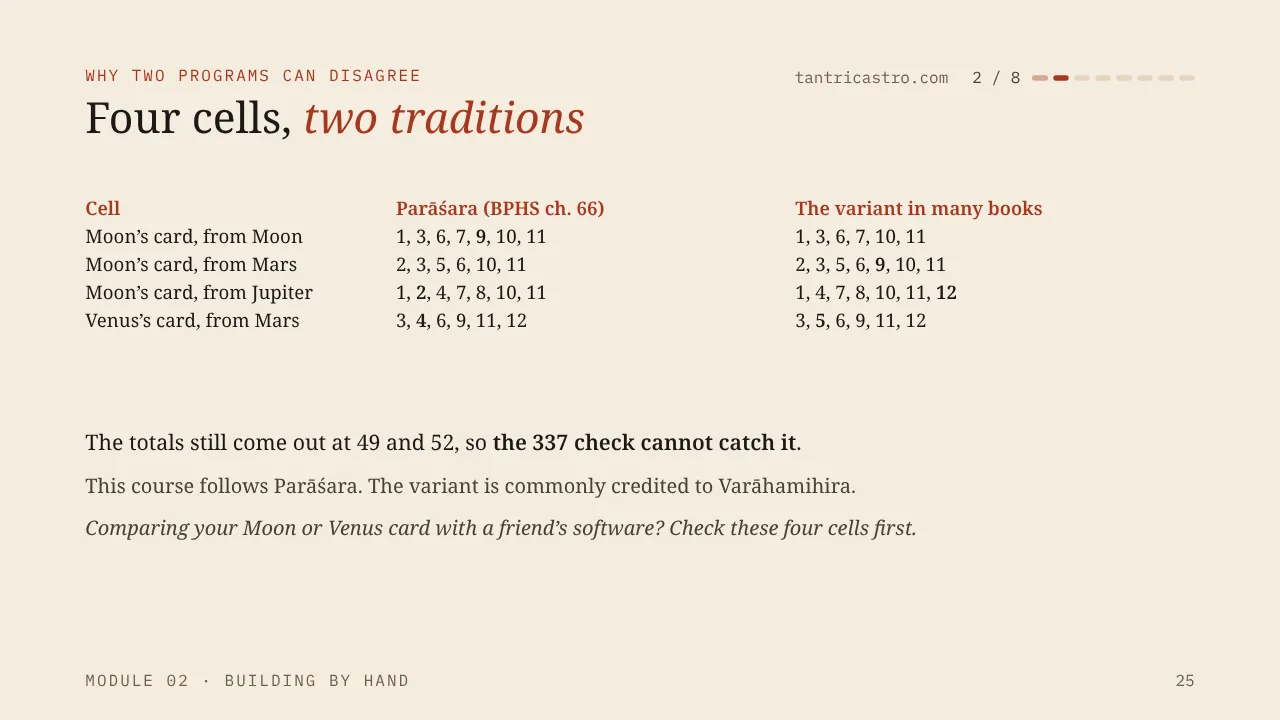
Now the two traditions. If you compare the Moon’s card or Venus’s card in two different programs, or two different books, sometimes they do not match. Why? Because there are two traditions for four cells of the tables. In Parāśara, chapter 66, the Moon gives itself a point in the 9th; the variant gives that 9th to Mars instead. Jupiter gives the Moon the 2nd in Parāśara, the 12th in the variant. And for Venus’s card, Mars gives the 4th in Parāśara, the 5th in the variant. The sneaky part: the totals still come out at 49 and 52 either way.
So the 337 check will not catch it. This course follows Parāśara, which is also what careful modern authors follow; the variant is commonly credited to Varāhamihira. So when your Moon or Venus card disagrees with someone else’s, look at these four cells first before you assume anyone made a mistake.
| Cell | Parashara (BPHS ch. 66) | The variant in many books |
|---|---|---|
| Moon’s card, from Moon | 1, 3, 6, 7, 9, 10, 11 | 1, 3, 6, 7, 10, 11 |
| Moon’s card, from Mars | 2, 3, 5, 6, 10, 11 | 2, 3, 5, 6, 9, 10, 11 |
| Moon’s card, from Jupiter | 1, 2, 4, 7, 8, 10, 11 | 1, 4, 7, 8, 10, 11, 12 |
| Venus’s card, from Mars | 3, 4, 6, 9, 11, 12 | 3, 5, 6, 9, 11, 12 |
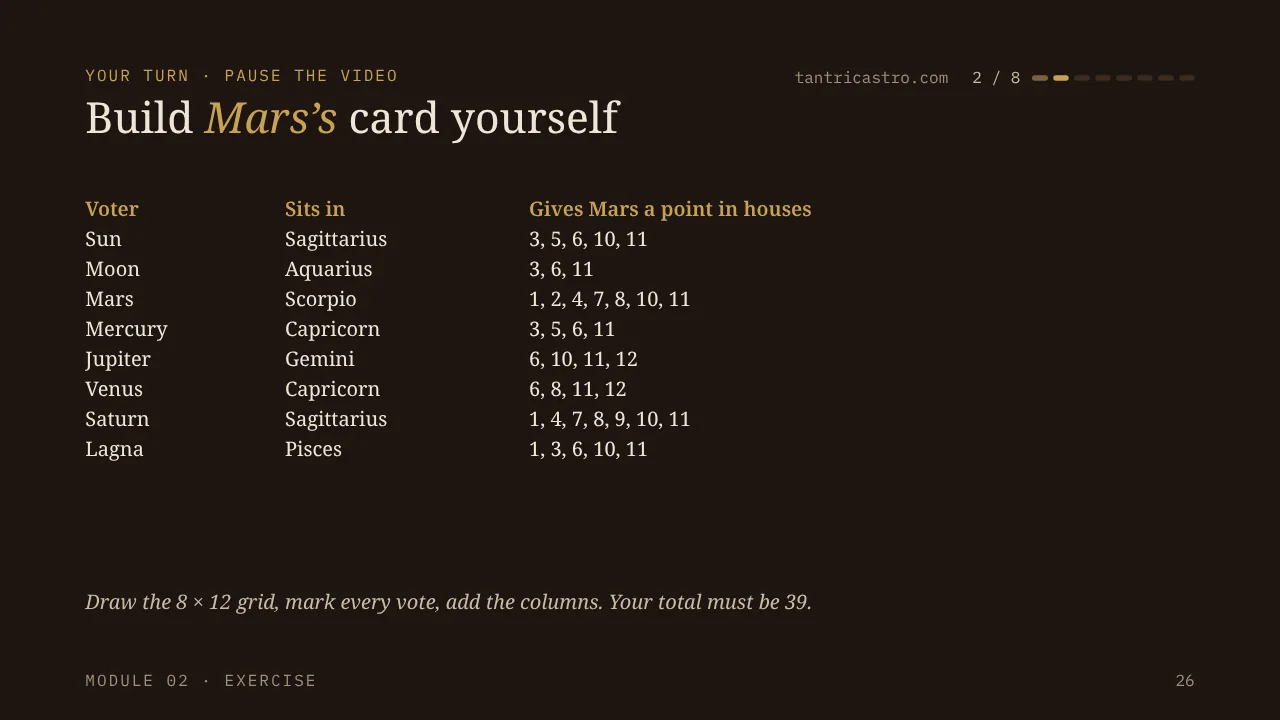
Now it is your turn. Do this once by hand; that is what makes the whole system click. Here is Mars’s classical table, with each voter’s sign from our teaching chart already written in. Draw an eight by twelve grid, go row by row, turn each house number into a sign by counting from that voter, mark it, and then add each column. Your total must come out to 39. The answer is on the next slide.
| Voter | Sits in | Gives Mars a point in houses |
|---|---|---|
| Sun | Sagittarius | 3, 5, 6, 10, 11 |
| Moon | Aquarius | 3, 6, 11 |
| Mars | Scorpio | 1, 2, 4, 7, 8, 10, 11 |
| Mercury | Capricorn | 3, 5, 6, 11 |
| Jupiter | Gemini | 6, 10, 11, 12 |
| Venus | Capricorn | 6, 8, 11, 12 |
| Saturn | Sagittarius | 1, 4, 7, 8, 9, 10, 11 |
| Lagna | Pisces | 1, 3, 6, 10, 11 |
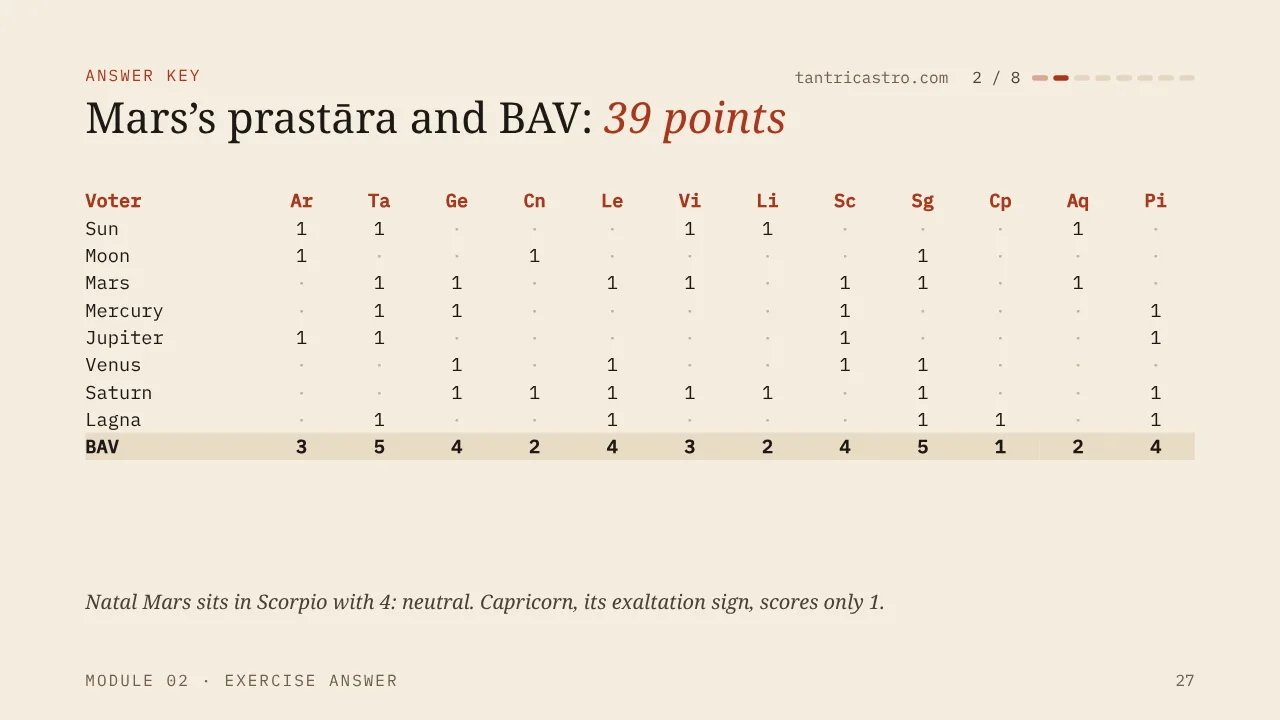
Here is the answer. Check your grid row by row against this one. Mars’s card for our teaching chart reads: Aries 3, Taurus 5, Gemini 4, Cancer 2, Leo 4, Virgo 3, Libra 2, Scorpio 4, Sagittarius 5, Capricorn 1, Aquarius 2, Pisces 4. Total 39.
If you got 39 but one column is off, you probably counted one voter’s houses from the wrong sign; go back to that row. Two quick readings. Natal Mars sits in Scorpio, its own sign, with 4 points: neutral, it can work but has no special backing. And look at Capricorn, the sign where Mars is exalted: only 1 point.
So when Mars transits Capricorn in this chart, the textbook says exalted and strong, but the voters say it gets almost no support. Again, aṣṭakavarga shows you something dignity alone hides. That is the theme of the next module.
| Voter | Ar | Ta | Ge | Cn | Le | Vi | Li | Sc | Sg | Cp | Aq | Pi |
|---|---|---|---|---|---|---|---|---|---|---|---|---|
| Sun | 1 | 1 | · | · | · | 1 | 1 | · | · | · | 1 | · |
| Moon | 1 | · | · | 1 | · | · | · | · | 1 | · | · | · |
| Mars | · | 1 | 1 | · | 1 | 1 | · | 1 | 1 | · | 1 | · |
| Mercury | · | 1 | 1 | · | · | · | · | 1 | · | · | · | 1 |
| Jupiter | 1 | 1 | · | · | · | · | · | 1 | · | · | · | 1 |
| Venus | · | · | 1 | · | 1 | · | · | 1 | 1 | · | · | · |
| Saturn | · | · | 1 | 1 | 1 | 1 | 1 | · | 1 | · | · | 1 |
| Lagna | · | 1 | · | · | 1 | · | · | · | 1 | 1 | · | 1 |
| BAV | 3 | 5 | 4 | 2 | 4 | 3 | 2 | 4 | 5 | 1 | 2 | 4 |
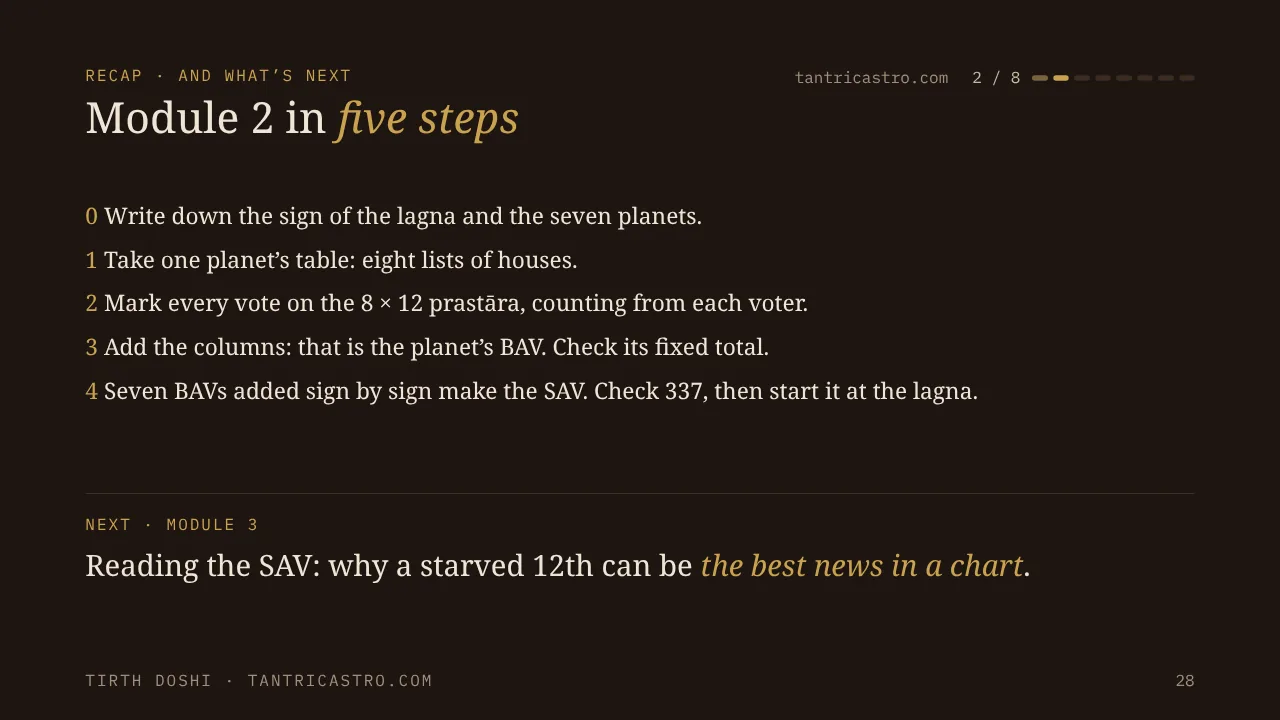
Let’s wrap up Module 2. Step zero: write down the sign of the lagna and the seven planets. Step one: take one planet’s classical table, eight lists of houses. Step two: mark every vote on the eight by twelve prastāra, always counting from the voter.
Step three: add the columns, that is the planet’s BAV, and check its fixed total. Step four: add the seven BAVs sign by sign to get the SAV, check that it is 337, and then start the row from the lagna to read it house by house. You now know exactly where every number on your software screen comes from. In Module 3 we start reading. And the first question we answer: can a starved 12th house be the best news in the whole chart? See you there.
Reading the SAV
Module 3: reading the SAV, house by house and in comparisons.
Module three. Now we read. Everything in this module comes from one row of twelve numbers, the SAV, and by the end you will be pulling money, career, direction and the phases of life out of it.
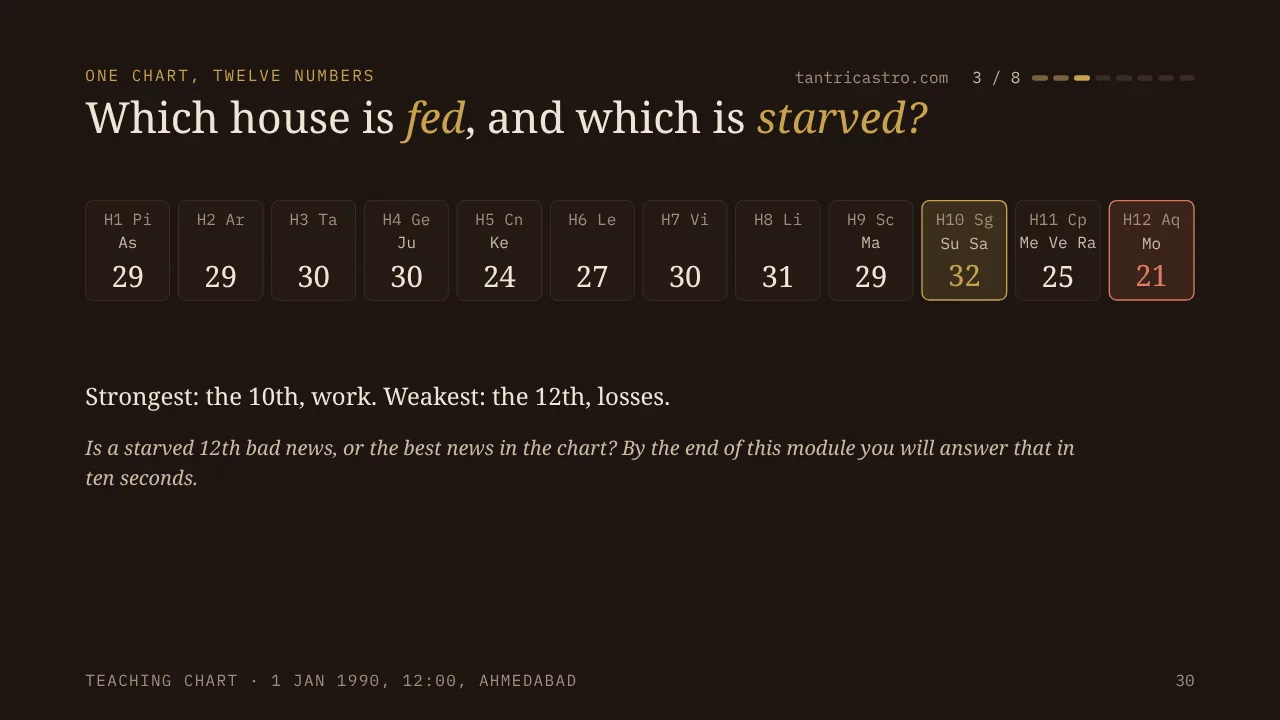
Here is the row we just built for our teaching chart: the sarvāṣṭakavarga, one number per house. From this module on you read a whole life from it. Look at it for a second. The 10th house, career, has the highest score, 32. The 12th house, the house of losses and expenses, has the lowest, 21.
Now hold on to this question. Is a starved 12th house bad news, or is it actually the best news in this chart? Most people guess wrong. By the end of this module you will answer it in ten seconds.
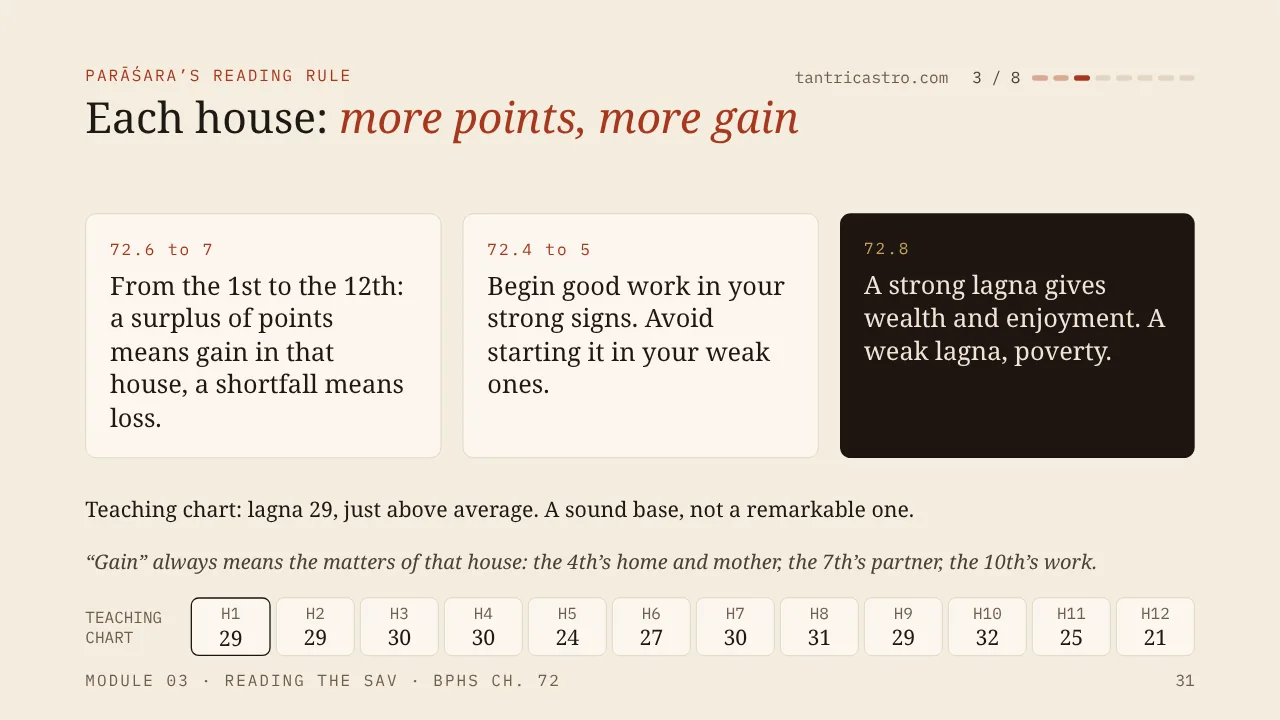
Start with Parāśara’s own reading rules from chapter 72. Verses 6 and 7: go through the houses from the 1st to the 12th; where there is a surplus of points the native gains in the matters of that house, where there is a shortfall he loses, and in between it is middling. Verses 4 and 5 turn it practical: begin good undertakings when the relevant sign is strong, and avoid starting them in weak signs. And verse 8 singles out the lagna: a strong lagna gives wealth and enjoyment, a weak lagna gives poverty.
So the lagna’s own score is the first number you look at. In our teaching chart the lagna has 29, just above the average of 28. A sound base, not a remarkable one. And remember, gain always means the matters of that particular house. A strong 4th is gain in home, property and mother. A strong 7th is gain through the partner and partnerships. A strong 10th is gain through work and status.
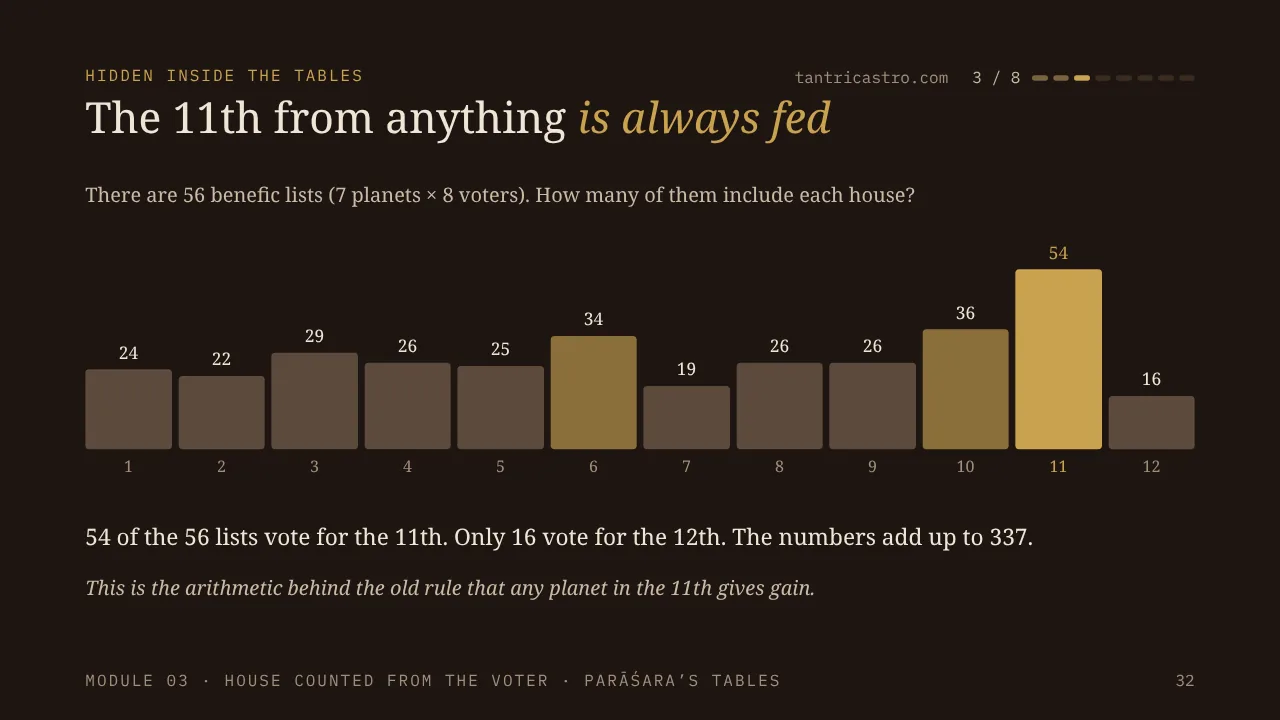
Now something hidden inside the tables. Seven planets, each with eight voters, gives fifty-six benefic lists. Now ask: of those fifty-six lists, how many include the 1st house from the voter? How many the 2nd, the 3rd, and so on?
Here is the answer. The 11th house appears in fifty-four of the fifty-six lists. Only two lists leave it out: the Sun’s card from Venus, and Jupiter’s card from Saturn. The 10th is next with thirty-six, then the 6th with thirty-four. And at the bottom, the 12th, with only sixteen, and the 7th with nineteen.
Add all twelve and you get 337 again. What does this mean? Whatever sign is the 11th from many planets collects points almost automatically. That is the arithmetic behind the old rule that any planet in the 11th gives gain. And notice the upacaya houses, 3, 6, 10 and 11, the houses that grow with time, are all high. The tables and the classical rules are telling the same story.
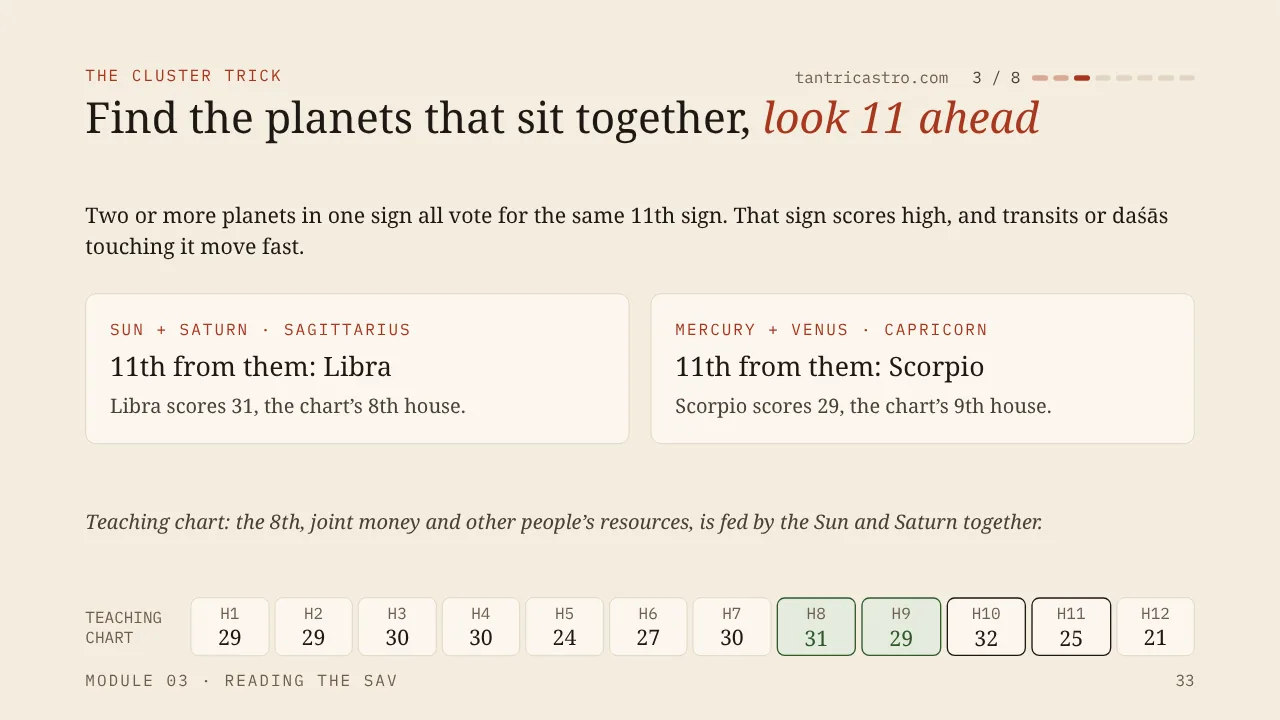
Here is a practical trick that falls straight out of the last slide. Because almost every voter gives a point to the 11th sign from itself, when two, three or four planets sit together in one sign, they all pour votes into the same sign, the 11th from that cluster.
So that sign ends up with a high score. Then, whenever a transit or a daśā touches that sign, things move fast there. In our teaching chart there are two pairs. The Sun and Saturn sit together in Sagittarius; the 11th from Sagittarius is Libra, and Libra scores 31. Libra is this chart’s 8th house, joint money, other people’s resources, inheritance. Mercury and Venus sit together in Capricorn; the 11th from Capricorn is Scorpio, scoring 29, this chart’s 9th house, fortune.
So when you meet a chart with a stellium, the very first thing to do is count eleven ahead and check that sign.
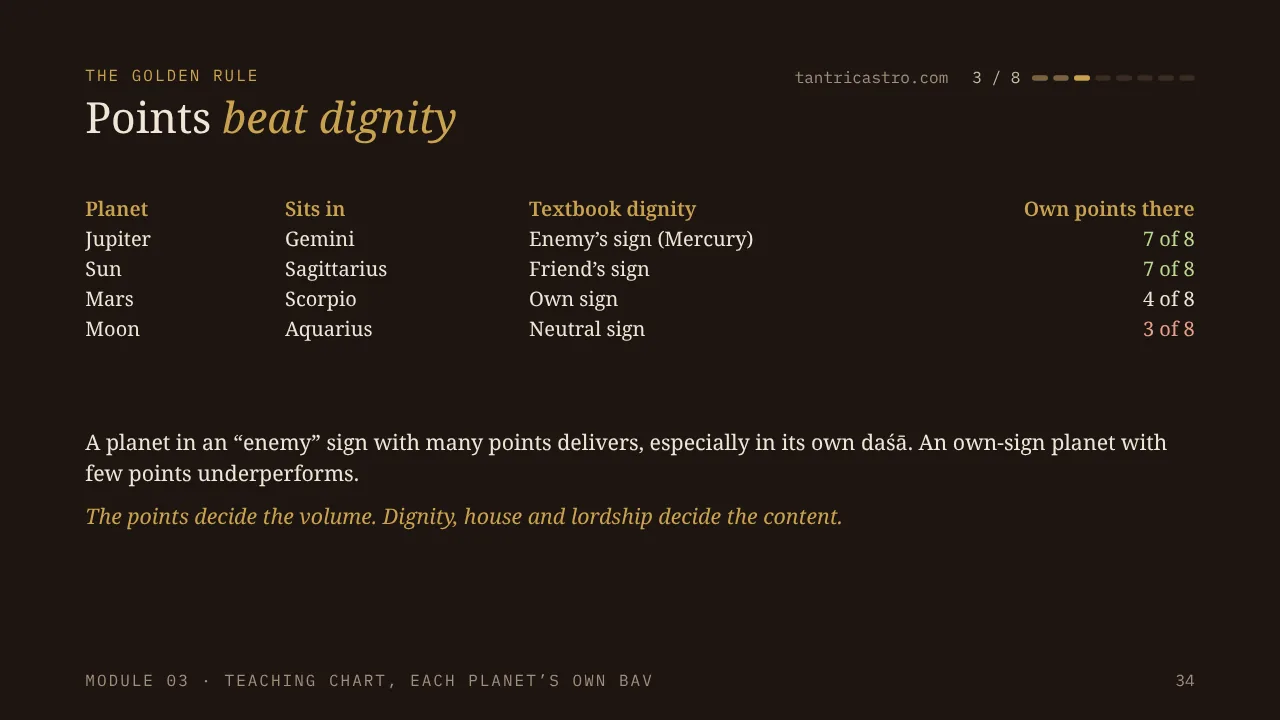
Points beat dignity. Look at our teaching chart. Jupiter sits in Gemini, a sign of Mercury, and Mercury is Jupiter’s enemy. A textbook reader says weak Jupiter. But look at Jupiter’s own card: Gemini gets 7 out of 8. Seven of the eight voters back Jupiter right where it sits. That Jupiter will deliver, especially in its own daśā. The Sun in Sagittarius also has 7.
Now Mars, in its own sign Scorpio, the textbook says strong; its own card gives it only 4, neutral. And the Moon in Aquarius has 3, below par. So the dignity tells you one story and the voters tell you another, and in practice the voters win more often than the dignity does. But do not throw dignity away.
Here is the balance. The points decide the volume, how much the planet can give. Dignity, the house it sits in and the houses it rules decide the content, what kind of result it gives and in which area of life.
| Planet | Sits in | Textbook dignity | Own points there |
|---|---|---|---|
| Jupiter | Gemini | Enemy’s sign (Mercury) | 7 of 8 |
| Sun | Sagittarius | Friend’s sign | 7 of 8 |
| Mars | Scorpio | Own sign | 4 of 8 |
| Moon | Aquarius | Neutral sign | 3 of 8 |
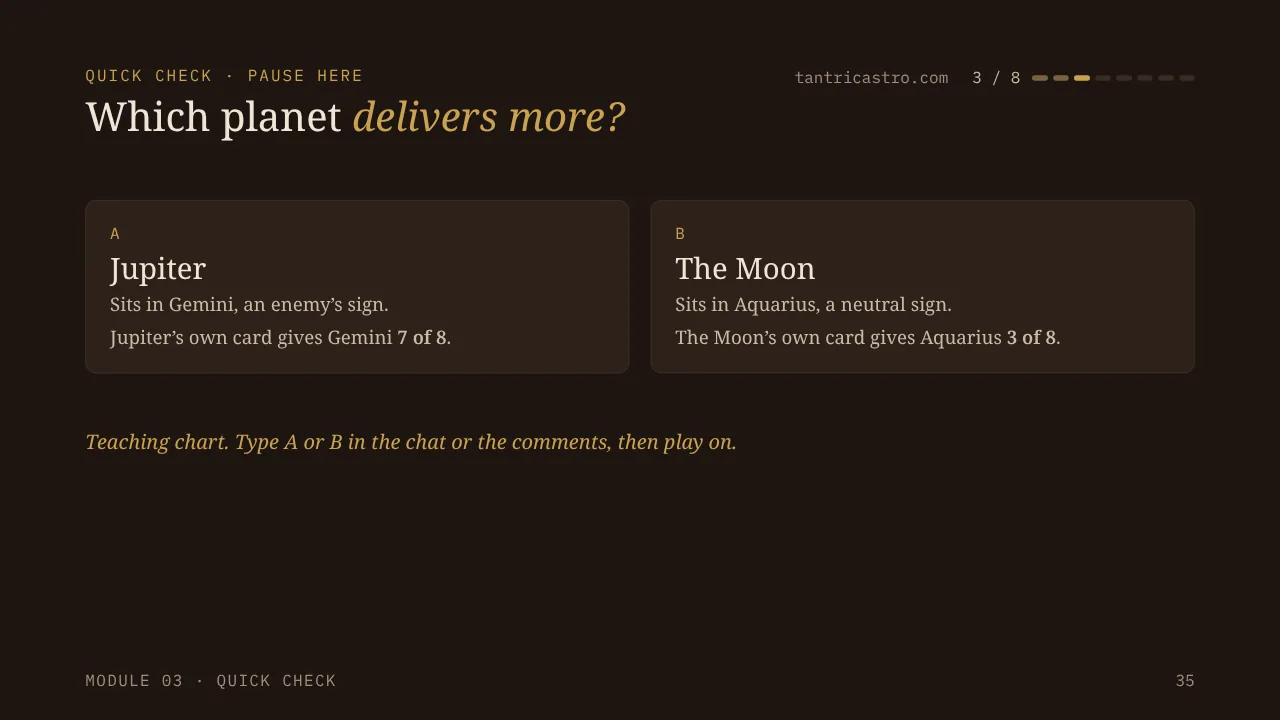
Quick check. On our teaching chart, Jupiter sits in Gemini, an enemy’s sign by the textbook, with seven of its own points. The Moon sits in Aquarius, a neutral sign, with three. Which planet delivers more of its own matters, in its own daśā and its own transits? A or B.
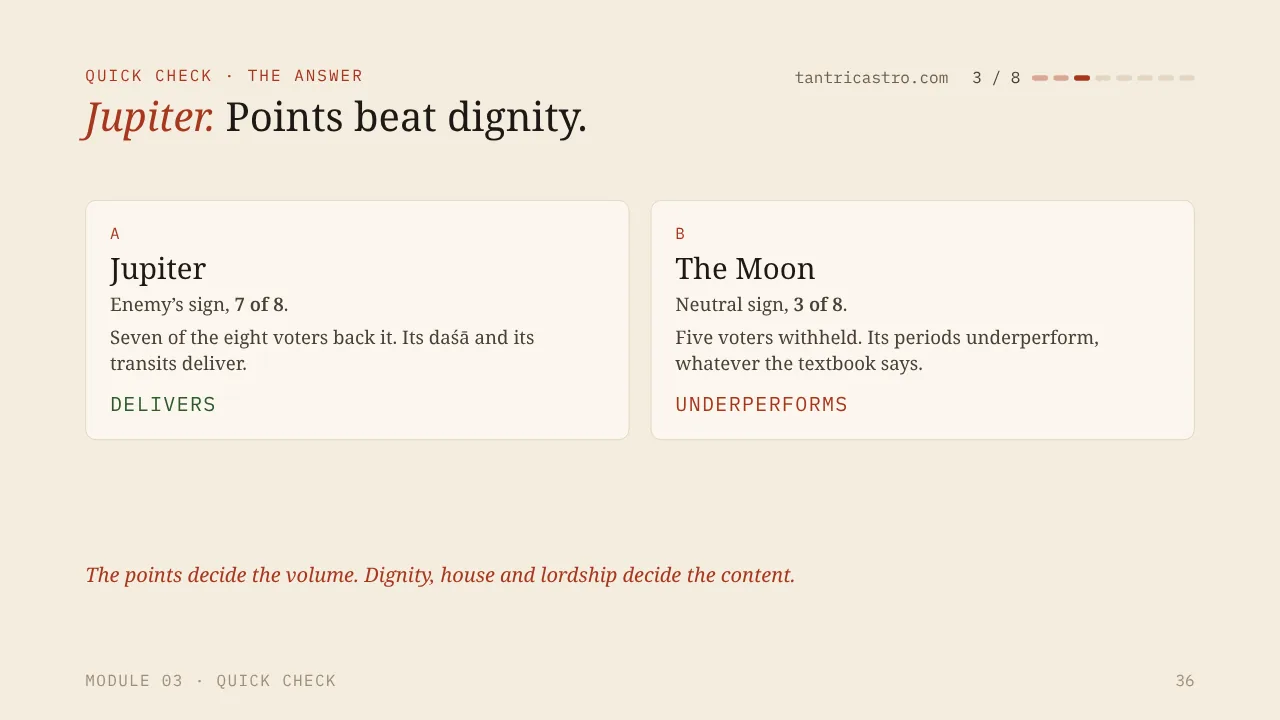
Jupiter. Seven of the eight voters back Jupiter in Gemini, so Jupiter’s daśā and Jupiter’s transits deliver, enemy sign or not. The Moon has only three; five voters withheld, so the Moon’s periods underperform, whatever the textbook says about a neutral sign. The points decide the volume. Dignity, house and lordship decide the content.
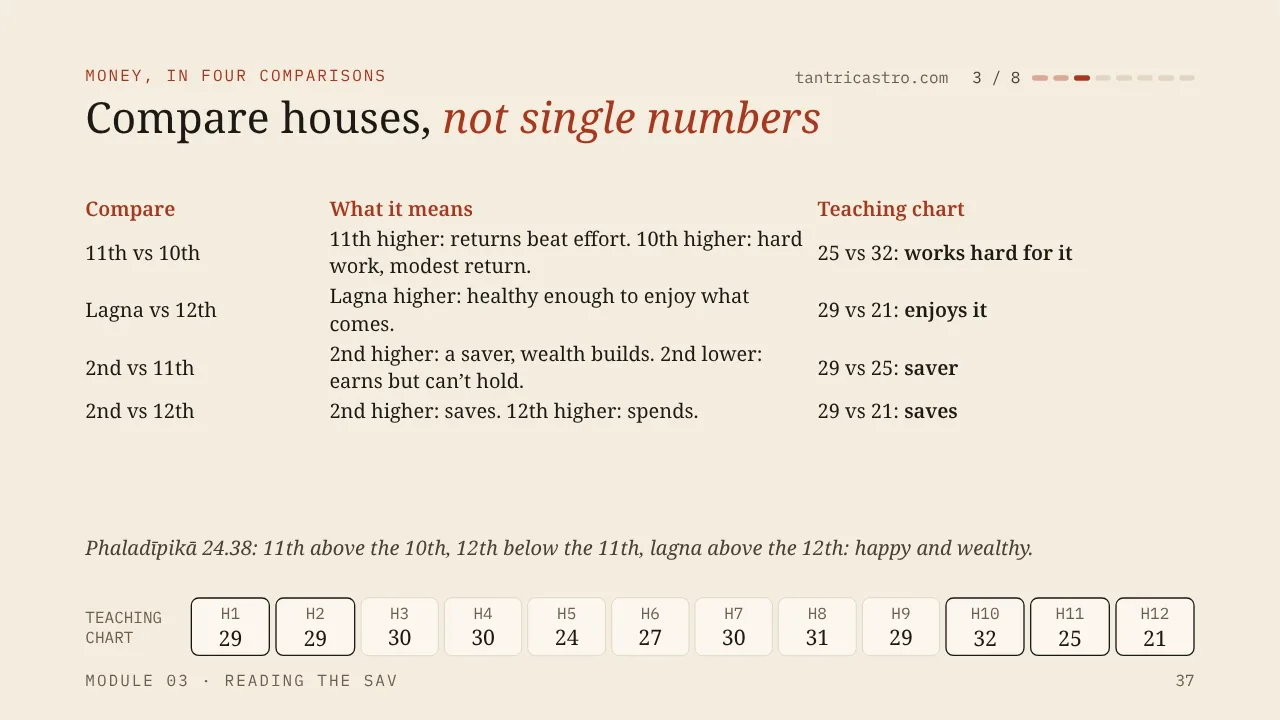
Single numbers only take you so far. The real reading comes from comparing houses. Here are four comparisons for money, and we run each on our teaching chart. One: the 11th against the 10th. The 10th is effort, the 11th is the return on that effort.
If the 11th is higher, you put in five and get back ten. If the 10th is higher, you work hard for a modest return. Teaching chart: 11th 25, 10th 32. This person works hard for what they get. Two: the lagna against the 12th.
If the lagna is higher, the person is sound enough to enjoy what comes. Here 29 against 21, so yes. Three: the 2nd against the 11th. The 2nd is the purse, the 11th the income. A higher 2nd means a saver, wealth accumulates; a lower 2nd means money comes in but does not stay.
Here 29 against 25: a saver. Four: the 2nd against the 12th, the quickest first read. 2nd higher, the person saves; 12th higher, the person spends. 29 against 21: saves. And Phaladīpikā, chapter 24, verse 38, quoting the older Horāsāra, puts three of these together: if the 11th has more points than the 10th, the 12th fewer than the 11th, and the lagna more than the 12th, the person is happy and wealthy. Some later texts add the reverse as a sign of poverty. Our chart fails the first condition, so this is a hard-working saver, not effortless wealth.
| Compare | What it means | Teaching chart |
|---|---|---|
| 11th vs 10th | 11th higher: returns beat effort. 10th higher: hard work, modest return. | 25 vs 32: works hard for it |
| Lagna vs 12th | Lagna higher: healthy enough to enjoy what comes. | 29 vs 21: enjoys it |
| 2nd vs 11th | 2nd higher: a saver, wealth builds. 2nd lower: earns but can’t hold. | 29 vs 25: saver |
| 2nd vs 12th | 2nd higher: saves. 12th higher: spends. | 29 vs 21: saves |
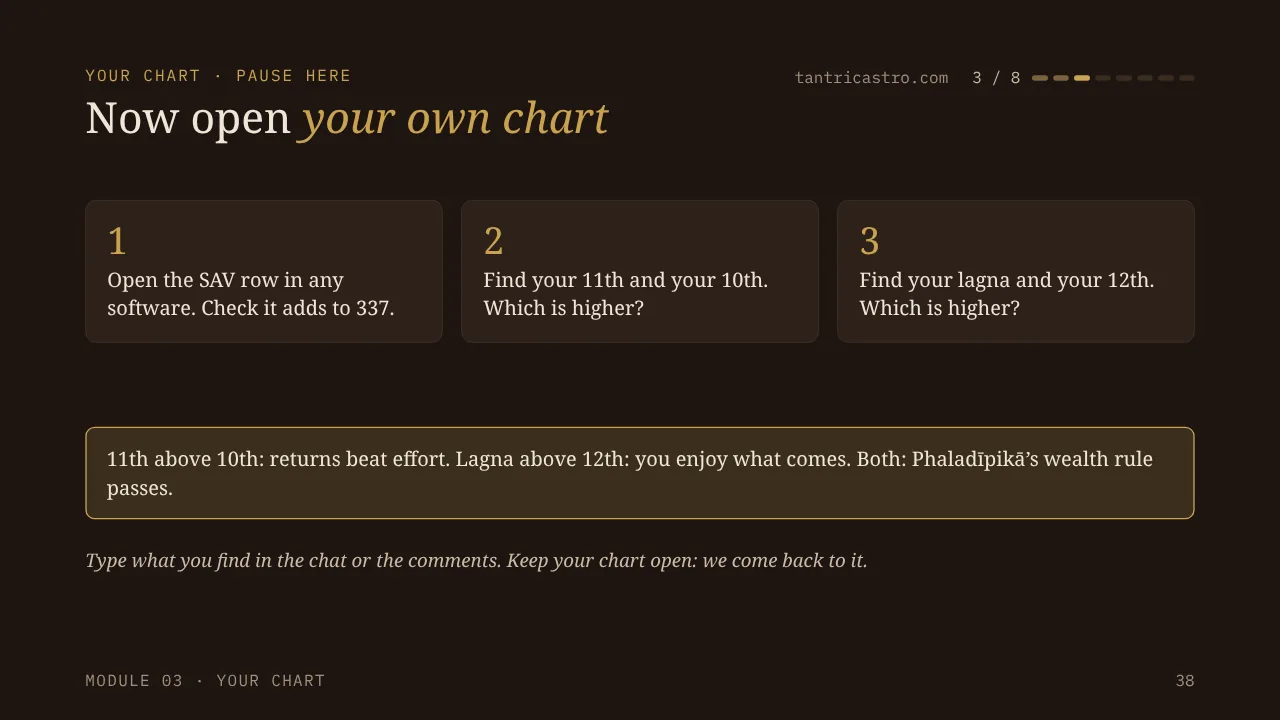
One: find the SAV row in any software and check that it adds to 337. Two: find your 11th house and your 10th. Which is higher? Three: find your lagna and your 12th. Which is higher? If the 11th beats the 10th, your returns beat your effort.
If the lagna beats the 12th, you enjoy what comes. Both together, and Phaladīpikā’s wealth rule passes in your chart.
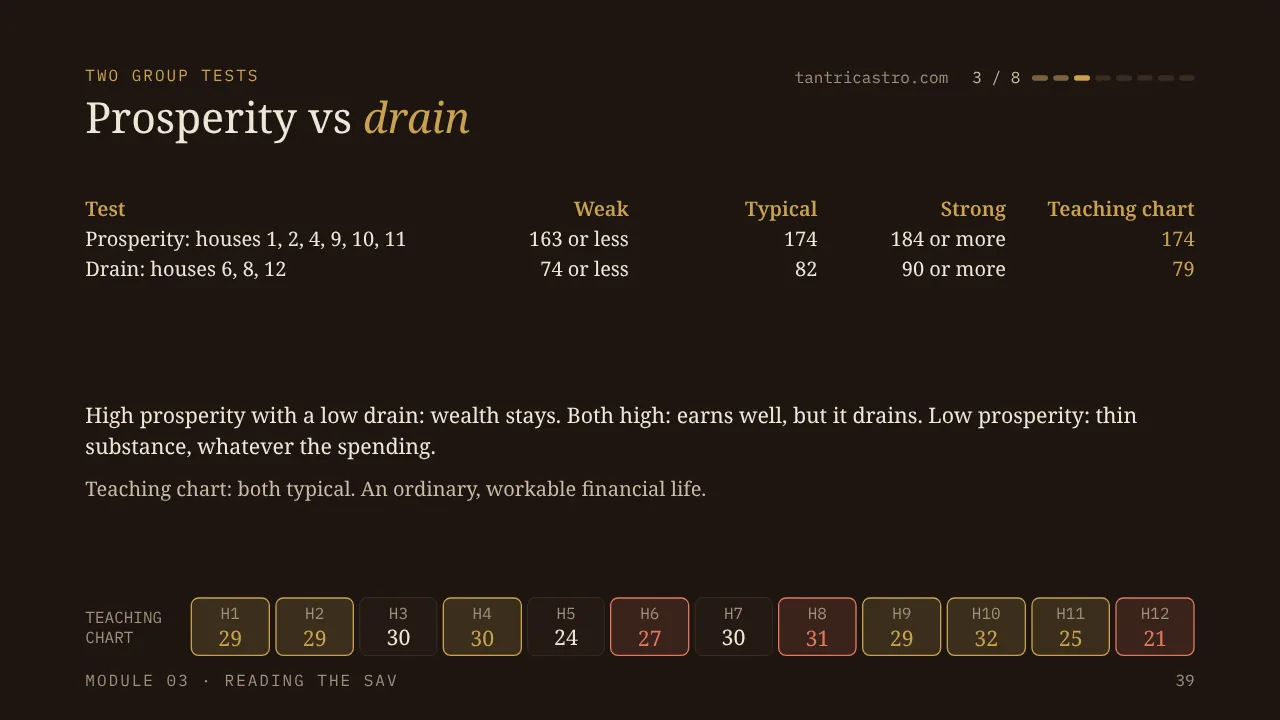
Now two group tests. The prosperity test adds the houses that build wealth: the 1st, 2nd, 4th, 9th, 10th and 11th. The drain test adds the three houses that take it away: the 6th, 8th and 12th. Here are the numbers to judge them by.
For prosperity, an ordinary chart sits around 174. 184 or more is a strong promise of wealth; 163 or less is thin. For the drain, an ordinary chart sits around 82. 90 or more and the outflow is heavy; 74 or less and very little leaks away.
Now read them together. High prosperity with a low drain, the wealth stays. Both high, the person earns well but it drains away. Low prosperity, the substance is thin no matter how carefully they spend. Our teaching chart: prosperity 174, drain 79. Both typical. An ordinary, workable financial life, which fits the four comparisons we just did.
| Test | Weak | Typical | Strong | Teaching chart |
|---|---|---|---|---|
| Prosperity: houses 1, 2, 4, 9, 10, 11 | 163 or less | 174 | 184 or more | 174 |
| Drain: houses 6, 8, 12 | 74 or less | 82 | 90 or more | 79 |
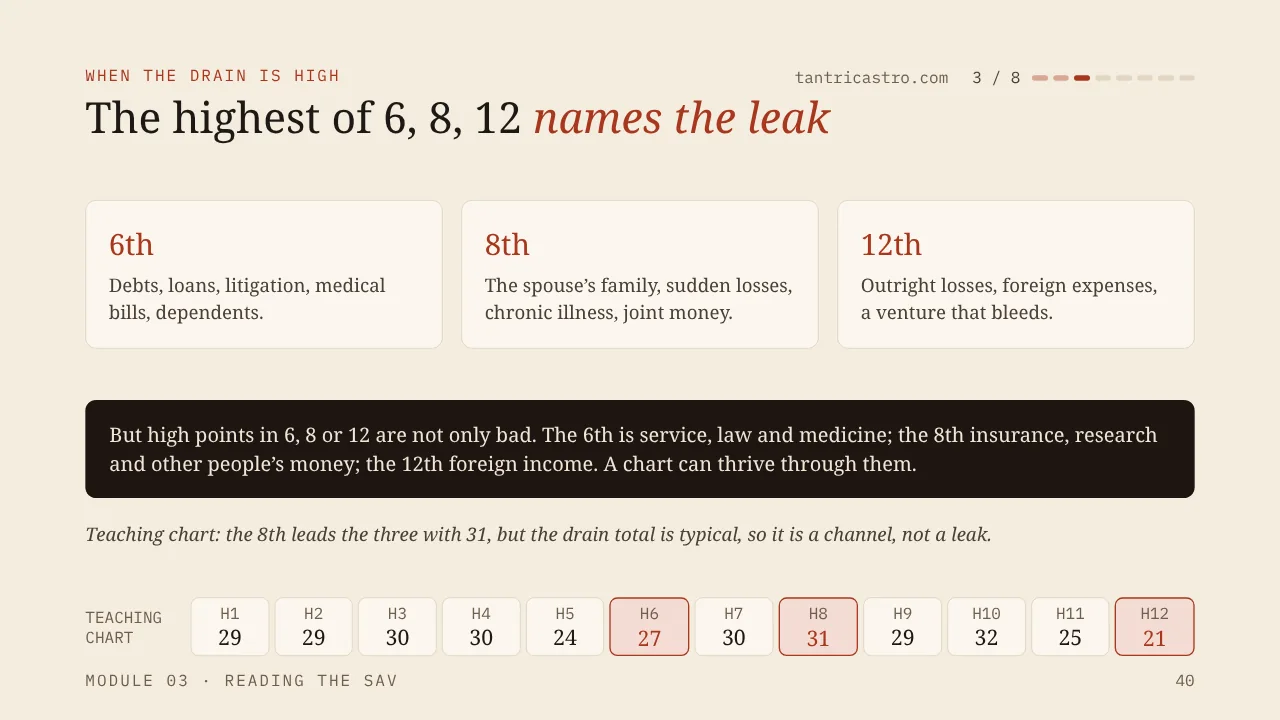
When the drain test is high, look at which of the three houses is highest, because that names where the money goes. If it is the 6th: debts, loans, court cases, medical bills, dependents. If it is the 8th: the spouse’s family, sudden losses, chronic illness, money held jointly.
If it is the 12th: outright losses, foreign expenses, a venture that keeps bleeding. But please do not read 6, 8 and 12 as only bad. In modern life the 6th is service, law and medicine. The 8th is insurance, research, and other people’s money. The 12th can be foreign income and settlement abroad. High points there can mean someone thriving in exactly those fields.
In our teaching chart the 8th leads with 31, but the drain total is typical, so it is a channel money moves through, not a leak.
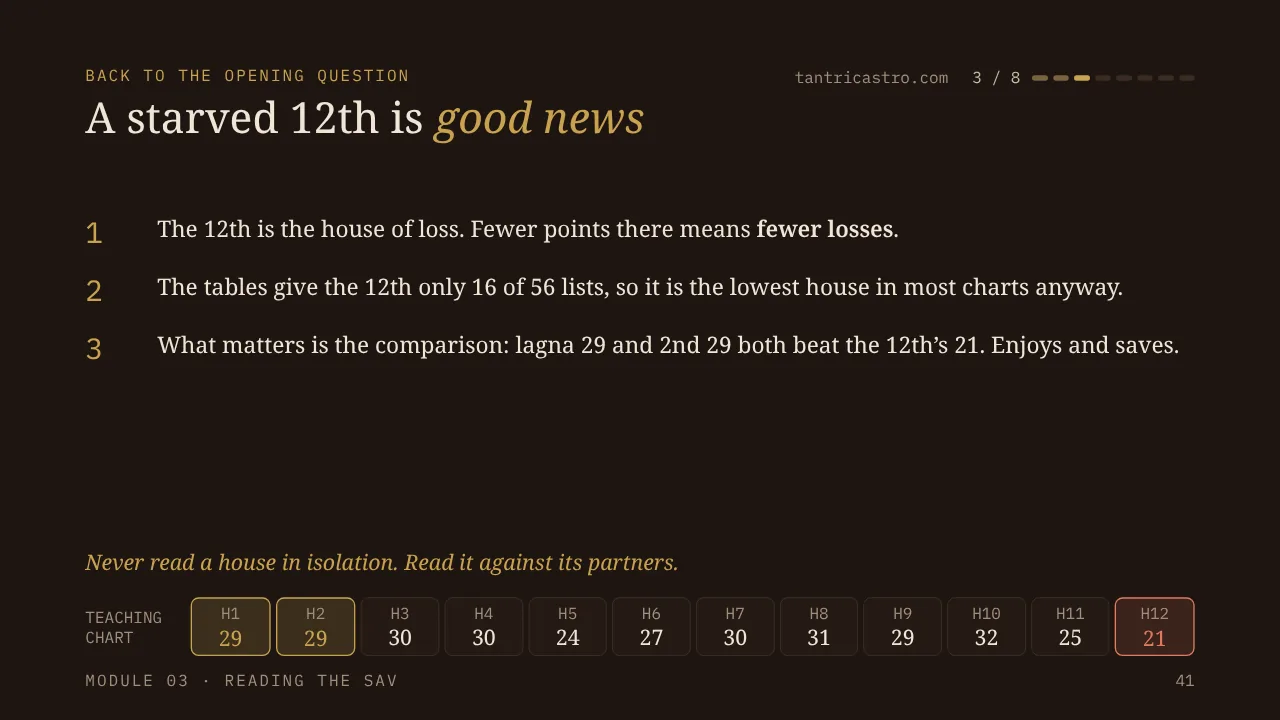
So now we can answer the question that opened this module. Our teaching chart has its lowest score, 21, in the 12th. Bad news or good news? Good news, for three reasons. One: the 12th is the house of loss and expense, so fewer points there means fewer losses.
Two: the tables themselves only vote for the 12th in sixteen of fifty-six lists, so in most charts the 12th is the lowest house anyway. A low 12th is normal, not a warning. Three: what matters is the comparison. The lagna has 29 and the 2nd has 29, both clearly above the 12th’s 21.
So this person enjoys what they have and they save it. If the 12th had been higher than the lagna and the 2nd, that would be the warning. So the lesson of Module 3 so far: never read a house in isolation. Read it against its partners.
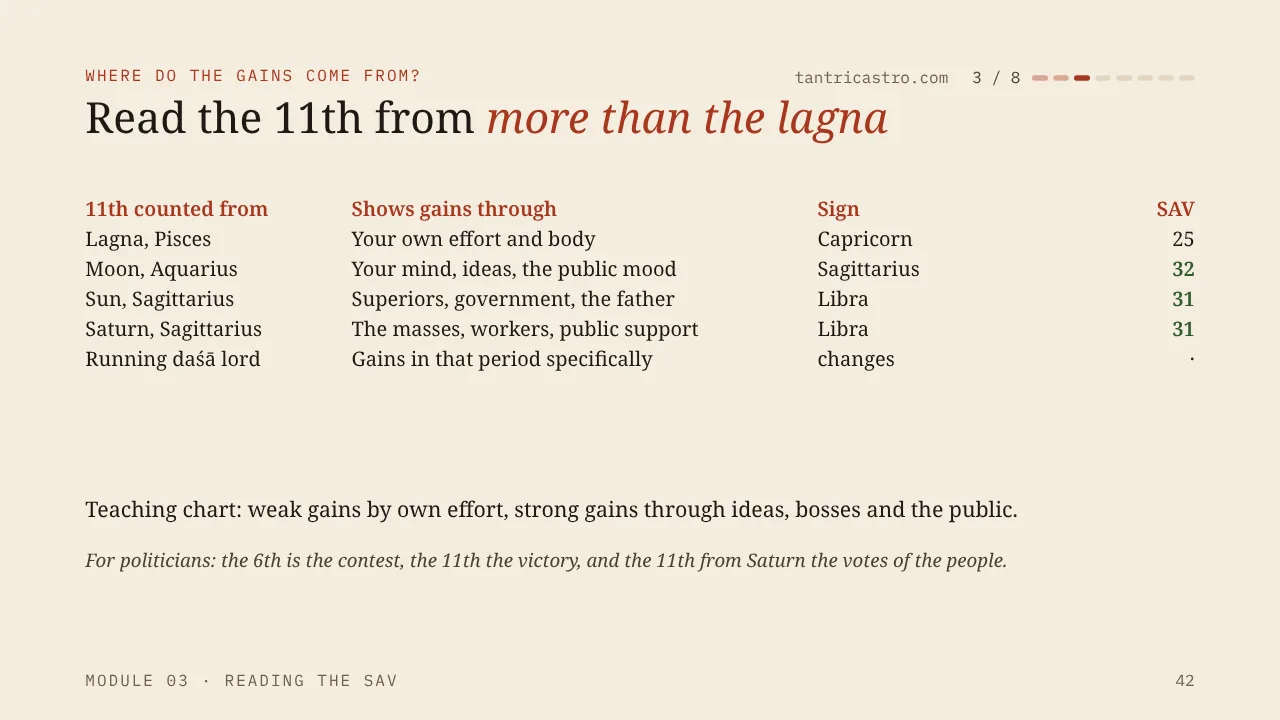
The 11th house is gains, but gains from where? You find out by counting the 11th from more than just the lagna. From the lagna it shows gains through your own effort. From the Moon it shows gains through your mind, your ideas, your emotional intelligence, the public mood. From the Sun it shows gains through superiors, government, authority, the father.
From Saturn it shows gains through the masses, workers, ordinary people, public support. And from the sign of the running daśā lord it shows gains during that particular period.
Let’s run our teaching chart. The 11th from the lagna is Capricorn with 25, below average. The 11th from the Moon is Sagittarius with 32. The 11th from the Sun is Libra with 31, and Saturn also sits in Sagittarius, so the 11th from Saturn is the same Libra, 31.
So this person does not gain much by grinding alone, but gains strongly through ideas, through people above them, and through public support. One more for politicians: the 6th house is the contest, the 11th is the victory, and the 11th from Saturn is the support of the people, because in a democracy Saturn represents the masses.
| 11th counted from | Shows gains through | Sign | SAV |
|---|---|---|---|
| Lagna, Pisces | Your own effort and body | Capricorn | 25 |
| Moon, Aquarius | Your mind, ideas, the public mood | Sagittarius | 32 |
| Sun, Sagittarius | Superiors, government, the father | Libra | 31 |
| Saturn, Sagittarius | The masses, workers, public support | Libra | 31 |
| Running daśā lord | Gains in that period specifically | changes | · |
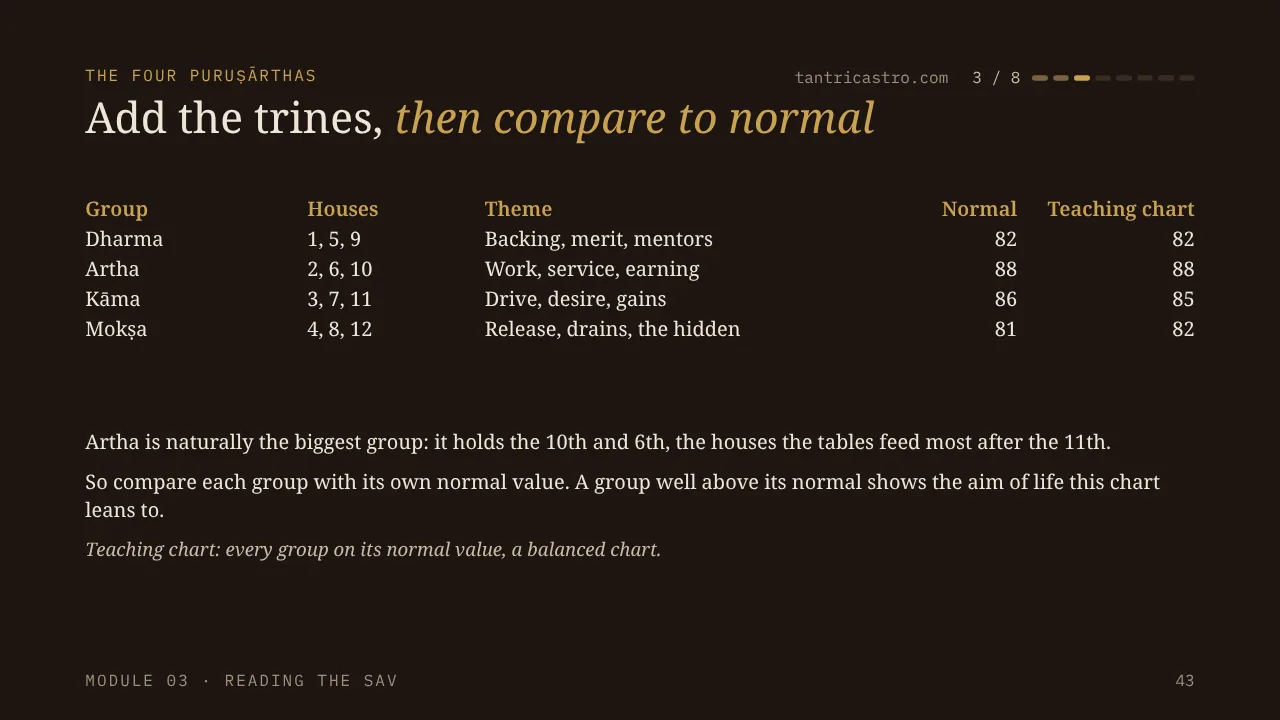
Now the four puruṣārthas, the aims of life. Group the houses into the four trines and add each group’s SAV. Dharma is 1, 5 and 9: backing, merit, mentors. Artha is 2, 6 and 10: work, service, earning. Kāma is 3, 7 and 11: drive, desire, gains. Mokṣa is 4, 8 and 12: release, drains, the hidden side of life. The four always add to 337. Artha is naturally the biggest group, because it holds the 10th and the 6th, the two houses the tables feed most after the 11th.
So never compare the groups with each other directly; compare each one with its own normal value: Dharma about 82, Artha 88, Kāma 86, Mokṣa 81. A group well above its normal shows the aim of life this chart leans towards. Our teaching chart sits right on the normal values: a balanced chart.
| Group | Houses | Theme | Normal | Teaching chart |
|---|---|---|---|---|
| Dharma | 1, 5, 9 | Backing, merit, mentors | 82 | 82 |
| Artha | 2, 6, 10 | Work, service, earning | 88 | 88 |
| Kāma | 3, 7, 11 | Drive, desire, gains | 86 | 85 |
| Mokṣa | 4, 8, 12 | Release, drains, the hidden | 81 | 82 |
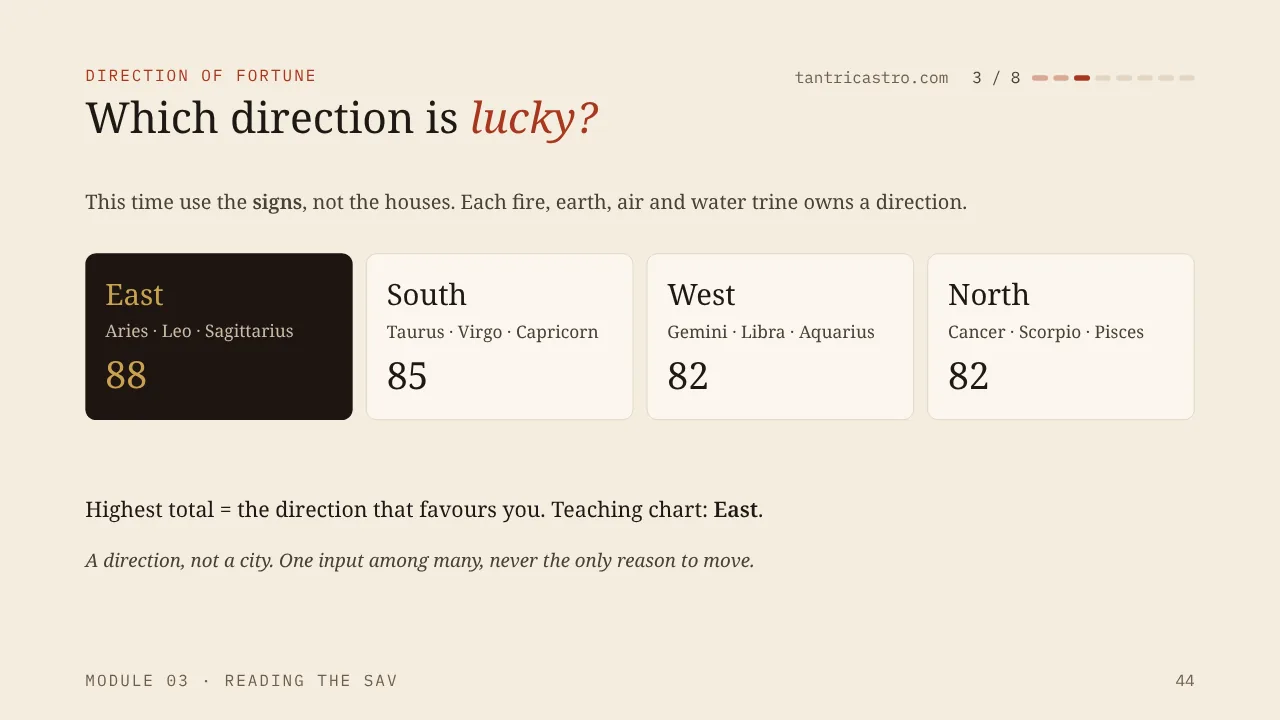
The same idea gives you the direction of fortune, but this time we use the signs of the zodiac, not the houses. The fire signs, Aries, Leo and Sagittarius, belong to the East. The earth signs, Taurus, Virgo and Capricorn, to the South. The air signs, Gemini, Libra and Aquarius, to the West. The water signs, Cancer, Scorpio and Pisces, to the North.
Add the SAV of each trio. The highest total is the direction that favours the person: where to look for opportunity, which way to face a desk, which direction a move tends to go well. Our teaching chart: East 88, South 85, West 82, North 82. East wins. Two cautions. This is a direction, not a specific city. And it is one input among many. Never tell someone to relocate on this alone.
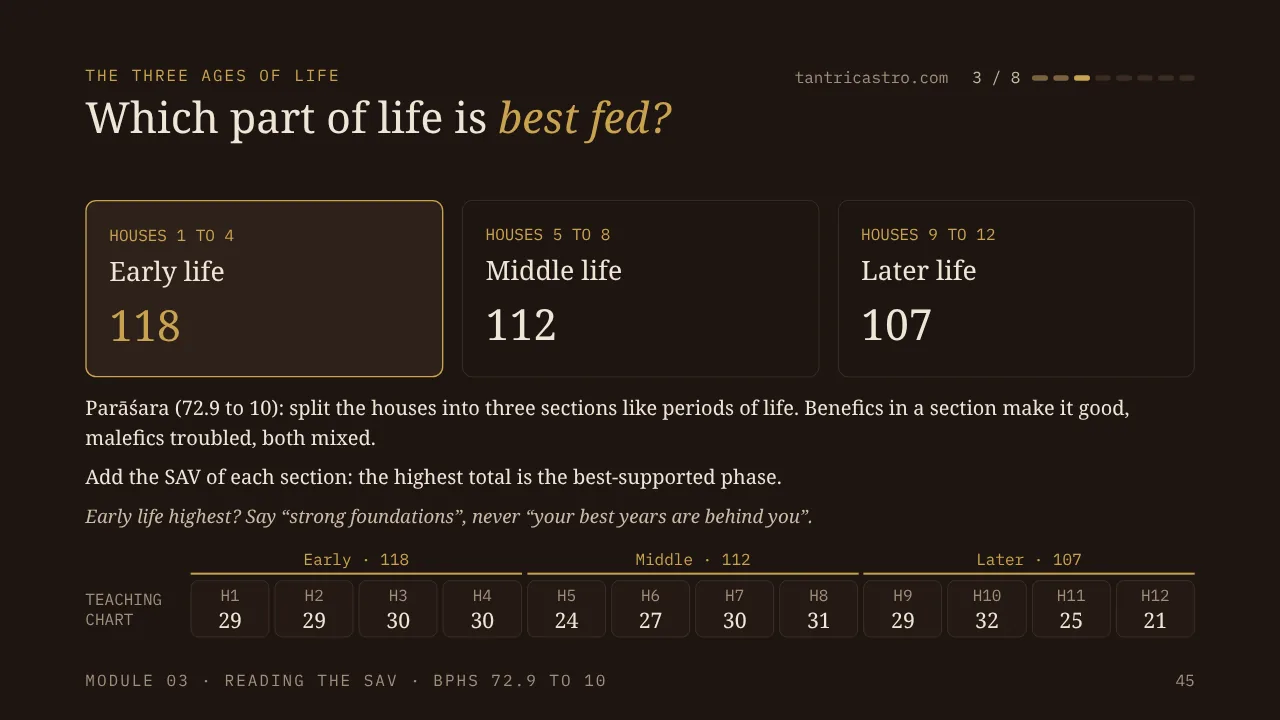
Parāśara gives a way to see which phase of life is best supported. In chapter 72, verses 9 and 10, he says to divide the houses into three sections, like periods of life, childhood, middle life and old age. A section holding benefics is good, one holding malefics is troubled, one with both is mixed. Practically, take houses 1 to 4 as early life, 5 to 8 as middle life, 9 to 12 as later life, and add up the SAV of each section.
Our teaching chart: early life 118, middle 112, later life 107. Early life is the best fed. And here is a rule of kindness, not of astrology. When the early section is the highest, do not tell someone their best years are behind them.
Say they were given strong foundations, and show them which houses they can build on now. Then look at which planets sit in each section to give it its colour.
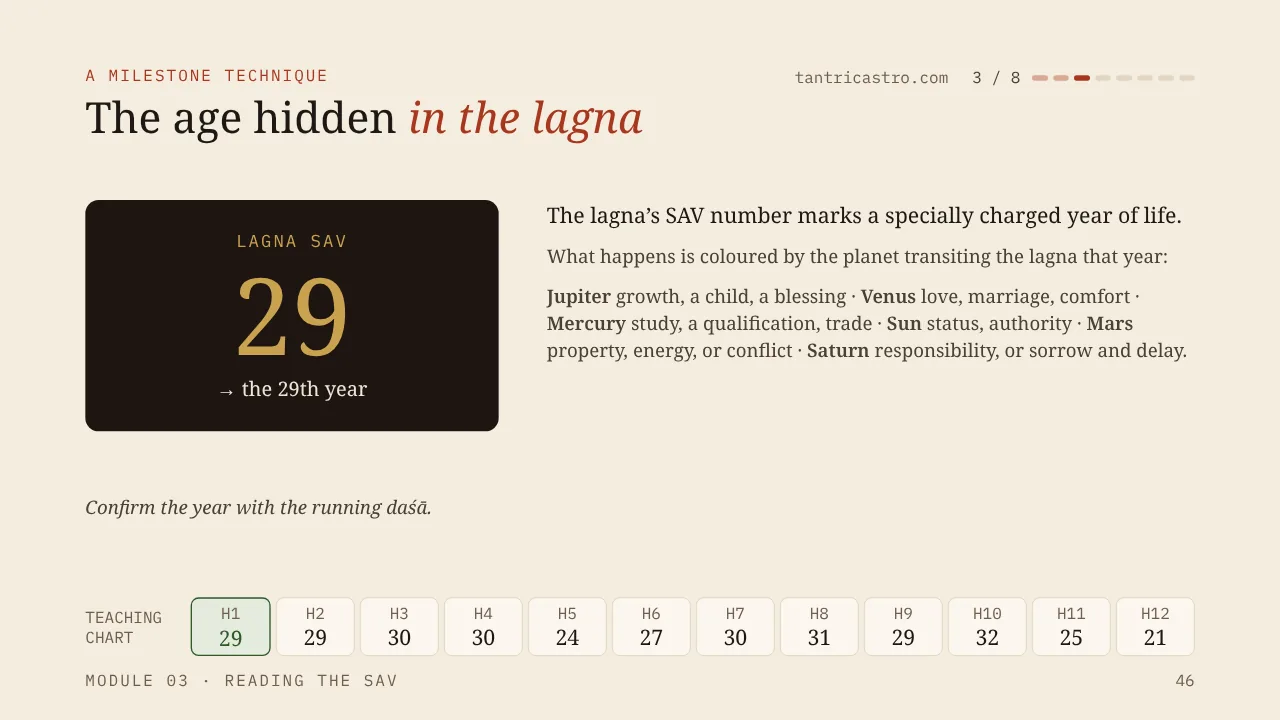
Here is a milestone technique. Take the lagna’s SAV number and read it as an age. Our teaching chart’s lagna has 29 points, so the 29th year of life is flagged as a specially charged year, a turning point. What kind of turning point depends on which planet is transiting the lagna that year. Jupiter brings growth, a child, a blessing.
Venus brings love, marriage, comfort. Mercury brings study, a qualification, trade. The Sun brings status and authority. Mars brings property and energy, but also conflict. Saturn brings responsibility, and sometimes sorrow and delay. If no planet is on the lagna that year, it can still be a personal turning point; check the daśā.
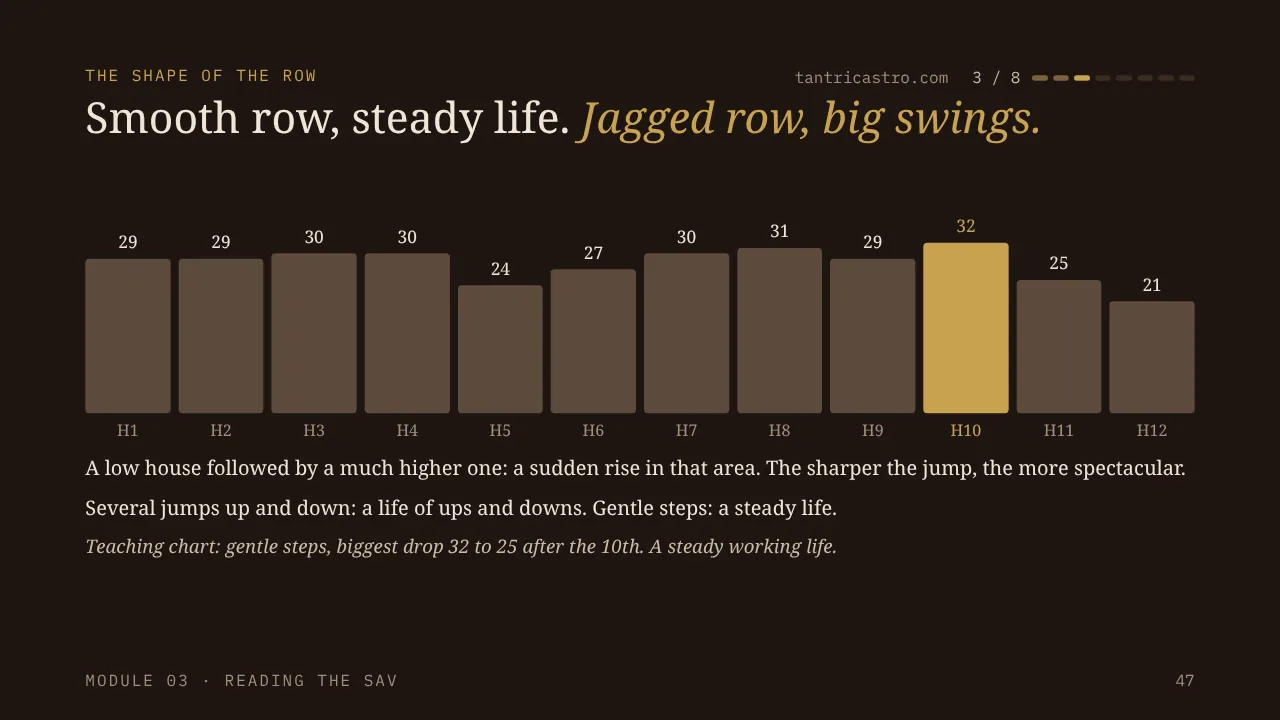
Finally, look at the shape of the whole row, house 1 to house 12. A low house followed by a much higher one shows a sudden rise in the matters of that higher house, and the sharper the jump, the more spectacular the rise. A row with several big jumps up and down shows a life of ups and downs. A row of gentle steps shows a steady life.
Our teaching chart is a row of gentle steps; the biggest change is the drop from 32 in the 10th to 25 in the 11th. That is a steady working life, not a rags-to-riches story. In the case studies coming up you will see rows that look completely different, with jumps of fifteen or twenty points between neighbouring houses, and you will see what those lives looked like.
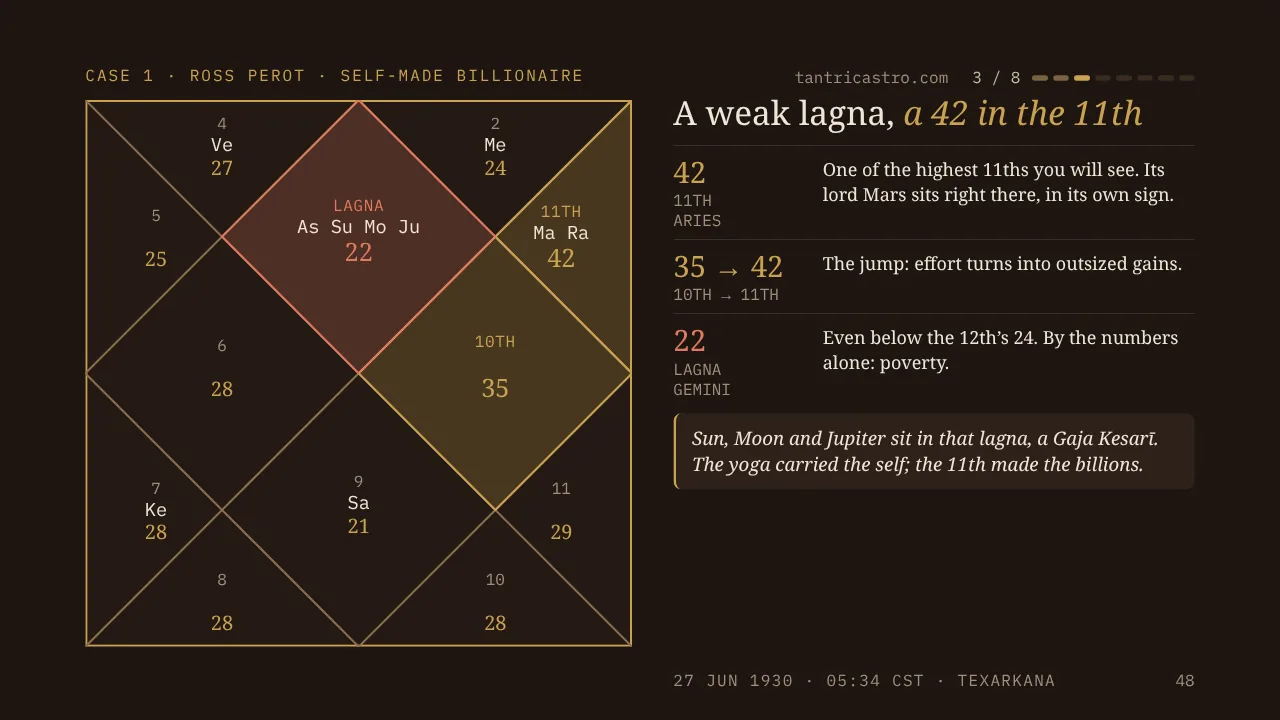
Let’s apply all of this to real lives. Case one, Ross Perot. He grew up in Texarkana, sold computers for IBM, founded EDS, sold it for billions, and later ran for President twice. Here is his chart, Gemini lagna in the top diamond, with the Sun, the Moon and Jupiter sitting in it. The houses I am reading are outlined. The 11th, Aries, on the right: 42. That is one of the highest scores you will ever see, and Mars, the lord of Aries, sits right there in its own sign.
Now the step from the 10th, 35, up to 42: effort turning into outsized gains, the quantum leap. Now the lagna, outlined in red: only 22, even below his 12th house, 24. Read by the numbers alone, that lagna says poverty. So what made him a billionaire? The Sun, the Moon and Jupiter all sit in that Gemini lagna, and Moon with Jupiter makes a Gaja Kesarī yoga.
The lagna was carried by its planets and its yoga, not by its score, and the 11th did the heavy lifting. The number is a witness, not the judge. Always check the lord and the yogas before you condemn a low house.
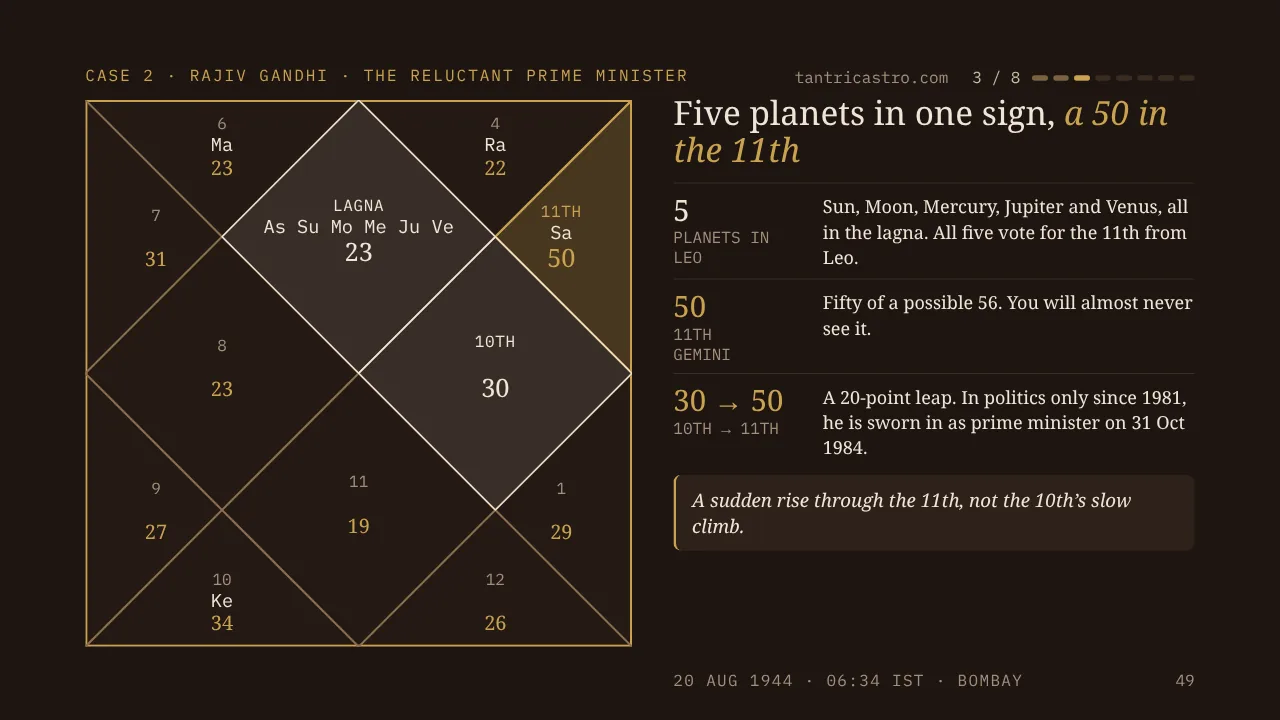
Case two, Rajiv Gandhi, and this one shows two rules at once. Leo lagna in the top diamond, and look how crowded it is: the Sun, the Moon, Mercury, Jupiter and Venus, five planets in one house. First, the cluster trick: all five vote for the 11th sign from Leo, which is Gemini, outlined in gold on the right.
So his 11th house scores 50. Fifty out of a possible fifty-six. You will almost never see that. Second, the quantum leap: his 10th house has 30, ordinary, and then the 11th jumps to 50. Twenty points in one step. Now the life. He was an airline pilot who stayed out of politics until his brother Sanjay died in 1980, and he entered Parliament only in 1981.
On 31 October 1984, after his mother Indira Gandhi was assassinated, he was sworn in as prime minister that same day. That is not the slow climb of the 10th house. That is the 11th house, position and the fulfilment of ambition, arriving all at once.
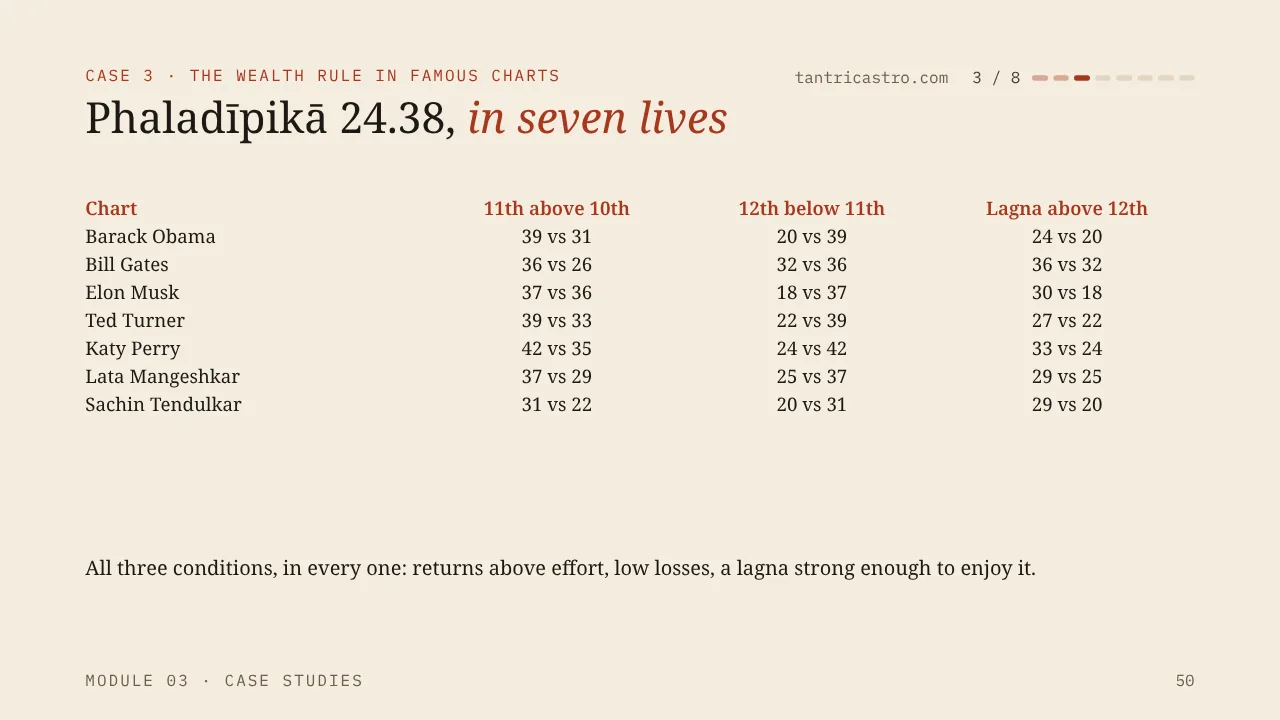
Now Phaladīpikā’s wealth rule, chapter 24, verse 38, in seven famous lives. The rule: the 11th has more points than the 10th, the 12th fewer than the 11th, and the lagna more than the 12th: happy and wealthy. Barack Obama: 11th 39 against 10th 31, 12th only 20, lagna 24 above it.
Bill Gates: 11th 36 against 26, 12th 32 under the 11th, lagna 36 above the 12th. Elon Musk: 37 against 36, a 12th of just 18, lagna 30. Ted Turner: 39 against 33, 12th 22, lagna 27. Katy Perry: 42 against 35, 12th 24, lagna 33. Lata Mangeshkar: 37 against 29, 12th 25, lagna 29. Sachin Tendulkar: 31 against 22, 12th 20, lagna 29.
Every one of them meets all three conditions: the returns are bigger than the effort, the losses are low, and the self is strong enough to enjoy what comes. A president, two of the richest men alive, a media mogul, a pop star, the nightingale of India and the god of cricket, all carrying the same three-line signature in one row of numbers.
| Chart | 11th above 10th | 12th below 11th | Lagna above 12th |
|---|---|---|---|
| Barack Obama | 39 vs 31 | 20 vs 39 | 24 vs 20 |
| Bill Gates | 36 vs 26 | 32 vs 36 | 36 vs 32 |
| Elon Musk | 37 vs 36 | 18 vs 37 | 30 vs 18 |
| Ted Turner | 39 vs 33 | 22 vs 39 | 27 vs 22 |
| Katy Perry | 42 vs 35 | 24 vs 42 | 33 vs 24 |
| Lata Mangeshkar | 37 vs 29 | 25 vs 37 | 29 vs 25 |
| Sachin Tendulkar | 31 vs 22 | 20 vs 31 | 29 vs 20 |
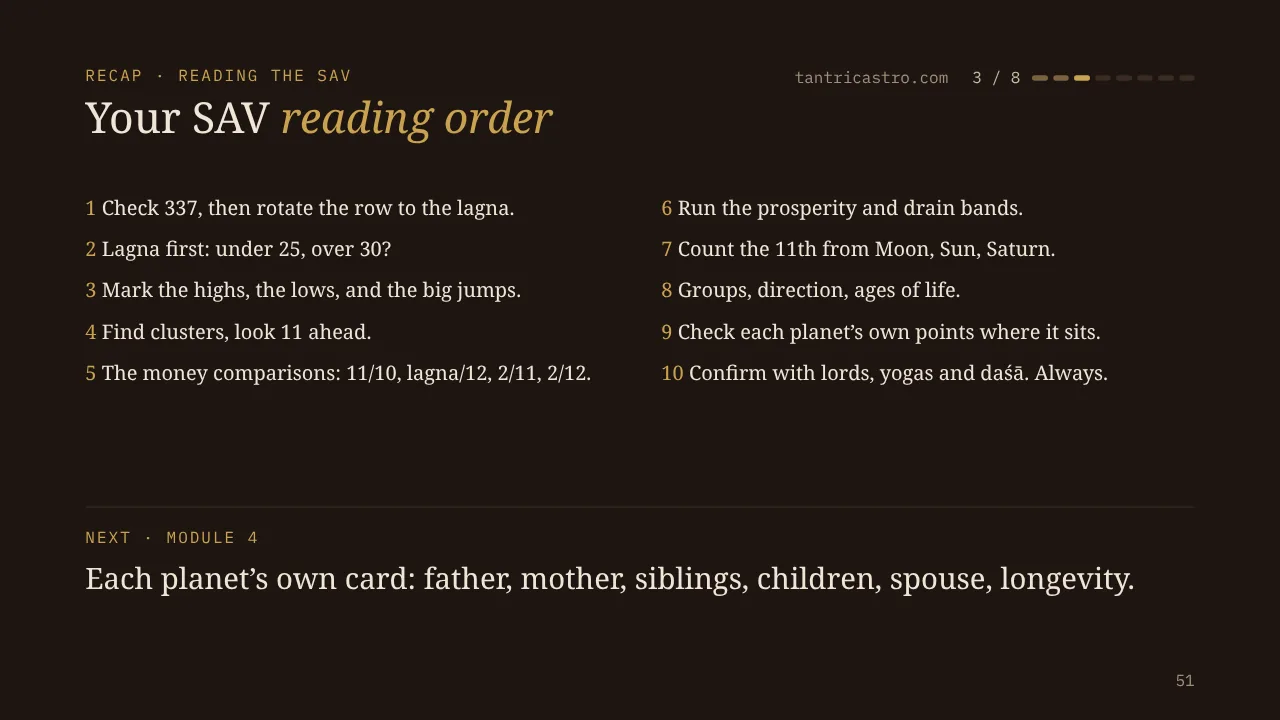
Let’s turn Module 3 into a checklist you can run on any chart. One: check that the SAV adds to 337, then rotate it to start at the lagna. Two: look at the lagna first; is it under 25 or over 30? Three: mark the highest and lowest houses and any big jumps between neighbours.
Four: find any clusters of planets and count eleven ahead. Five: run the four money comparisons, 11th against 10th, lagna against 12th, 2nd against 11th, 2nd against 12th. Six: run the prosperity and drain totals against the typical bands.
Seven: count the 11th from the Moon, the Sun and Saturn to see where gains come from. Eight: the groups, the direction, and the ages of life. Nine: check each planet’s own points in the sign it occupies, points beat dignity. And ten, always: confirm everything with the lords, the yogas and the running daśā before you say a word. In Module 4 we go one level deeper, into each planet’s own card, and read the father, the mother, siblings, children, the spouse and longevity, the way Parāśara lays it out in chapter 70.
Each planet’s own card
Module 4: each planet’s own card and what Parāśara reads from it.
Module four. The SAV is the big picture. Now we go into each planet’s own card, the BAV, and read the people and themes each planet stands for, the way Parāśara lays it out in chapter 70.
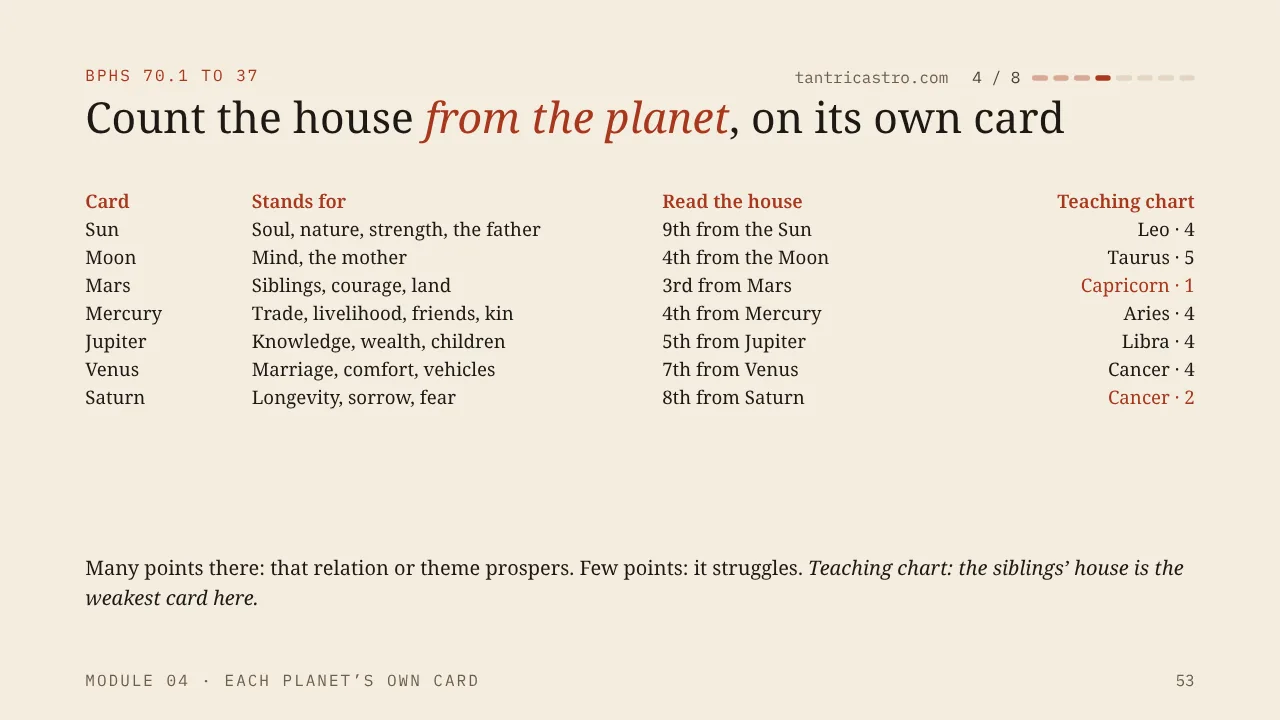
This is the core of chapter 70. Each planet’s card speaks for the things that planet signifies, and you read one particular house counted from the planet itself, on that planet’s own card. The Sun stands for the soul, one’s nature and strength, and the father; read the 9th from the Sun on the Sun’s card. The Moon is the mind and the mother; read the 4th from the Moon on the Moon’s card.
Mars is siblings, courage and land; read the 3rd from Mars. Mercury is trade, livelihood, friends and relatives; read the 4th from Mercury. Jupiter is knowledge, wealth and children; read the 5th from Jupiter. Venus is marriage, comforts and vehicles; read the 7th from Venus. Saturn is longevity, sorrow and fear; read the 8th from Saturn. Many points in that house, the relation or theme prospers; few points, it struggles.
Here is our teaching chart. Most of them sit at four or five, ordinary. Two stand out low: Mars gives only 1 point to the 3rd from itself, so siblings and courage are the weak card, and Saturn gives only 2 to the 8th from itself. Remember this is one layer. Always confirm with the house itself and its lord in the normal chart.
| Card | Stands for | Read the house | Teaching chart |
|---|---|---|---|
| Sun | Soul, nature, strength, the father | 9th from the Sun | Leo · 4 |
| Moon | Mind, the mother | 4th from the Moon | Taurus · 5 |
| Mars | Siblings, courage, land | 3rd from Mars | Capricorn · 1 |
| Mercury | Trade, livelihood, friends, kin | 4th from Mercury | Aries · 4 |
| Jupiter | Knowledge, wealth, children | 5th from Jupiter | Libra · 4 |
| Venus | Marriage, comfort, vehicles | 7th from Venus | Cancer · 4 |
| Saturn | Longevity, sorrow, fear | 8th from Saturn | Cancer · 2 |
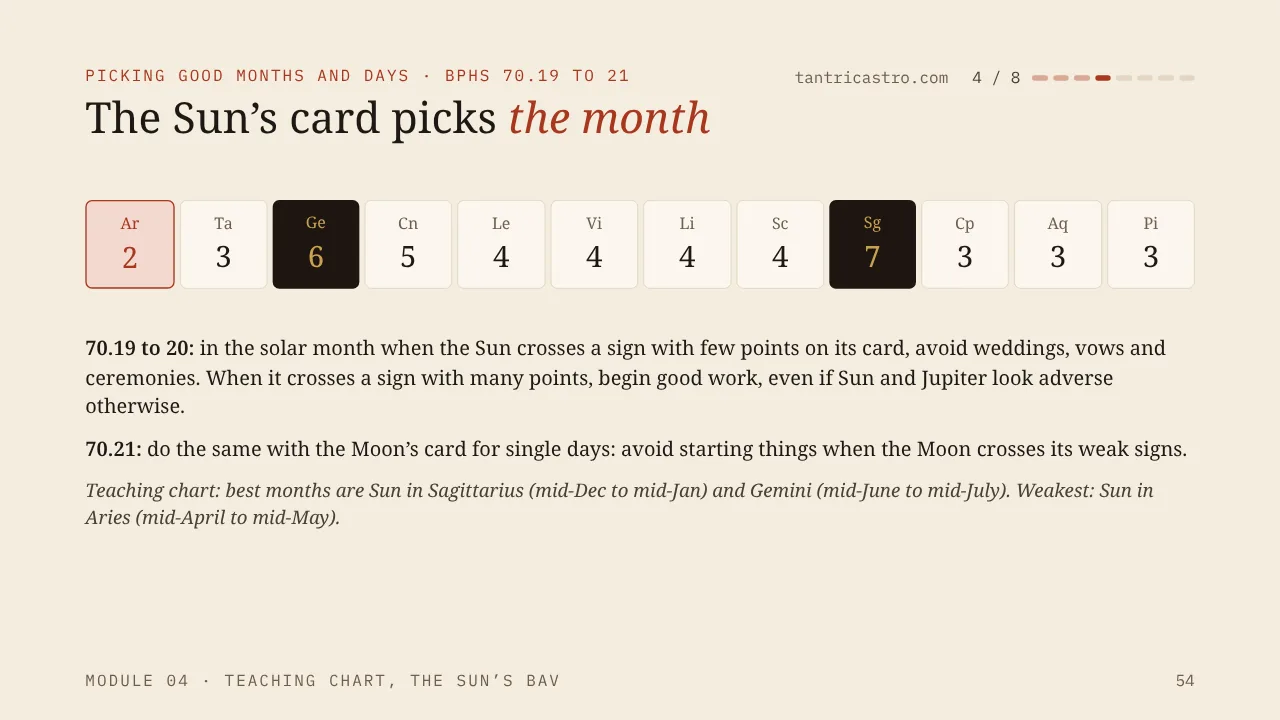
Here is one of the most practical uses of a single planet’s card, straight from chapter 70. The Sun moves through one sign a month, so the Sun’s own card gives you a personal calendar of months. Verse 19: in the month when the Sun crosses a sign that has few points on the native’s Sun card, avoid weddings, vows and ceremonies. Verse 20: in a month when it crosses a sign with many points, begin good work, even if the Sun and Jupiter look adverse by ordinary transit. And verse 21 does the same with the Moon’s card for single days: avoid starting things on days the Moon crosses its weak signs.
Our teaching chart’s Sun card: Sagittarius 7 and Gemini 6 are the best. So the best months to start something are when the Sun is in Sagittarius, roughly mid-December to mid-January, and in Gemini, roughly mid-June to mid-July. The weakest is Aries with 2, roughly mid-April to mid-May. A simple, testable way to time a launch, a signing or a ceremony from the native’s own chart.
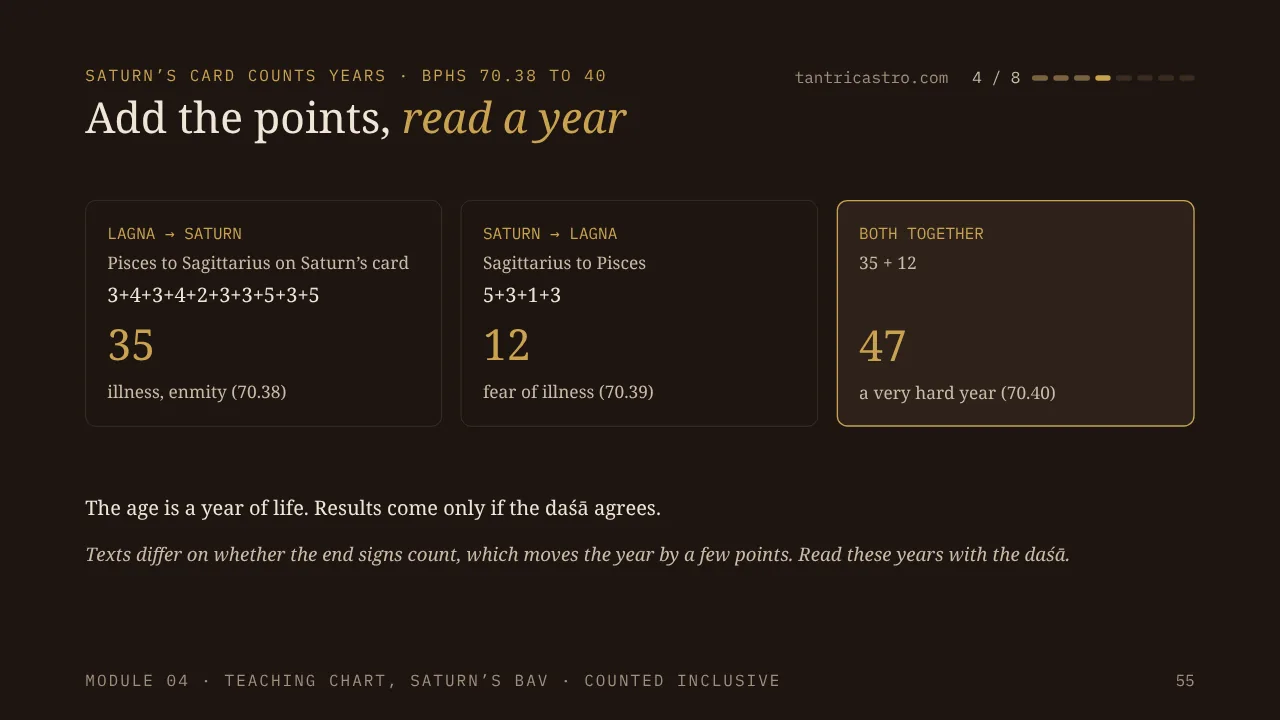
Saturn’s card has a special timing use in chapter 70. Verse 38: on Saturn’s card, add the points of every sign from the lagna up to Saturn; in the year of life equal to that total, there is illness and enmity. Verse 39: add from Saturn back round to the lagna; that year brings fear of illness. Verse 40: add the two totals; that year brings suffering close to death.
Our teaching chart: lagna Pisces, Saturn in Sagittarius. From Pisces to Sagittarius on Saturn’s card: 3, 4, 3, 4, 2, 3, 3, 5, 3, 5, which is 35. From Sagittarius round to Pisces: 5, 3, 1, 3, which is 12. Together, 47. So the 35th, 12th and 47th years are flagged. Two cautions. Texts and teachers differ on whether you count the starting and ending signs, which moves these numbers. And Parāśara himself ties results to the daśā. So read these years together with the daśā, and speak about health with care.
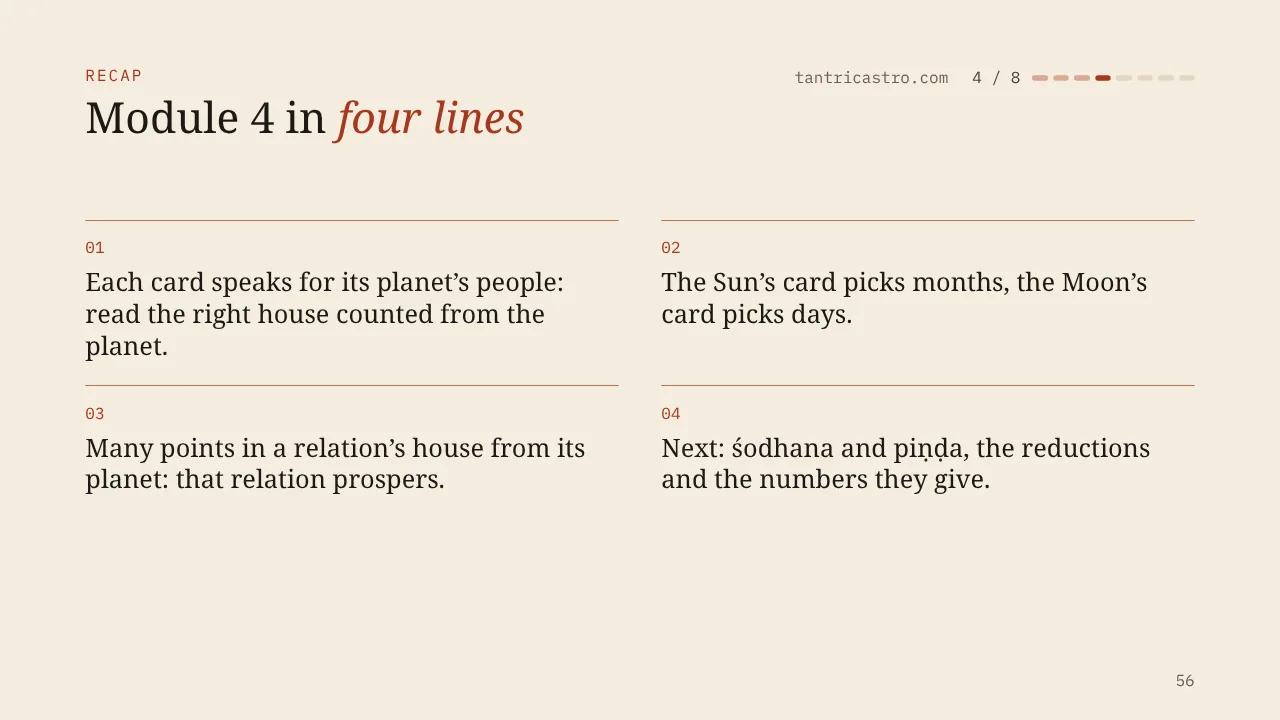
Module 4 in four lines. One: each planet’s card speaks for that planet’s people and themes, and you read the right house counted from the planet itself. Two: the Sun’s card gives you good and bad months, the Moon’s card good and bad days.
Three: many points in a relation’s house counted from its planet, and that relation prospers. Four: next we go into the advanced maths, śodhana and piṇḍa, which Parāśara uses for his most precise timing.
Shodhana and pinda
Module 5: the two reductions, the piṇḍa, and testing what it times.
Module five, the advanced maths. Parāśara cleans each card with two reductions, multiplies what is left, and gets one number per planet called the piṇḍa. Every step is just subtraction and multiplication, so stay with me.
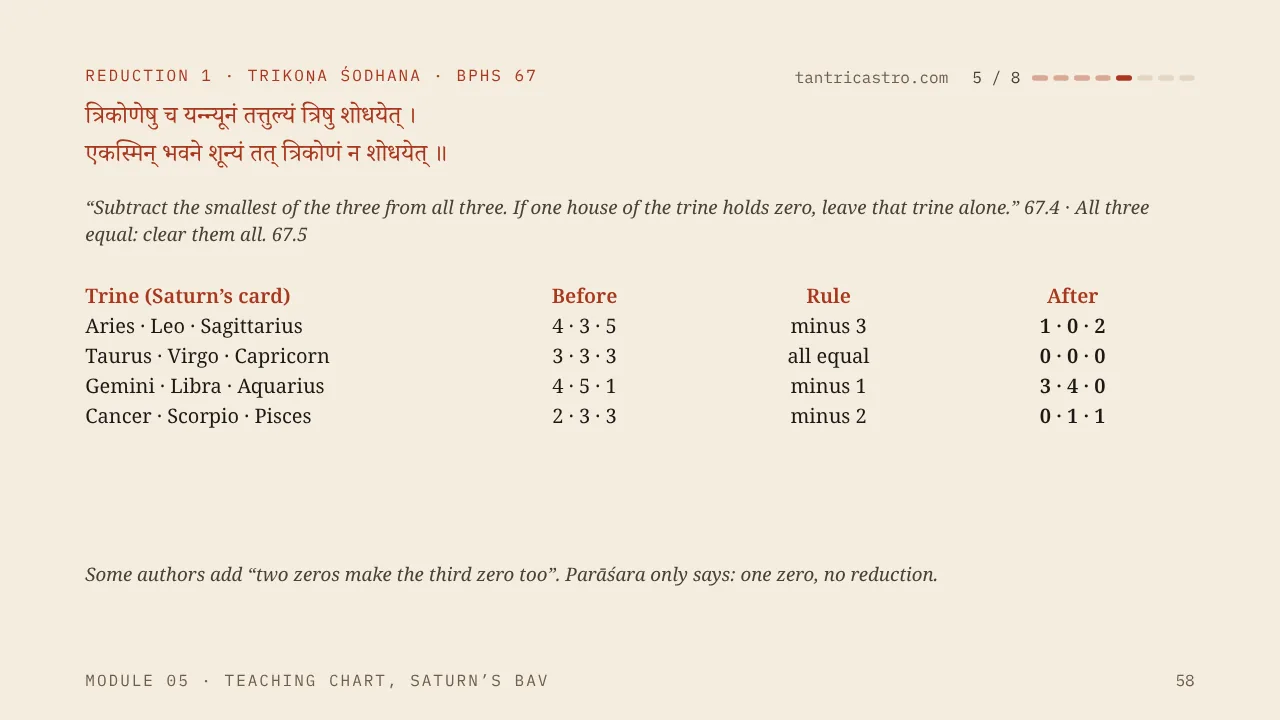
The first reduction is trikoṇa śodhana, the trine reduction, chapter 67. Trikoṇeṣu ca yan nyūnaṁ tat tulyaṁ triṣu śodhayet, ekasmin bhavane śūnyaṁ tat trikoṇaṁ na śodhayet. In each group of three trine signs, find the smallest number and subtract it from all three. But if any one of the three is zero, leave that trine untouched. And verse 5: if all three are equal, clear them all to zero.
The four trines are the fire signs Aries, Leo, Sagittarius; the earth signs Taurus, Virgo, Capricorn; the air signs Gemini, Libra, Aquarius; and the water signs Cancer, Scorpio, Pisces.
Let’s do Saturn’s card. Fire: 4, 3, 5. The smallest is 3, subtract it: 1, 0, 2. Earth: 3, 3, 3. All equal, so all become zero. Air: 4, 5, 1. Subtract 1: 3, 4, 0. Water: 2, 3, 3. Subtract 2: 0, 1, 1. That is it. One note: some later authors say that if two signs of a trine are zero, the third becomes zero too. Parāśara does not say that; he only says one zero means no reduction, so we follow him.
| Trine (Saturn’s card) | Before | Rule | After |
|---|---|---|---|
| Aries · Leo · Sagittarius | 4 · 3 · 5 | minus 3 | 1 · 0 · 2 |
| Taurus · Virgo · Capricorn | 3 · 3 · 3 | all equal | 0 · 0 · 0 |
| Gemini · Libra · Aquarius | 4 · 5 · 1 | minus 1 | 3 · 4 · 0 |
| Cancer · Scorpio · Pisces | 2 · 3 · 3 | minus 2 | 0 · 1 · 1 |
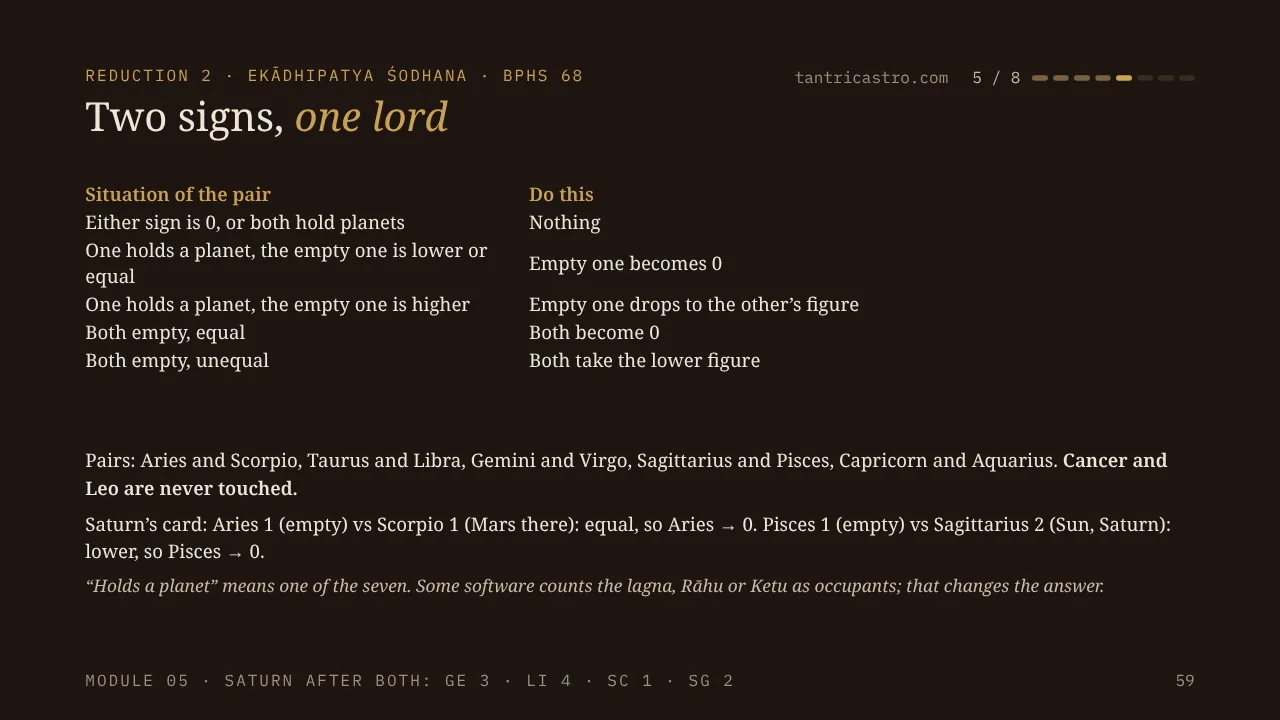
The second reduction, ekādhipatya, chapter 68, deals with signs that share one lord: Aries and Scorpio for Mars, Taurus and Libra for Venus, Gemini and Virgo for Mercury, Sagittarius and Pisces for Jupiter, Capricorn and Aquarius for Saturn. Cancer and Leo have their own single lords, so they are never touched.
Take each pair, after the trine reduction. If either sign is already zero, or both signs hold planets, do nothing. If one holds a planet and the empty one has a lower or equal figure, the empty one becomes zero. If the empty one is higher, it comes down to the other’s figure.
If both are empty and equal, both become zero; both empty and unequal, both take the lower figure. Saturn’s card. Aries has 1 and is empty; Scorpio has 1 and holds Mars. Equal, one occupied, so Aries goes to zero. Sagittarius has 2 with the Sun and Saturn; Pisces has 1 and is empty. Pisces is lower, so it goes to zero. The other pairs have a zero already.
So Saturn’s cleaned card is Gemini 3, Libra 4, Scorpio 1, Sagittarius 2. One warning: occupied means one of the seven planets. Some software counts the lagna, Rāhu or Ketu as occupants, and that changes the result, so check what your software does.
| Situation of the pair | Do this |
|---|---|
| Either sign is 0, or both hold planets | Nothing |
| One holds a planet, the empty one is lower or equal | Empty one becomes 0 |
| One holds a planet, the empty one is higher | Empty one drops to the other’s figure |
| Both empty, equal | Both become 0 |
| Both empty, unequal | Both take the lower figure |
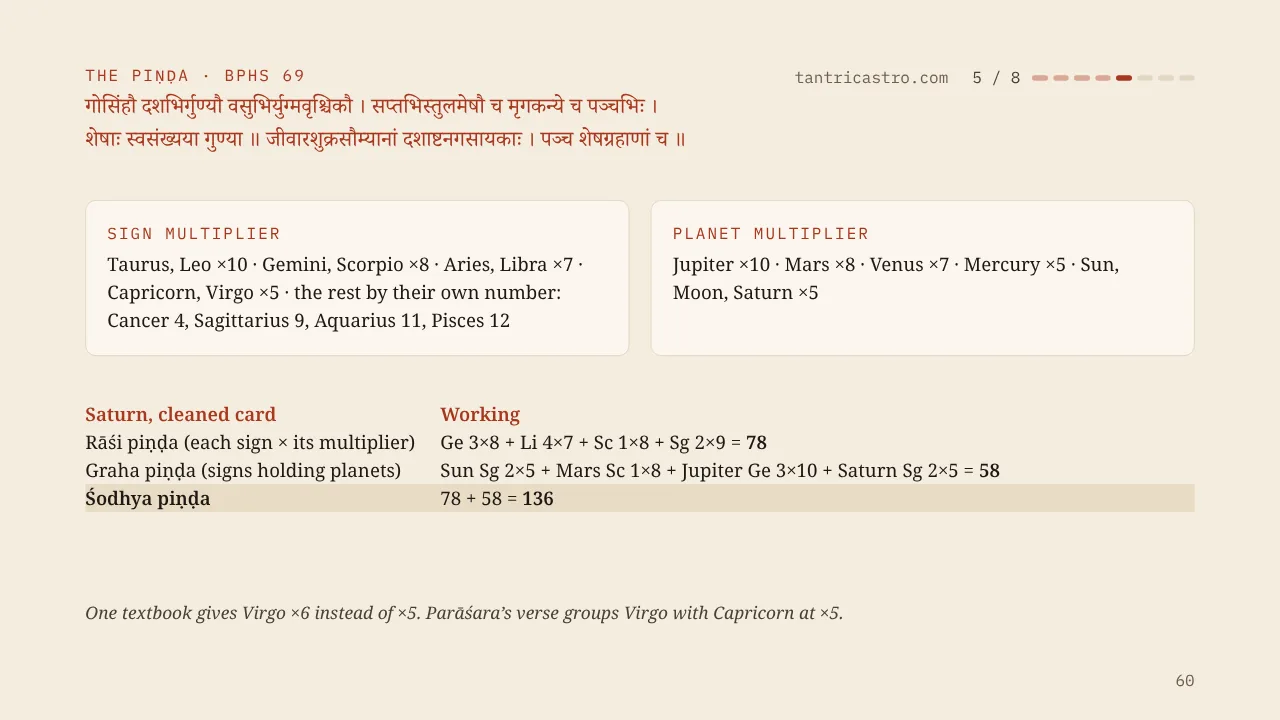
Now the piṇḍa, chapter 69. Parāśara gives two sets of multipliers in verse. Gosiṁhau daśabhir guṇyau, vasubhir yugma vṛścikau: Taurus and Leo times ten, Gemini and Scorpio times eight. Saptabhis tula meṣau ca, mṛga kanye ca pañcabhiḥ: Libra and Aries times seven, Capricorn and Virgo times five. Śeṣāḥ svasaṅkhyayā guṇyā: the rest by their own number, Cancer four, Sagittarius nine, Aquarius eleven, Pisces twelve.
Then the planets: jīva āra śukra saumyānāṁ daśa aṣṭa naga sāyakāḥ, pañca śeṣa grahāṇāṁ ca: Jupiter ten, Mars eight, Venus seven, Mercury five, and five for the rest. Step one, the rāśi piṇḍa: multiply each sign’s cleaned figure by the sign multiplier and add. Saturn’s card: Gemini 3 times 8 is 24, Libra 4 times 7 is 28, Scorpio 1 times 8 is 8, Sagittarius 2 times 9 is 18. Total 78.
Step two, the graha piṇḍa: for each sign that holds a planet, multiply its cleaned figure by that planet’s multiplier. The Sun in Sagittarius: 2 times 5 is 10. Mars in Scorpio: 1 times 8 is 8. Jupiter in Gemini: 3 times 10 is 30. Saturn in Sagittarius: 2 times 5 is 10. The others sit on zeros. Total 58.
Add them: 136. That is Saturn’s śodhya piṇḍa. One textbook gives Virgo times six; Parāśara’s verse clearly puts Virgo with Capricorn at five, so we use five.
| Saturn, cleaned card | Working |
|---|---|
| Rāśi piṇḍa (each sign × its multiplier) | Ge 3×8 + Li 4×7 + Sc 1×8 + Sg 2×9 = 78 |
| Graha piṇḍa (signs holding planets) | Sun Sg 2×5 + Mars Sc 1×8 + Jupiter Ge 3×10 + Saturn Sg 2×5 = 58 |
| Śodhya piṇḍa | 78 + 58 = 136 |
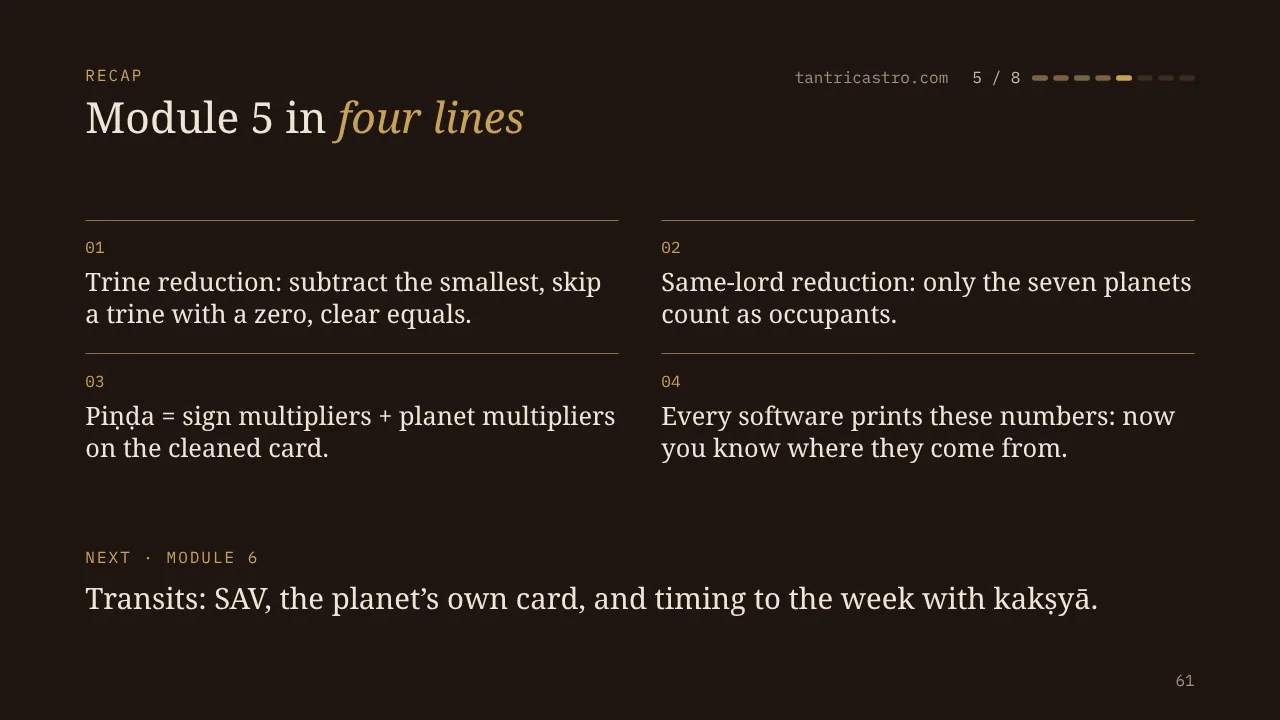
Module 5 in four lines. One: the trine reduction subtracts the smallest of three, skips any trine with a zero, and clears a trine of equals. Two: the same-lord reduction works on the five pairs, and only the seven planets count as occupants.
Three: the piṇḍa is the cleaned card multiplied by the sign multipliers, plus the planet multipliers for occupied signs. Four: every software prints these numbers, and now you know exactly where they come from. Now, transits. Module 6.
Transits and timing
Module 6: judging transits, kakṣyā timing and Sāḍe Sātī on real lives.
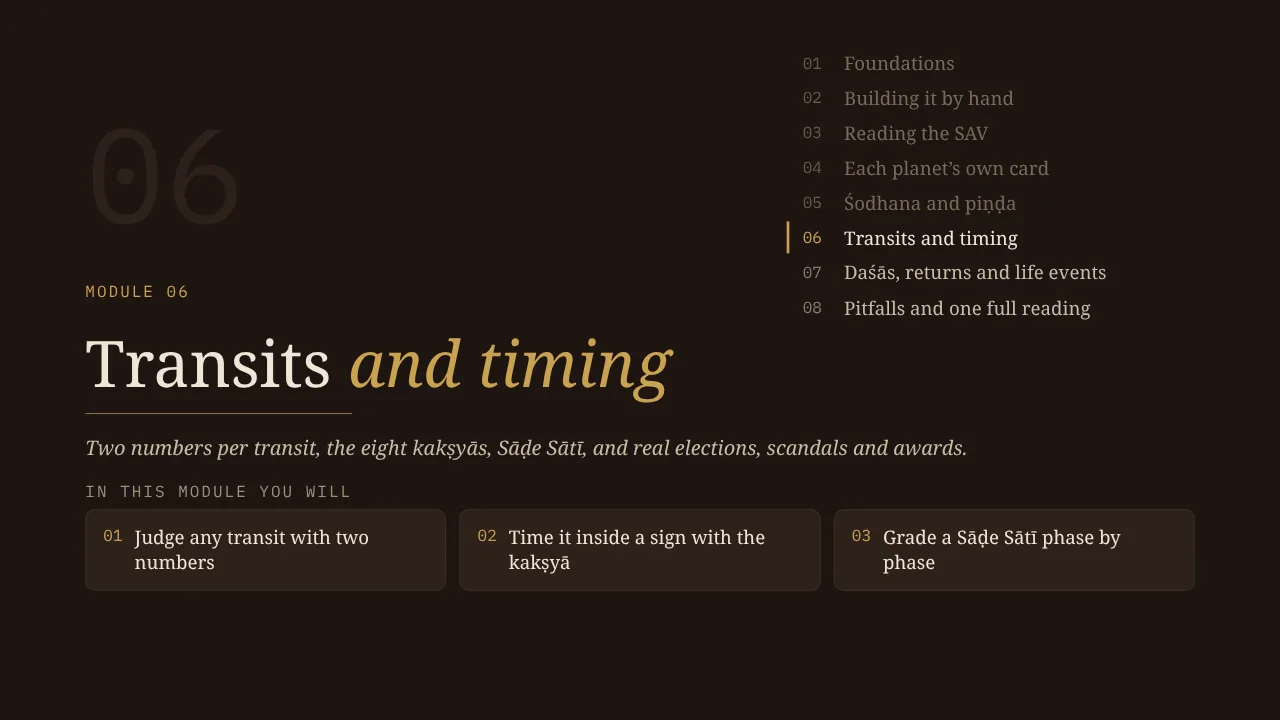
Module six. This is where aṣṭakavarga earns its reputation: judging transits. Two numbers per transit, the kakṣyās for timing within a sign, Sāḍe Sātī done properly, and then real elections, scandals and awards.
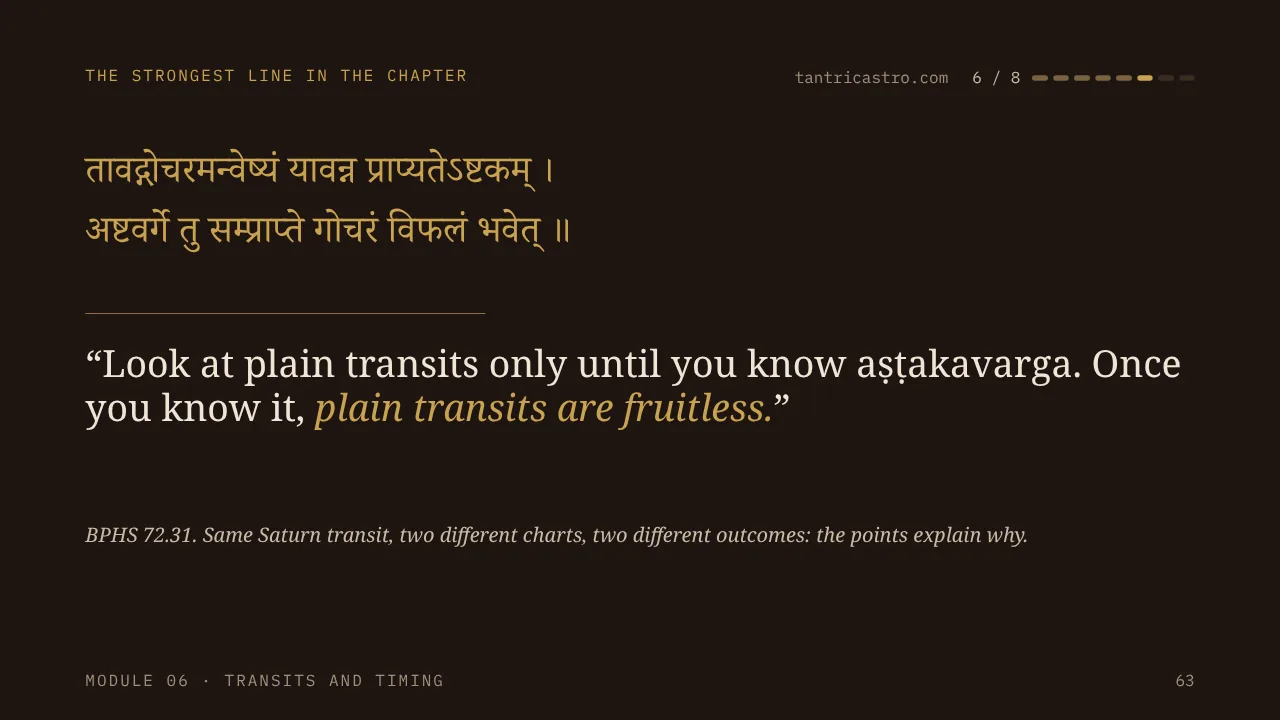
Now the strongest line in the chapter. It is the last verse of chapter 72. Tāvad gocaram anveṣyaṁ yāvan na prāpyate ’ṣṭakam. Aṣṭavarge tu samprāpte gocaraṁ viphalaṁ bhavet. Study plain transits only until you have the aṣṭakavarga. Once you have it, plain transits are fruitless. That is a strong statement from Parāśara.
Plain transit rules say Saturn in the 8th from the Moon is bad, full stop. But you and I both know people who sailed through that transit and people who were crushed by it. Aṣṭakavarga is what explains the difference: how many points that sign actually holds in that person’s chart. That is what this module teaches you to do. Here is the method.
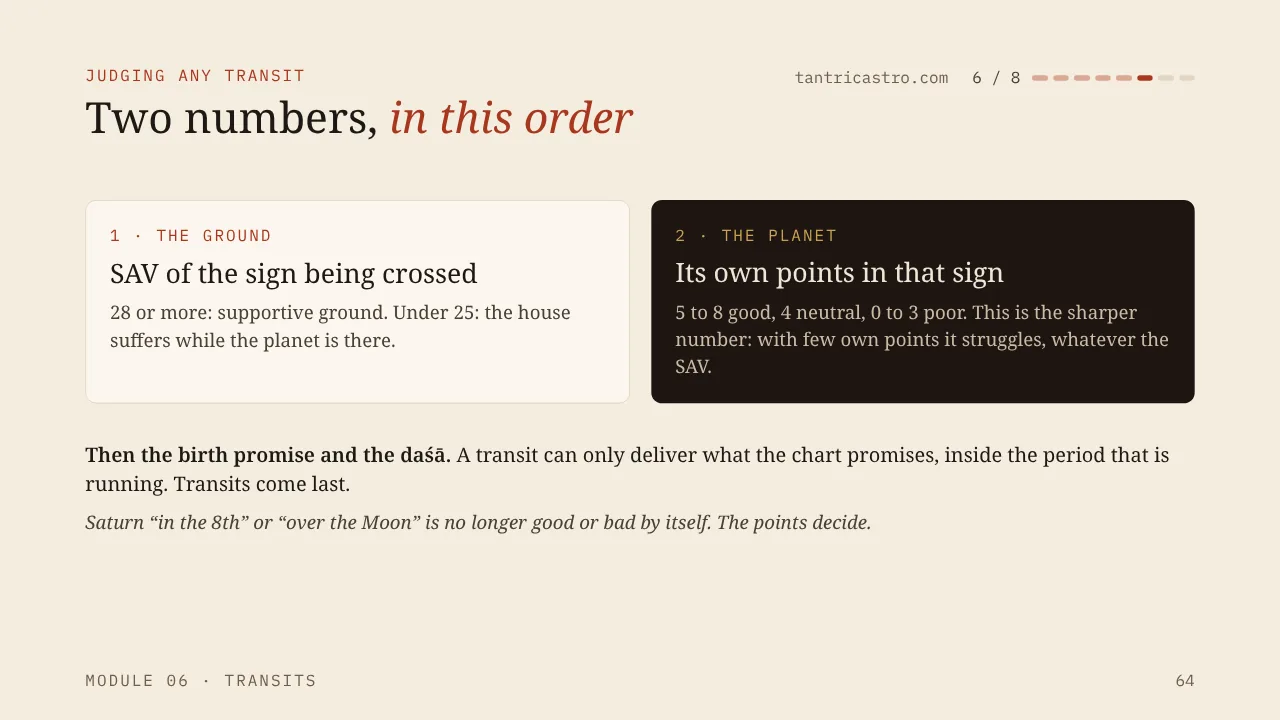
Here is the method for judging any transit, and it uses two numbers. First, the ground: the SAV of the sign the planet is crossing. Twenty-eight or more is supportive ground; under twenty-five, the matters of that house suffer while the planet is there.
Second, and sharper: the transiting planet’s own points in that sign, on its own card. Five to eight is good, four neutral, zero to three poor. If a planet has few points of its own in a sign, it struggles there no matter how good the SAV is.
Then two checks before you say anything. The birth promise: a transit can only deliver what the natal chart promises. And the daśā: transits work inside the running period. Transits come last. This is exactly why Parāśara said plain transit rules become fruitless once you know aṣṭakavarga. Saturn in the 8th, or Saturn over the Moon, is no longer good or bad by itself. The points decide.
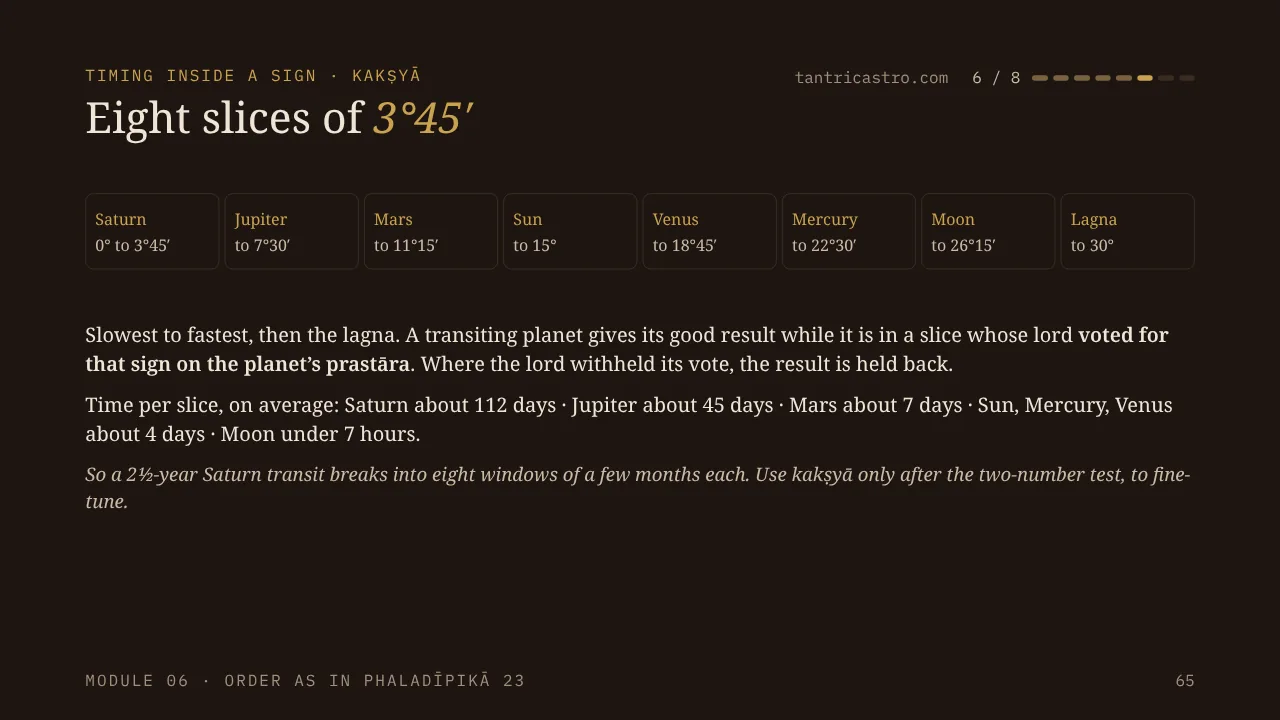
Now the timing tool that makes aṣṭakavarga special: the kakṣyā. Every sign is divided into eight equal slices of three degrees forty-five minutes. Each slice has a lord, in the order of the planets from slowest to fastest, then the lagna. Saturn rules 0 to 3 degrees 45. Jupiter to 7 degrees 30. Mars to 11 degrees 15. The Sun to 15. Venus to 18 degrees 45. Mercury to 22 degrees 30. The Moon to 26 degrees 15. And the lagna to 30. This order is given in Phaladīpikā.
Here is the rule. A transiting planet gives its good result while it moves through a slice whose lord voted for that sign on the planet’s own prastāra, the grid we built in Module 2. Where that lord withheld its vote, the result is held back. How long is each slice?
On average Saturn spends about 112 days in one, Jupiter about 45 days, Mars about a week, the Sun, Mercury and Venus about four days, the Moon under seven hours. So a two and a half year Saturn transit breaks into eight windows of a few months each. Use kakṣyā after the two-number test, to fine-tune, never instead of it.
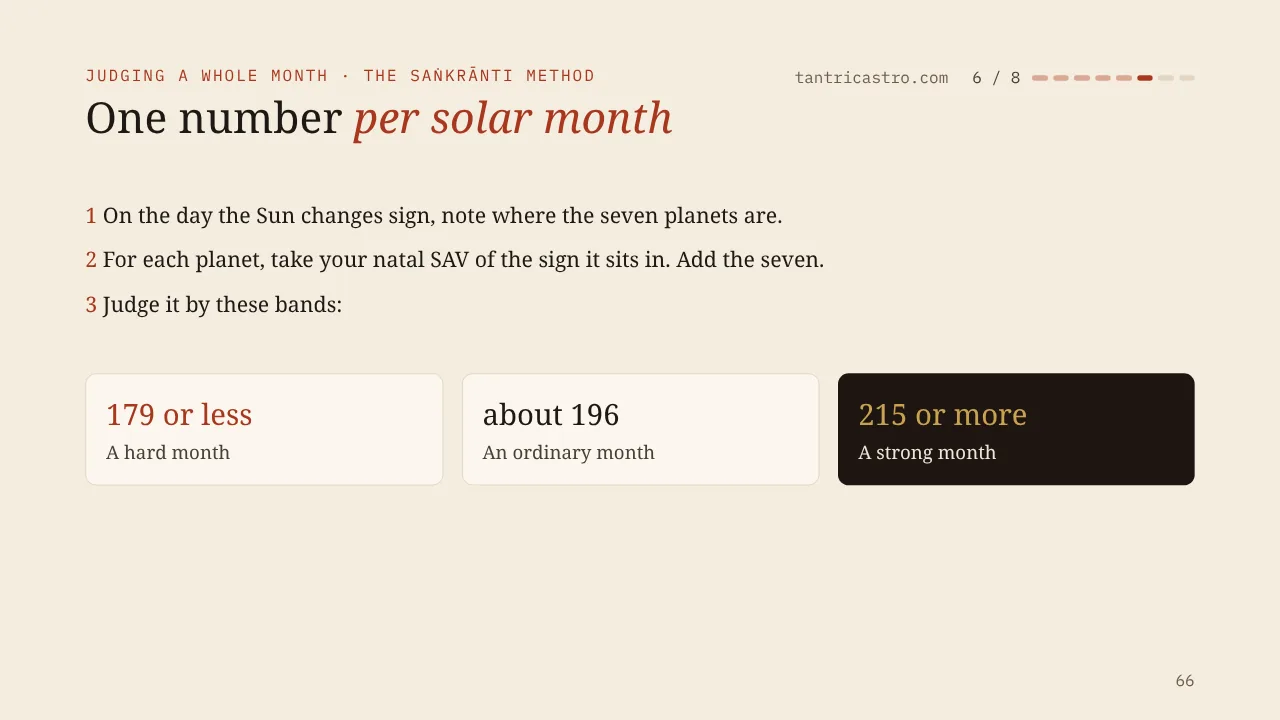
Here is a quick way to judge a whole month. The solar month starts on the Saṅkrānti, the day the Sun changes sign. On that day, note where all seven planets are. For each planet, look up your own natal SAV of the sign it is sitting in, and add the seven numbers. That total judges the month. An ordinary month scores about 196. 179 or less is a hard month: postpone what you can. 215 or more is a strong month: launch, sign, begin.
For a specific matter, also check its kāraka: for career and authority, the Sun, with the two-number test on the sign it enters.
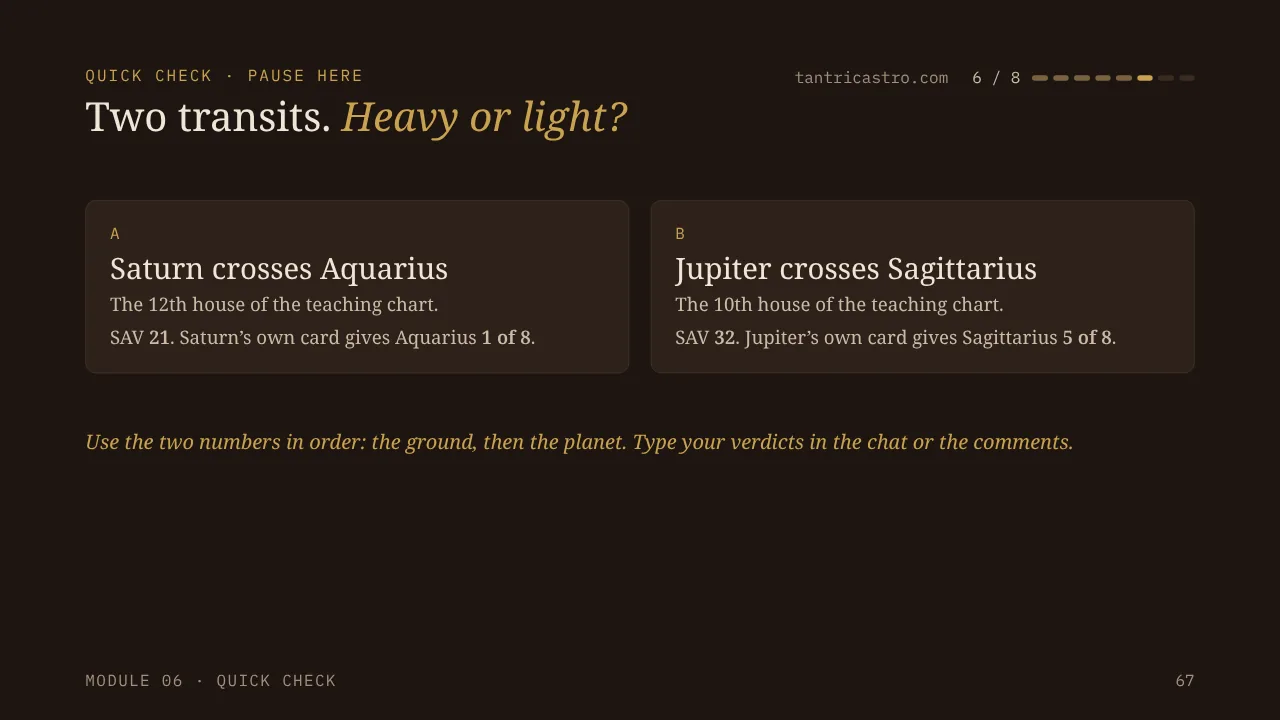
Quick check. A: Saturn crossing Aquarius, the 12th house. The SAV is 21, and Saturn’s own card gives Aquarius one point. B: Jupiter crossing Sagittarius, the 10th house. The SAV is 32, and Jupiter’s own card gives Sagittarius five. Heavy or light?
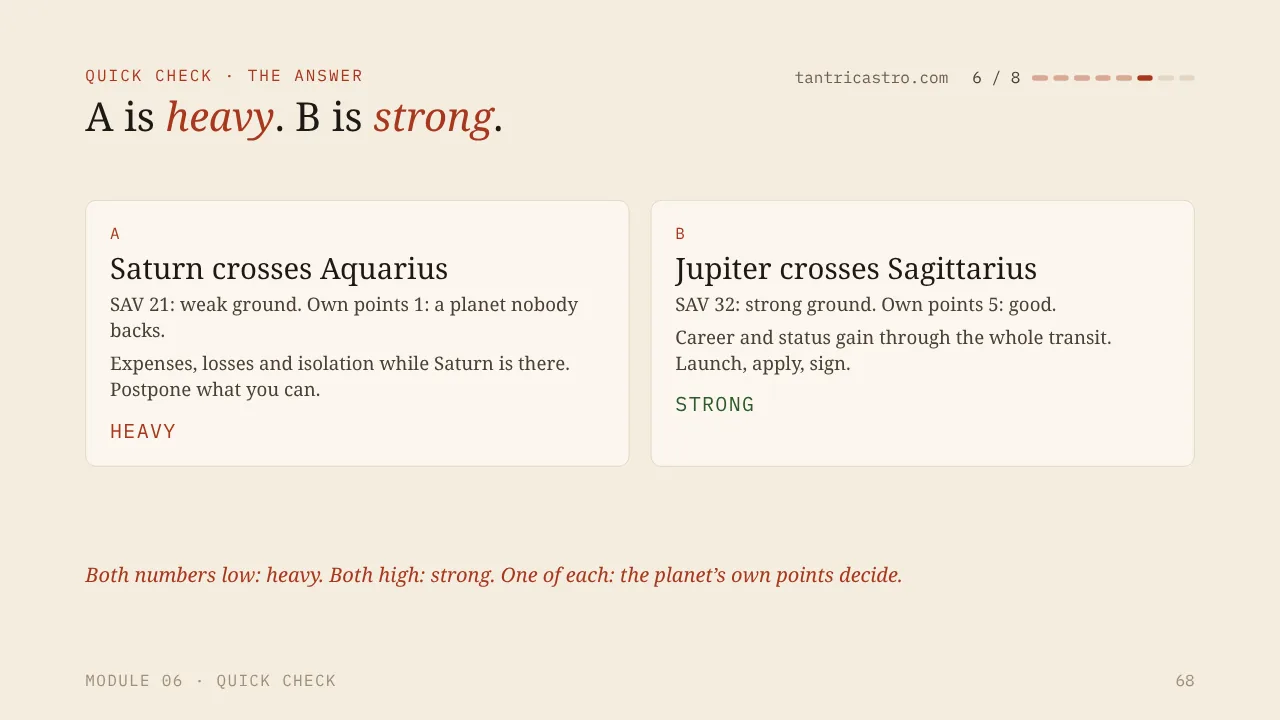
A is heavy. The ground is 21, weak, and Saturn’s own points are 1, a planet nobody backs: expenses, losses and isolation for the whole stretch, so postpone what you can. B is strong. The ground is 32 and Jupiter has five of its own: career and status gain through the whole transit, so launch, apply, sign. Both numbers low, heavy. Both high, strong. One of each, the planet’s own points decide.
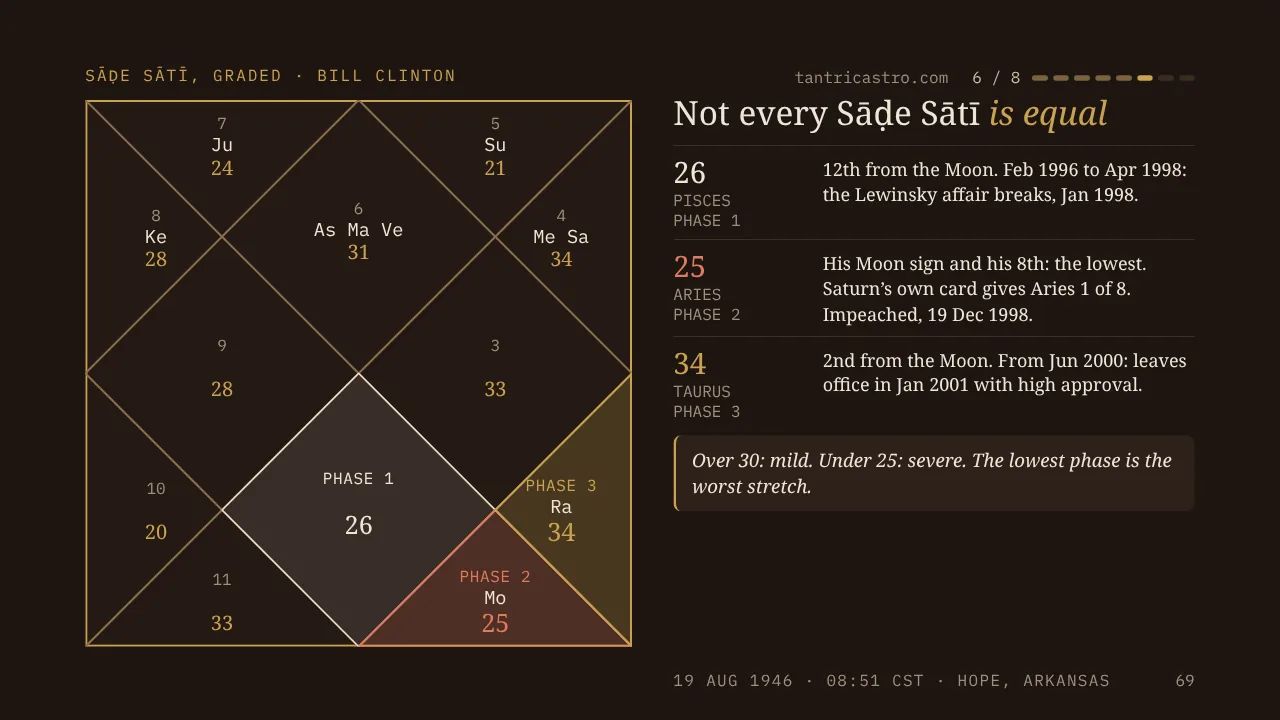
Sāḍe Sātī, Saturn’s seven and a half years over the Moon, terrifies people. Aṣṭakavarga grades it. Read the SAV of the three signs Saturn crosses: the 12th from the Moon, the Moon’s own sign, and the 2nd from the Moon. A phase over thirty is mild; under twenty-five is severe; and the lowest of the three is the worst stretch.
Bill Clinton’s chart: Virgo lagna, and his Moon in Aries, his 8th house. The three phases are outlined. Phase one, Pisces, 26: Saturn crossed it from February 1996 to April 1998, and in January 1998 the Lewinsky affair broke. Phase two, Aries, his Moon sign, only 25, the lowest of the three, outlined in red, and Saturn’s own card gives Aries just 1 point out of 8.
Aries is also his 8th house, exposure and scandal. Saturn stayed there from April 1998 to June 2000, and on 19 December 1998 he was impeached, with Saturn at 3 degrees of Aries, in the Saturn slice, and Saturn had withheld its own vote from Aries. He was acquitted in February 1999, but the whole Aries stretch was the hardest of his presidency.
Phase three, Taurus, 34: Saturn entered it in June 2000, and in January 2001 he left office with very high approval. The same Sāḍe Sātī, three very different phases, and the numbers line up with the life.
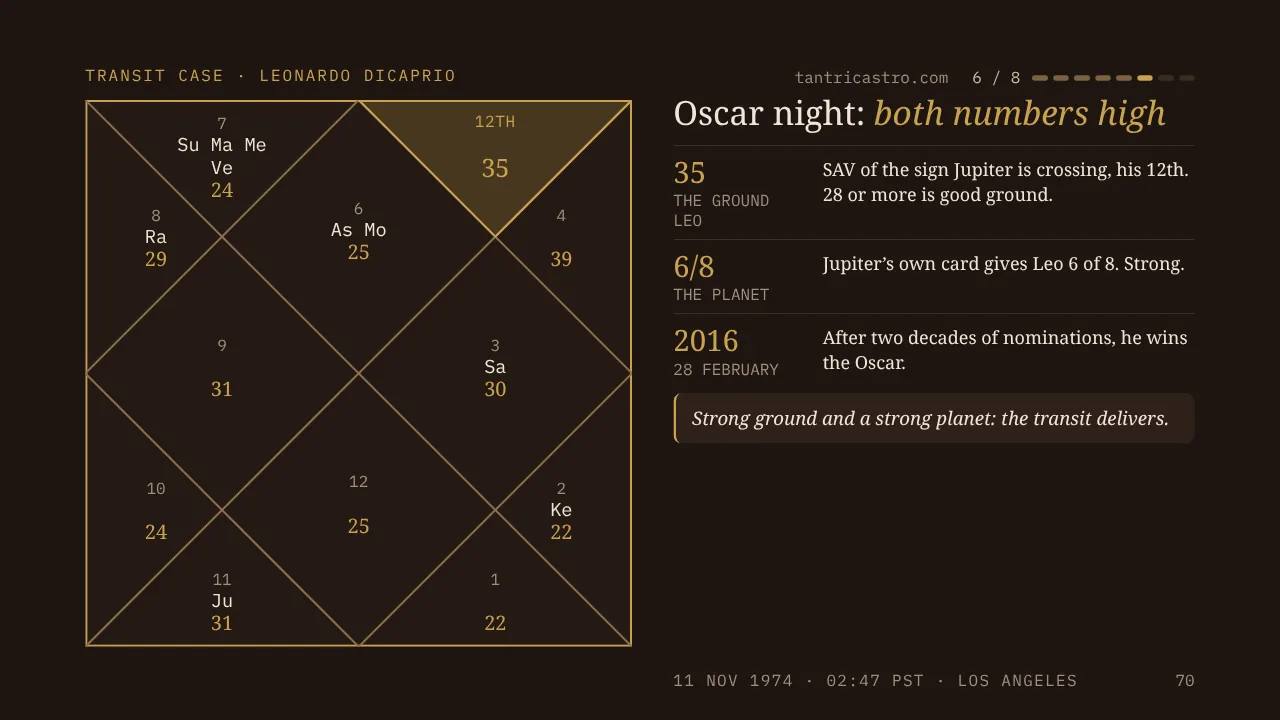
Now the two-number test on a famous day. Leonardo DiCaprio’s chart, Virgo lagna. Find Leo, his 12th house, outlined in gold at the top right: 35 points in his SAV. That is the ground. Now the planet: on Jupiter’s own card, Leo has 6 out of 8. Strong ground and a strong planet.
On 28 February 2016, with Jupiter crossing exactly that sign, he finally won the Oscar he had been chasing for two decades.
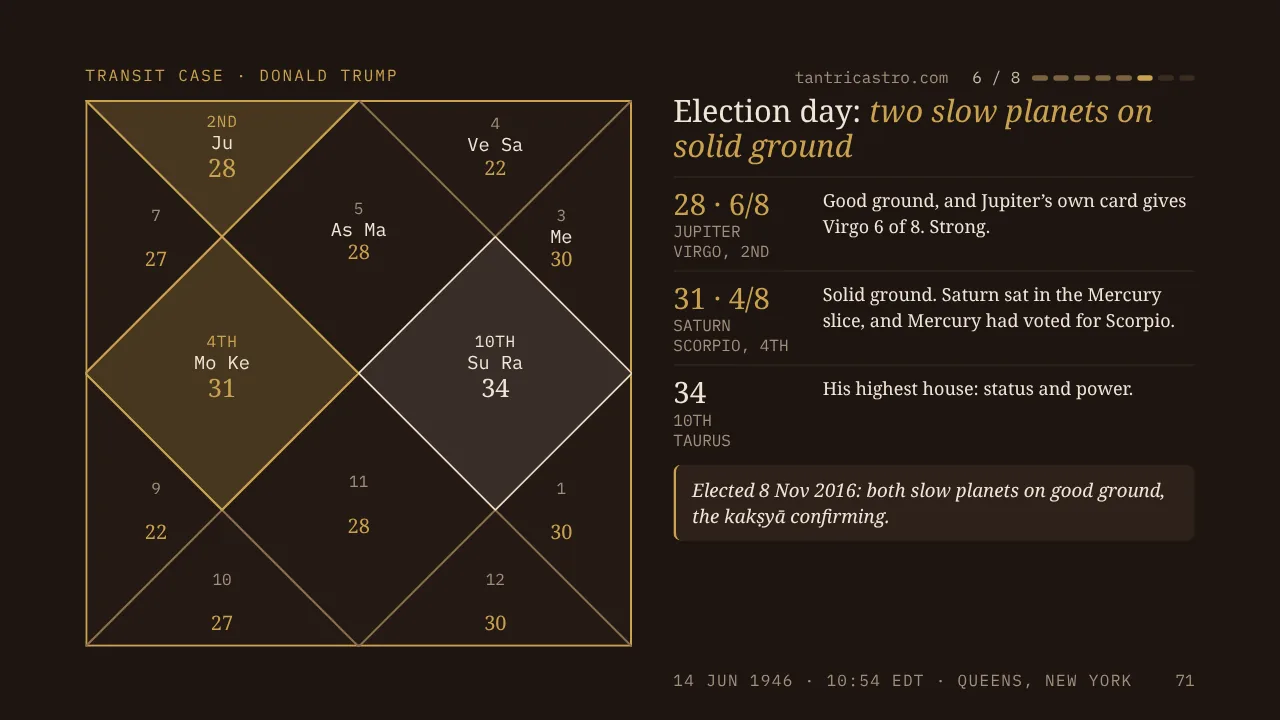
Donald Trump’s chart, Leo lagna. His highest house is the 10th, Taurus, with 34: status and power. On election day, 8 November 2016, the two slow planets were here, both outlined. Jupiter in Virgo, his 2nd: SAV 28, and Jupiter’s own card gives Virgo 6 out of 8. Strong. Saturn in Scorpio, his 4th: SAV 31, Saturn’s own points 4. And the kakṣyā: at that degree Saturn was inside the Mercury slice, and Mercury had voted for Scorpio on Saturn’s card. Both slow planets on solid ground, the kakṣyā confirming. A clean win.
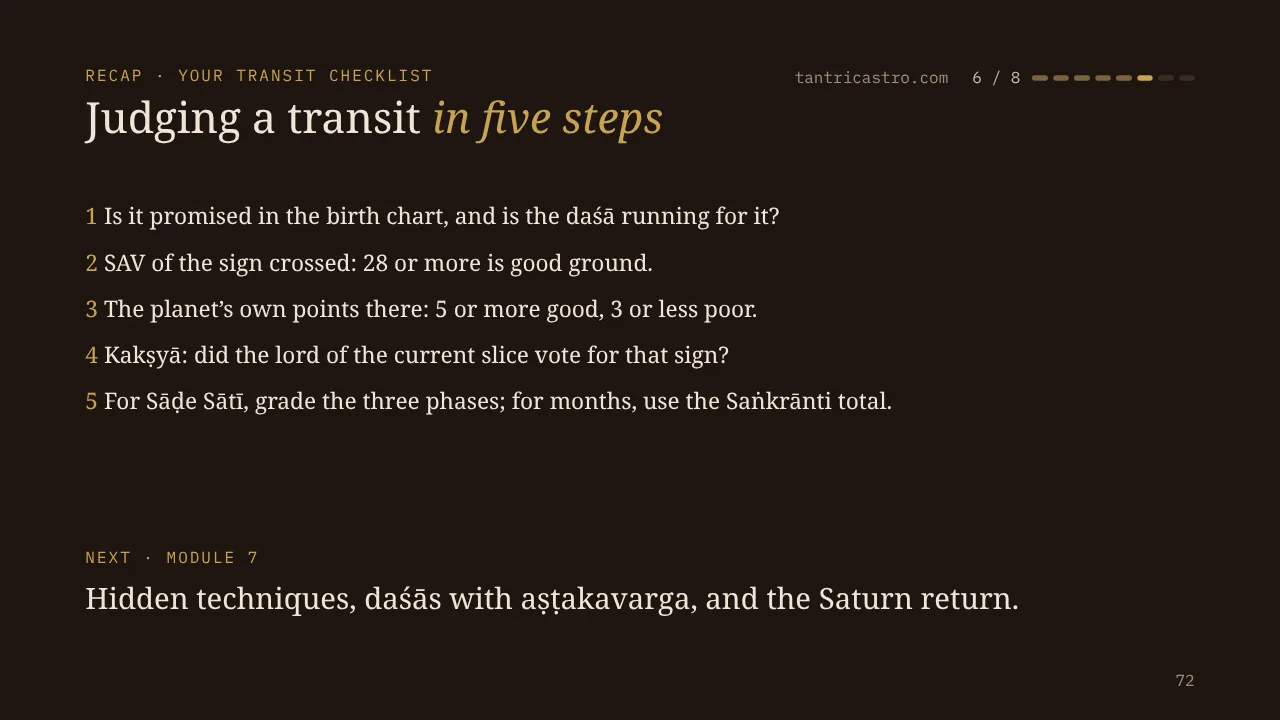
Your transit checklist. One: is the event promised in the birth chart, and is the daśā running for it? Without that, no transit produces it. Two: the SAV of the sign being crossed; twenty-eight or more is good ground. Three: the planet’s own points there; five or more good, three or less poor.
Four: the kakṣyā; did the lord of the current slice vote for that sign? Five: for Sāḍe Sātī, grade the three phases separately; for a month, add the Saṅkrānti total and compare with the bands. Next, Module 7: the hidden techniques, aṣṭakavarga joined to the daśās, and the Saturn return.
Dashas, returns and life events
Module 7: hidden techniques, daśās with aṣṭakavarga, returns, and timing sorrow and joy.
Module seven. The hidden techniques, then aṣṭakavarga joined to the daśās, Vimśottarī and Nārāyaṇa, then the Saturn return, and finally a method for timing sorrow and joy. Real charts all the way.
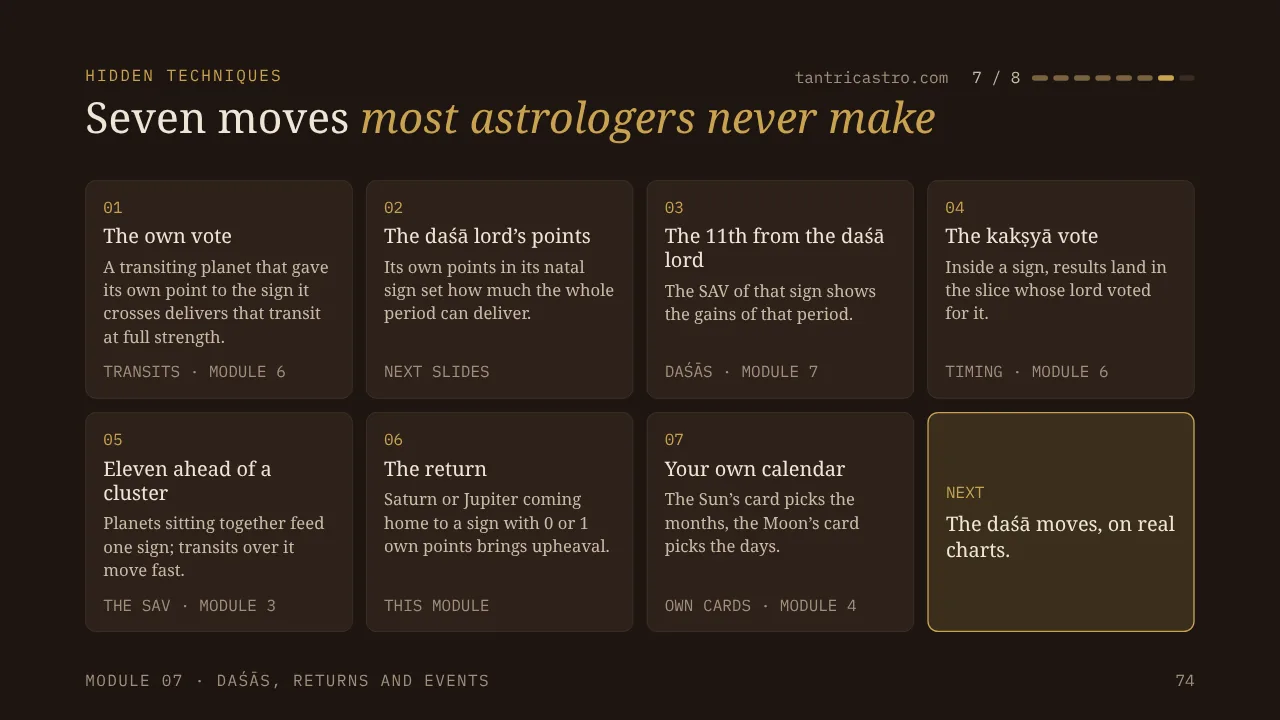
Seven moves most astrologers never make with aṣṭakavarga. One, the own vote: when a transiting planet gave its own point to the sign it is crossing, on its own prastāra, that transit delivers at full strength. Two, the daśā lord’s points: the daśā lord’s own points in the sign it sits in at birth set how much that entire period can deliver.
Three, the 11th from the daśā lord: count eleven signs from the daśā lord, and the SAV of that sign shows the gains of that period. Four, the kakṣyā vote: inside a sign, results land while the planet is in the slice whose lord voted for that sign.
Five, eleven ahead of a cluster: planets sitting together all feed the 11th sign from them, and transits over it move fast. Six, the return: when Saturn or Jupiter comes back to its own natal sign, and that sign carries zero or one of its own points, expect upheaval.
Seven, your own calendar: the Sun’s card picks your good and bad months, the Moon’s card your good and bad days. Now let’s put the daśā moves on real charts.
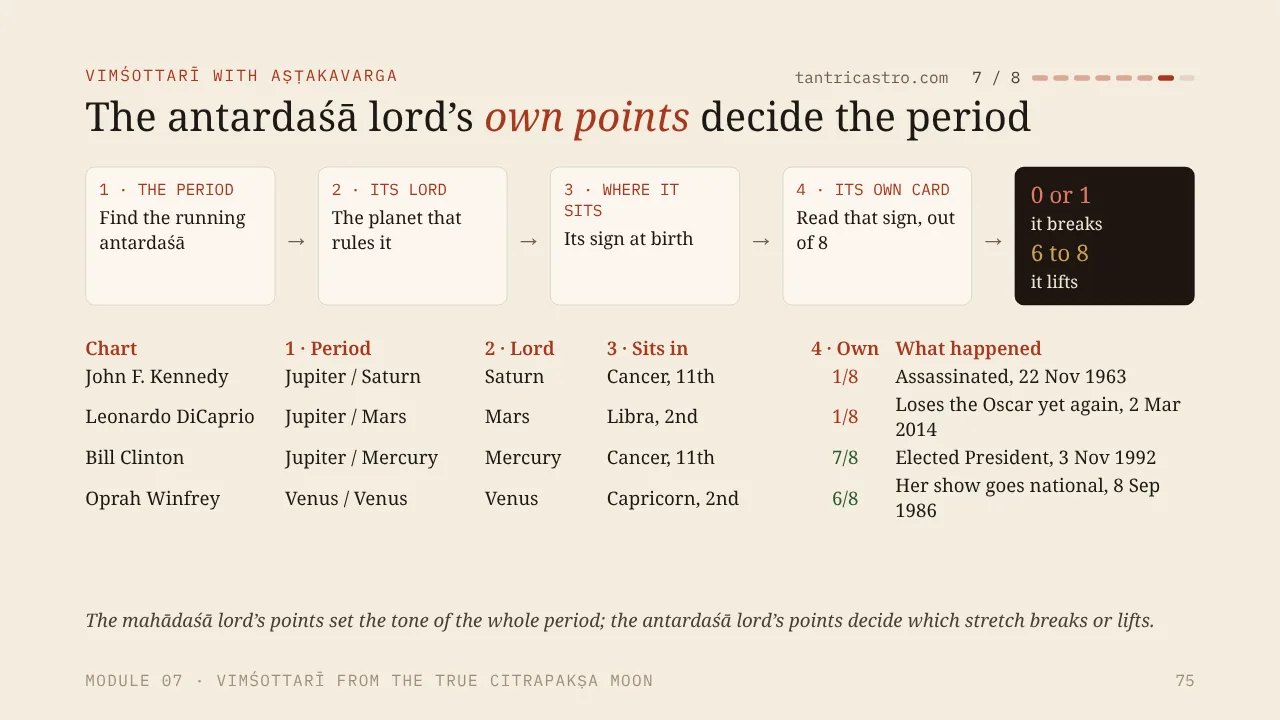
Here is the daśā move that changes how you read every period. Follow the chain on the slide. One, find the running antardaśā. Two, take its lord. Three, find where that lord sits at birth. Four, open that lord’s own card and read that sign, out of 8. Zero or one point: that sub-period breaks something. Six to eight: it lifts.
John F. Kennedy: on 22 November 1963 he was running Jupiter mahādaśā, Saturn antardaśā. His Saturn sits in Cancer, and Saturn’s own card gives Cancer just one point. He was assassinated in Dallas that day. Leonardo DiCaprio: on 2 March 2014 he was running Jupiter, Mars. His Mars sits in Libra with one point. He lost the Oscar yet again, for The Wolf of Wall Street.
Now the other side. Bill Clinton on 3 November 1992: Jupiter mahādaśā, Mercury antardaśā. His Mercury sits in Cancer with seven points, and his Jupiter in Libra with seven too. He was elected President of the United States.
Oprah Winfrey on 8 September 1986: Venus mahādaśā, Venus antardaśā, and her Venus sits in Capricorn with six points. That is the day her show went national. So the mahādaśā lord’s points set the tone of the whole period, and the antardaśā lord’s points decide which stretch breaks or lifts.
| Chart | 1 · Period | 2 · Lord | 3 · Sits in | 4 · Own | What happened |
|---|---|---|---|---|---|
| John F. Kennedy | Jupiter / Saturn | Saturn | Cancer, 11th | 1/8 | Assassinated, 22 Nov 1963 |
| Leonardo DiCaprio | Jupiter / Mars | Mars | Libra, 2nd | 1/8 | Loses the Oscar yet again, 2 Mar 2014 |
| Bill Clinton | Jupiter / Mercury | Mercury | Cancer, 11th | 7/8 | Elected President, 3 Nov 1992 |
| Oprah Winfrey | Venus / Venus | Venus | Capricorn, 2nd | 6/8 | Her show goes national, 8 Sep 1986 |
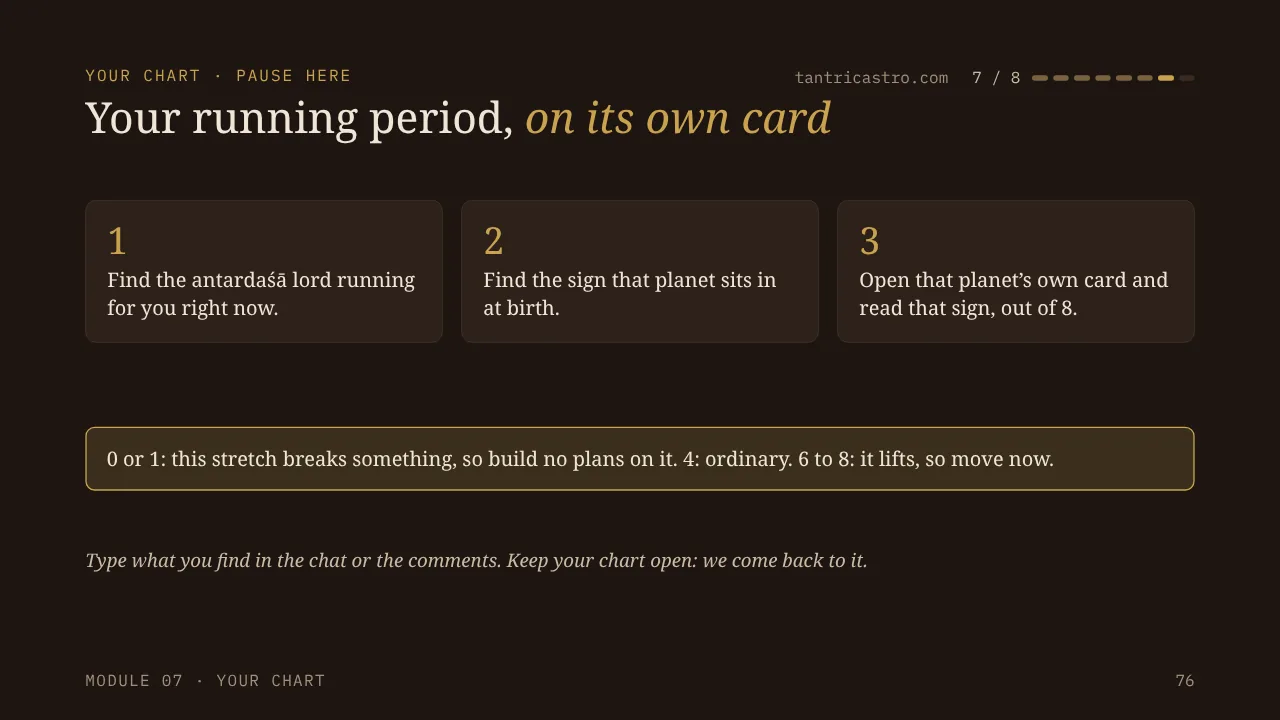
One: find the antardaśā lord running for you right now. Two: find the sign that planet sits in at birth. Three: open that planet’s own card and read that sign, out of eight. Zero or one: this stretch breaks something, build no plans on it. Four: ordinary. Six to eight: it lifts, move now.
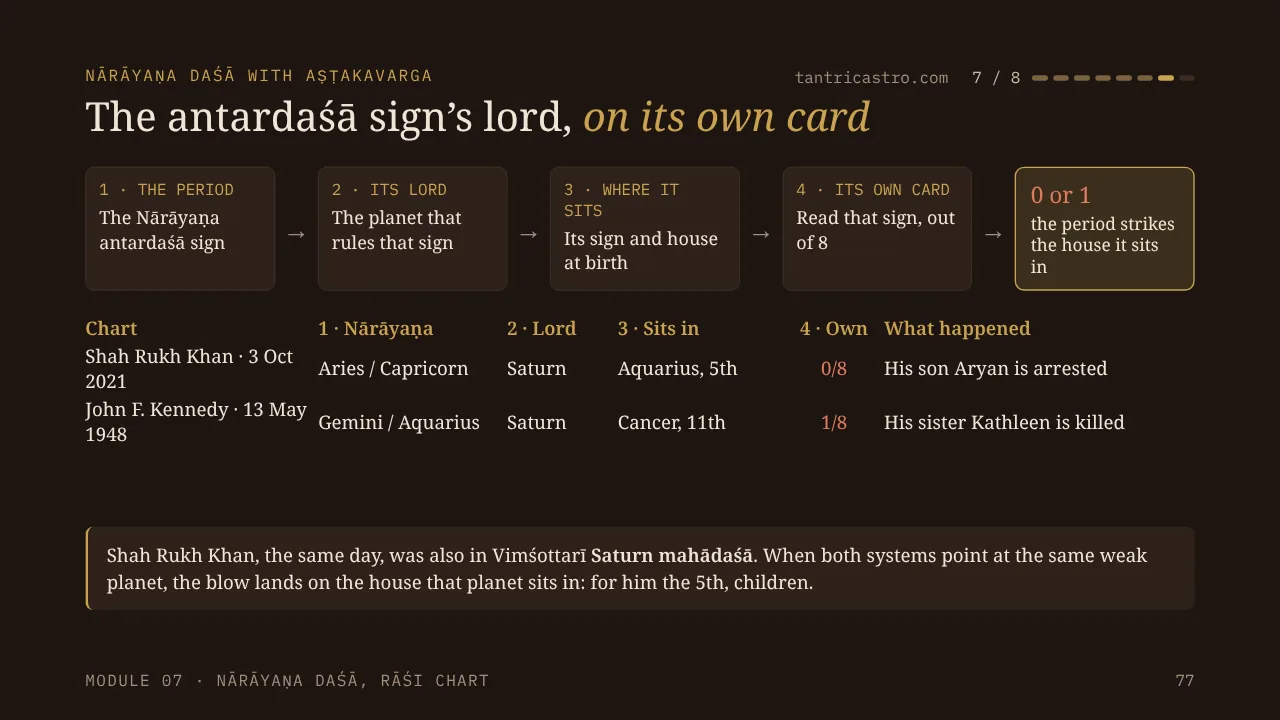
Now Nārāyaṇa daśā, the sign daśā of Jaimini. It runs by signs, not planets, so read the chain on the slide. One, the Nārāyaṇa antardaśā sign. Two, the lord of that sign. Three, where that lord sits at birth. Four, that lord’s own points there. Zero or one, and the period strikes.
Shah Rukh Khan: in October 2021 he was running Nārāyaṇa Aries mahādaśā, Capricorn antardaśā. Capricorn’s lord is Saturn. His Saturn sits in Aquarius, his 5th house, the house of children, with zero points on its own card. In Vimśottarī that same day he was running Saturn mahādaśā: the same zero-point Saturn from both systems.
On 3 October 2021 his son Aryan was arrested. John F. Kennedy: in May 1948 he was running Nārāyaṇa Gemini, Aquarius. Aquarius’s lord is Saturn, his one-point Saturn in Cancer. On 13 May 1948 his sister Kathleen was killed in a plane crash.
When both daśā systems point at the same weak planet, as they did for Shah Rukh Khan, the blow lands on the house that planet sits in. Let’s see it on his chart.
| Chart | 1 · Narayana | 2 · Lord | 3 · Sits in | 4 · Own | What happened |
|---|---|---|---|---|---|
| Shah Rukh Khan · 3 Oct 2021 | Aries / Capricorn | Saturn | Aquarius, 5th | 0/8 | His son Aryan is arrested |
| John F. Kennedy · 13 May 1948 | Gemini / Aquarius | Saturn | Cancer, 11th | 1/8 | His sister Kathleen is killed |
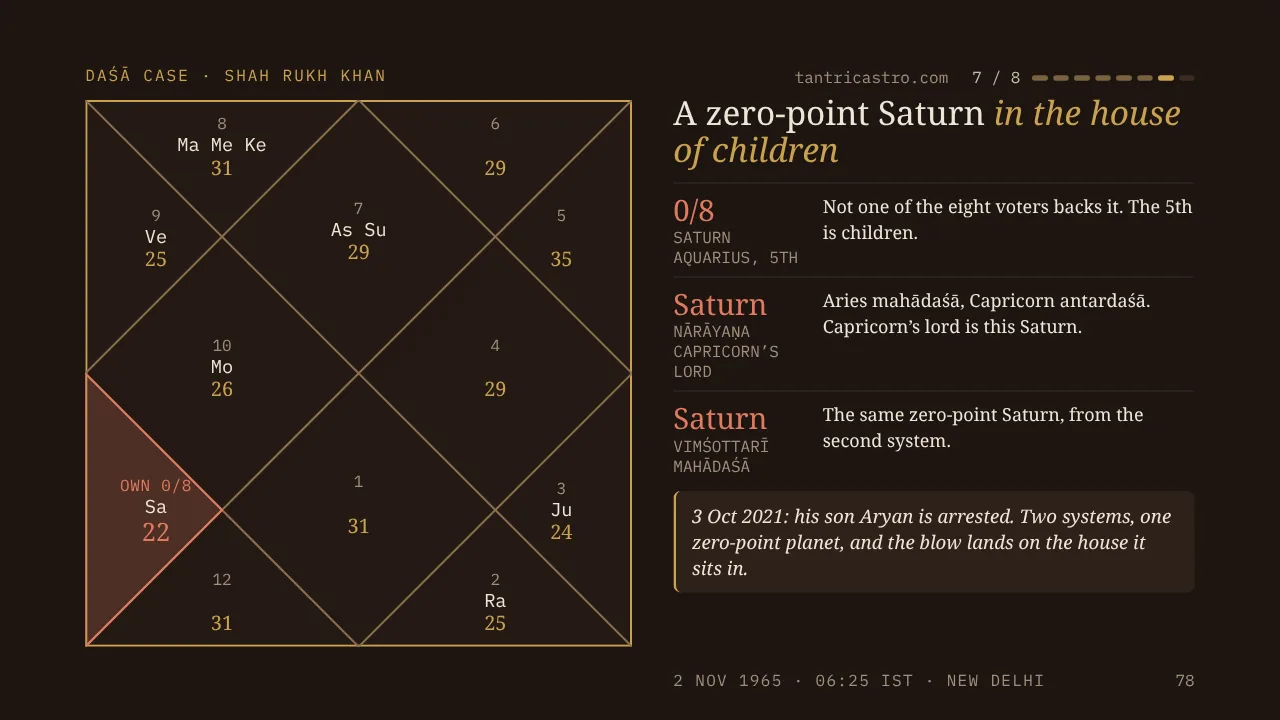
Here it is on the chart. Shah Rukh Khan, Libra lagna with 29 points. Find Saturn: it sits in Aquarius, his 5th house, the house of children, outlined in red. On Saturn’s own card, Aquarius has zero points. Not one of the eight voters backs this Saturn. In October 2021 he was running Nārāyaṇa Aries mahādaśā, Capricorn antardaśā, and Capricorn’s lord is Saturn. In Vimśottarī the same day he was running Saturn mahādaśā. The same zero-point Saturn from both systems at once.
On 3 October 2021 his son Aryan was arrested. Two systems, one zero-point planet, and the blow lands on the house it sits in.
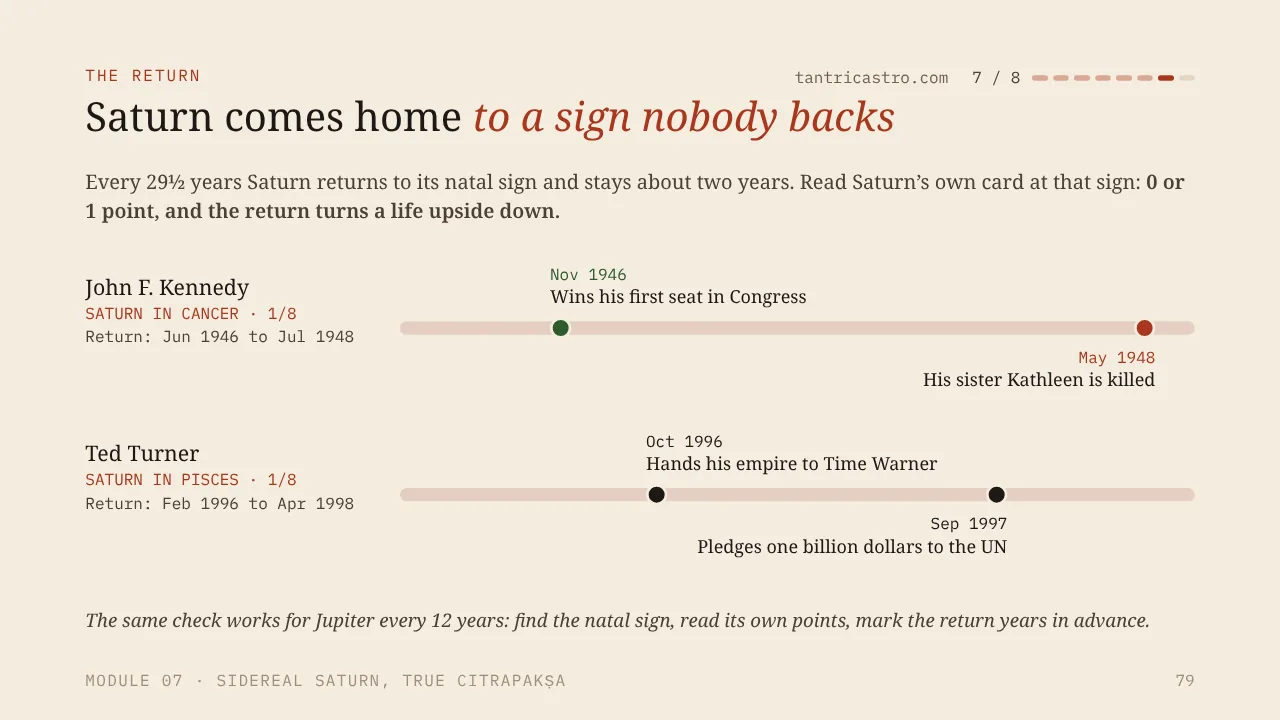
The return. Every twenty-nine and a half years Saturn comes back to the sign it occupied at your birth, and stays about two years. Look at Saturn’s own card for that sign. If it gives zero or one points, the return turns a life upside down.
John F. Kennedy: Saturn in Cancer, one point. Saturn came back to Cancer from June 1946 to July 1948. In November 1946 he won his first seat in Congress, the start of everything. And in May 1948 his sister Kathleen was killed in a plane crash.
Both inside the same return. Ted Turner: Saturn in Pisces, one point.
Use the same check for Jupiter every twelve years: find its natal sign, read its own points, and you can mark the return years in a client’s life in advance.
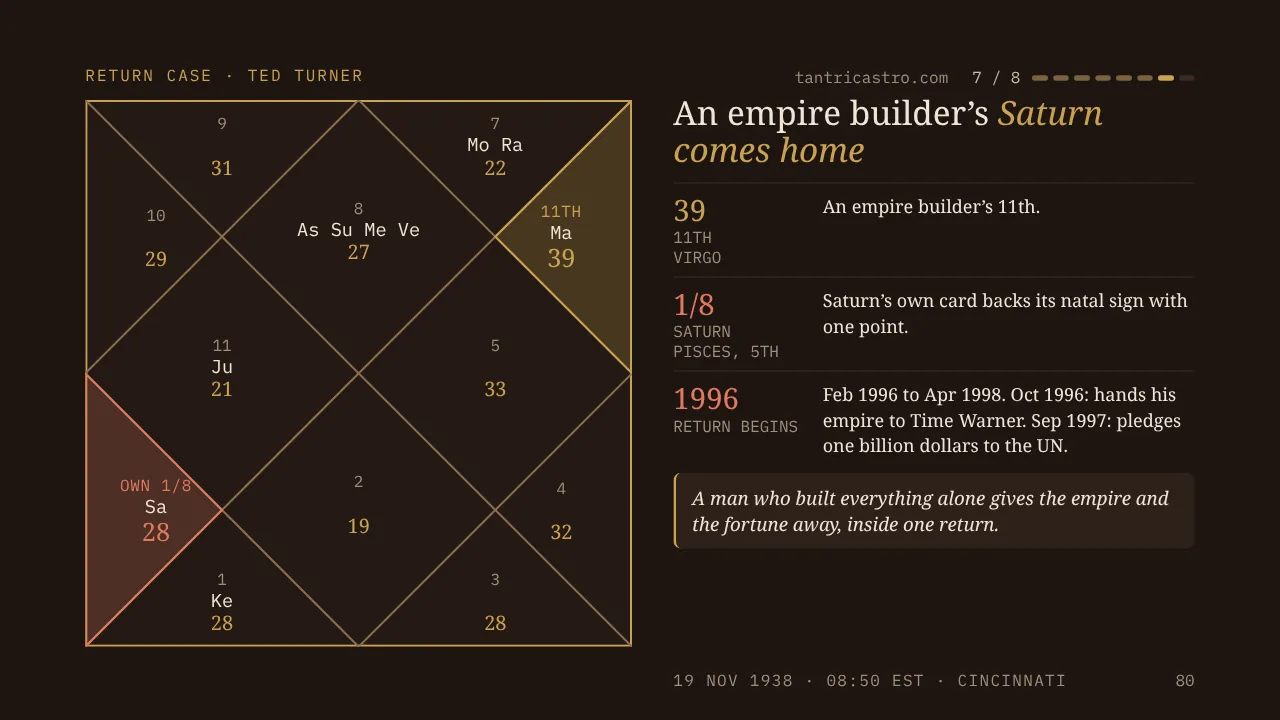
Ted Turner’s chart, Scorpio lagna. His 11th house, Virgo, outlined in gold, scores 39: the chart of an empire builder. Now Saturn, outlined in red: it sits in Pisces, his 5th, and Saturn’s own card gives Pisces just one point. Saturn came back to Pisces from February 1996 to April 1998. In October 1996 he handed his whole broadcasting empire to Time Warner.
In September 1997 he stood up and pledged one billion dollars to the United Nations. A man who built everything alone, giving the empire and the fortune away, inside one Saturn return.
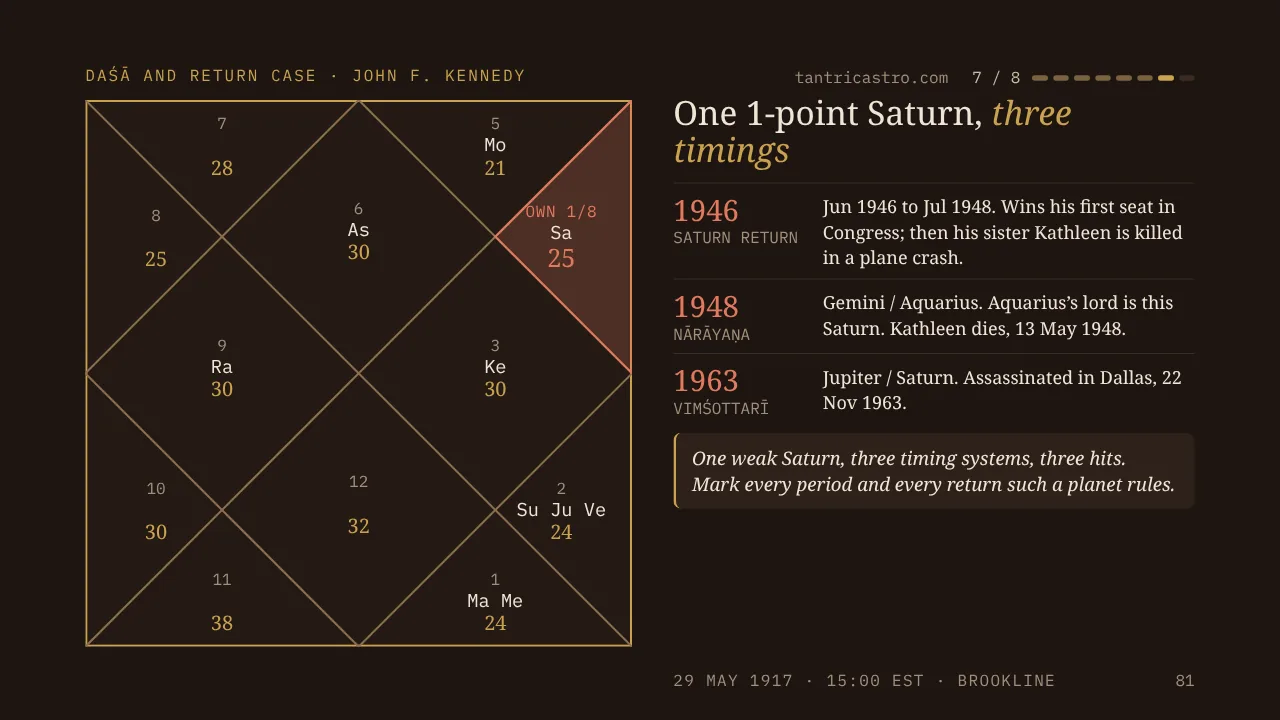
Now watch one weak planet fire in every system. John F. Kennedy, Virgo lagna. Saturn sits in Cancer, his 11th house, outlined in red, and Saturn’s own card gives Cancer just one point. First, the return: Saturn came back to Cancer from June 1946 to July 1948. In November 1946 he won his first seat in Congress, and in May 1948 his sister Kathleen was killed in a plane crash.
Second, Nārāyaṇa daśā: in May 1948 he was running Gemini mahādaśā, Aquarius antardaśā, and Aquarius’s lord is Saturn. Kathleen died on 13 May 1948. Third, Vimśottarī: on 22 November 1963 he was running Jupiter mahādaśā, Saturn antardaśā, and he was assassinated in Dallas. One Saturn with one point, three different timing systems, three hits. When you find a planet with zero or one point of its own, mark every period and every return it rules.
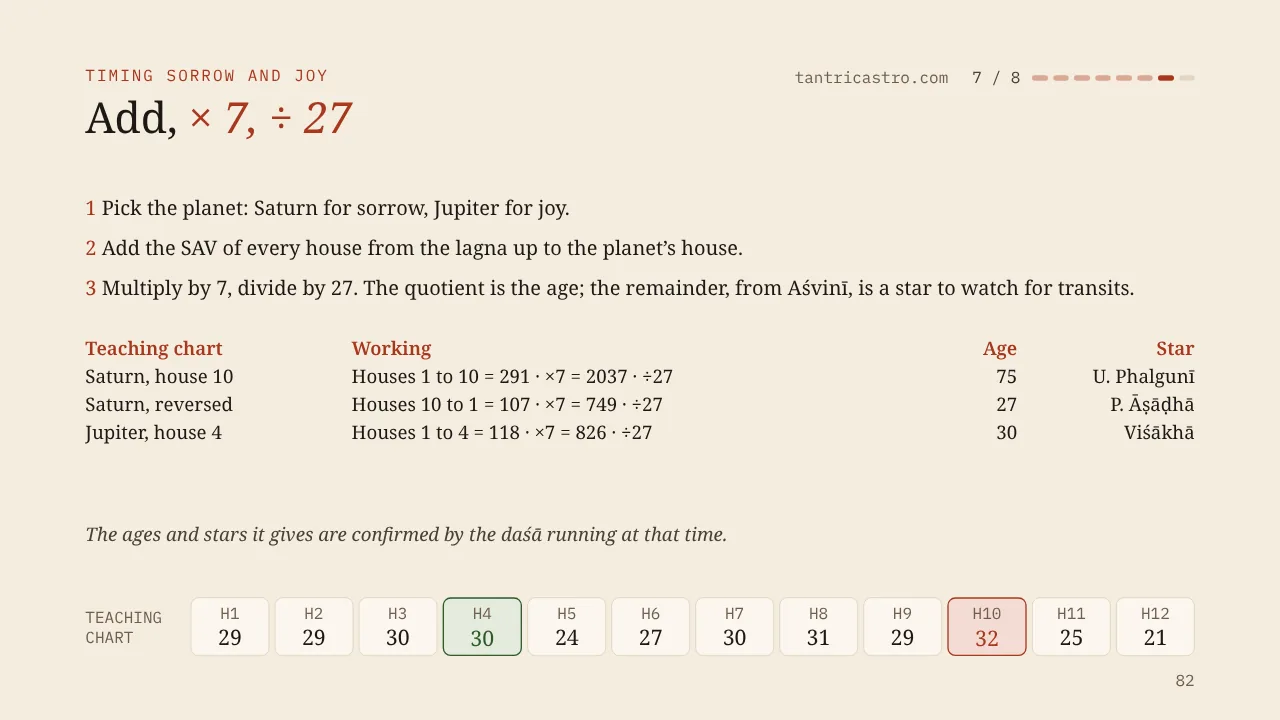
Now a timing method for sorrow and joy. Pick the planet: Saturn for sorrow, Jupiter for joy. Add the SAV of every house from the lagna up to and including the house that planet sits in. Multiply by seven and divide by twenty-seven. The quotient is an age; the remainder, counted from Aśvinī, is a star to watch for transits of malefics for sorrow, or of benefics for joy.
Our teaching chart. Saturn sits in the 10th house; houses 1 to 10 add to 291; times 7 is 2037; divided by 27 is 75 remainder 12, so age 75, and the 12th star from Aśvinī, Uttara Phalgunī. Reversed, from the 10th round to the 1st: 107, times 7 is 749, divided by 27 is 27 remainder 20, age 27 and the 20th star, Pūrva Āṣāḍhā.
For joy, Jupiter sits in the 4th: houses 1 to 4 add to 118, times 7 is 826, divided by 27 is 30 remainder 16, age 30 and the 16th star, Viśākhā. Then confirm each age with the daśā running at that time.
| Teaching chart | Working | Age | Star |
|---|---|---|---|
| Saturn, house 10 | Houses 1 to 10 = 291 · ×7 = 2037 · ÷27 | 75 | U. Phalgunī |
| Saturn, reversed | Houses 10 to 1 = 107 · ×7 = 749 · ÷27 | 27 | P. Āṣāḍhā |
| Jupiter, house 4 | Houses 1 to 4 = 118 · ×7 = 826 · ÷27 | 30 | Viśākhā |
Pitfalls, and one full reading
Module 8: the traps, one full reading, and the close.
The final module. First the traps that make astrologers wrong with aṣṭakavarga, then we put every layer of this course together on one famous chart.
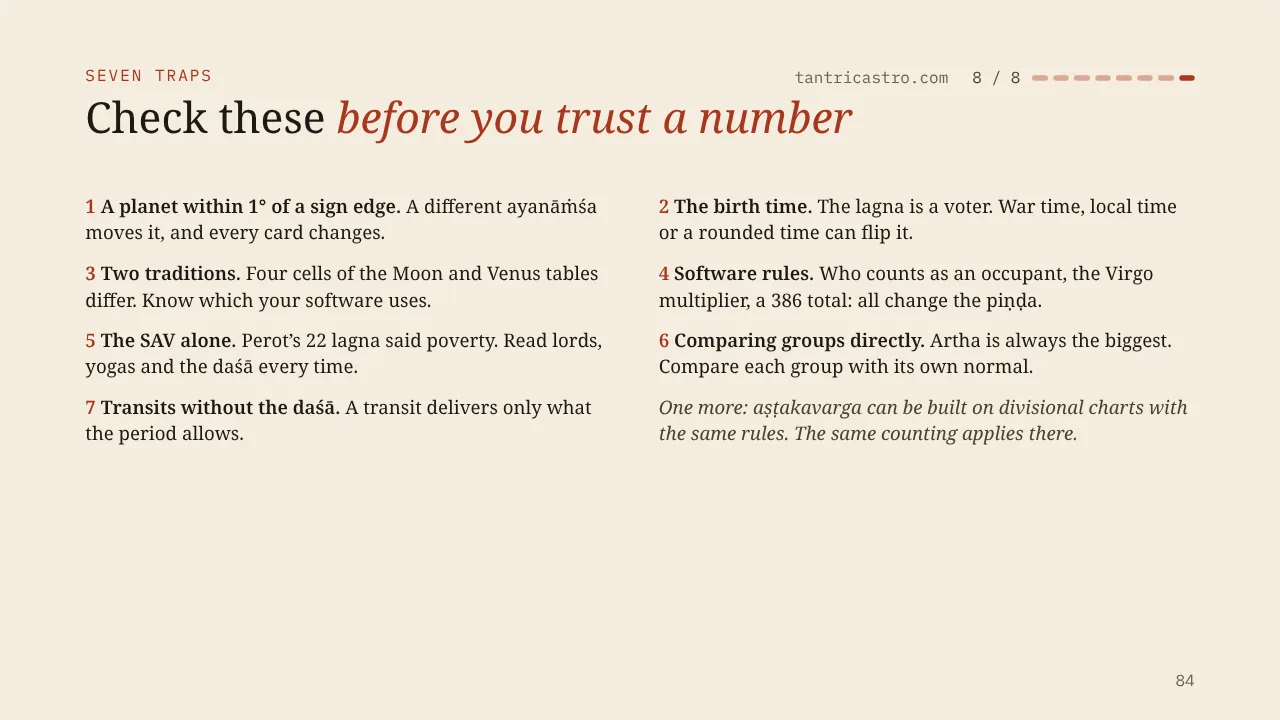
Seven traps, all of which we met in this course. One: a planet within a degree of a sign edge. A different ayanāṁśa can push it into the next sign, and because each card depends only on signs, every number changes. Always check edge planets.
Two: the birth time. The lagna is one of the eight voters. War time, local mean time, or a time rounded to the hour can flip the lagna. Three: the two traditions for the Moon and Venus tables; know which one your software uses.
Four: software rules. Whether the lagna or the nodes count as occupants in the reduction, whether Virgo is multiplied by five or six, a grand total of 386 instead of 337: all of these change the piṇḍa. Five: reading the SAV alone.
Ross Perot’s lagna of 22 said poverty; he was a billionaire. Lords, yogas and the daśā, every time. Six: comparing the puruṣārtha groups directly with each other; Artha is always the biggest, so compare each group with its own normal value.
Seven: judging a transit without the daśā; a transit only delivers what the running period allows. And one more: aṣṭakavarga can be built on divisional charts with the same rules, the 10th-house chart for career for instance; the same counting applies there.
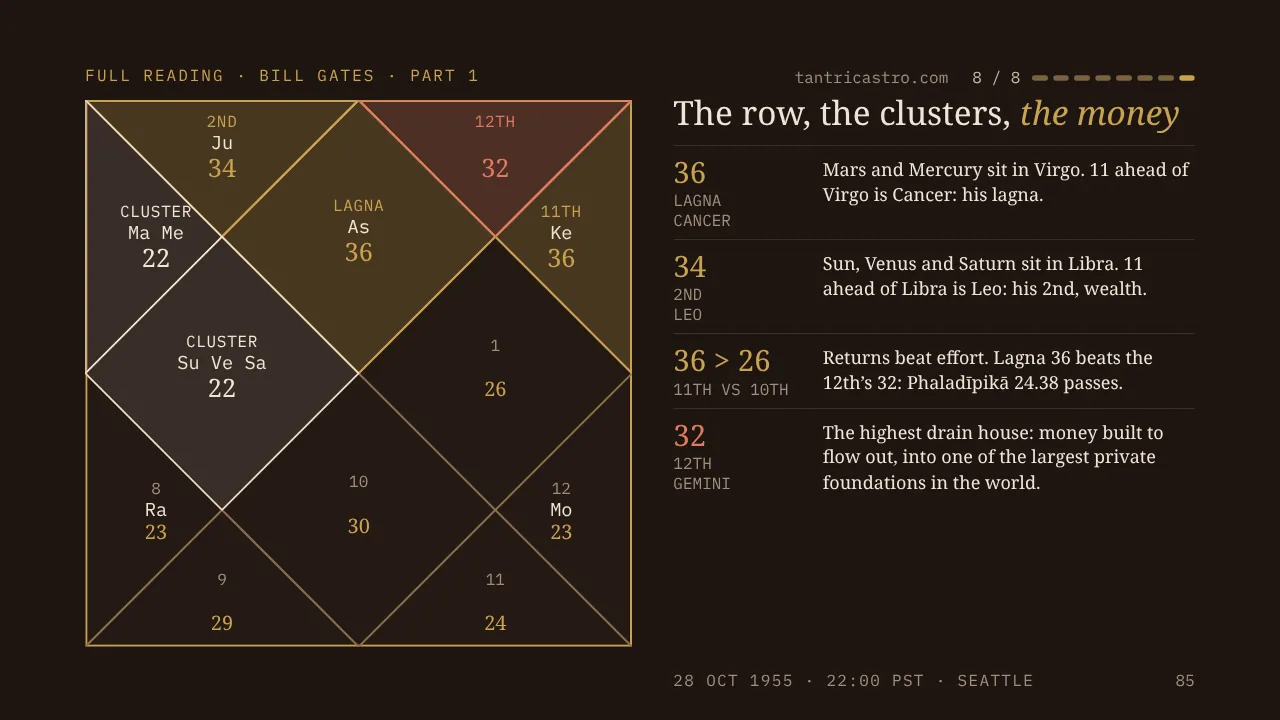
Let’s put the whole course together on one chart: Bill Gates, born 28 October 1955 at 10 pm in Seattle, Cancer lagna. Step one, the row. Check it adds to 337, it does, and look at the extremes: the lagna 36, the 2nd 34, the 11th 36 and the 12th 32 are high; the 3rd, 4th, 5th and 9th are low.
Step two, clusters. Mars and Mercury sit together in Virgo. Count eleven ahead from Virgo and you land on Cancer, his lagna, 36. The Sun, Venus and Saturn sit together in Libra. Eleven ahead from Libra is Leo, his 2nd house of wealth, 34.
So the two clusters feed exactly the self and the bank account. Step three, the money comparisons. The 11th, 36, beats the 10th, 26: returns far beyond effort. The lagna, 36, beats the 12th, 32: able to enjoy it. All three conditions of Phaladīpikā’s wealth rule pass.
Step four, the drain. The 12th at 32 is the biggest of the three drain houses, and the 2nd at 34 sits just under the 11th at 36. Money in this chart is built to flow out. And it did: into what became one of the largest private foundations in the world, with much of its work abroad, which is the 12th house’s own territory. The numbers do not just say rich; they say rich and giving it away.
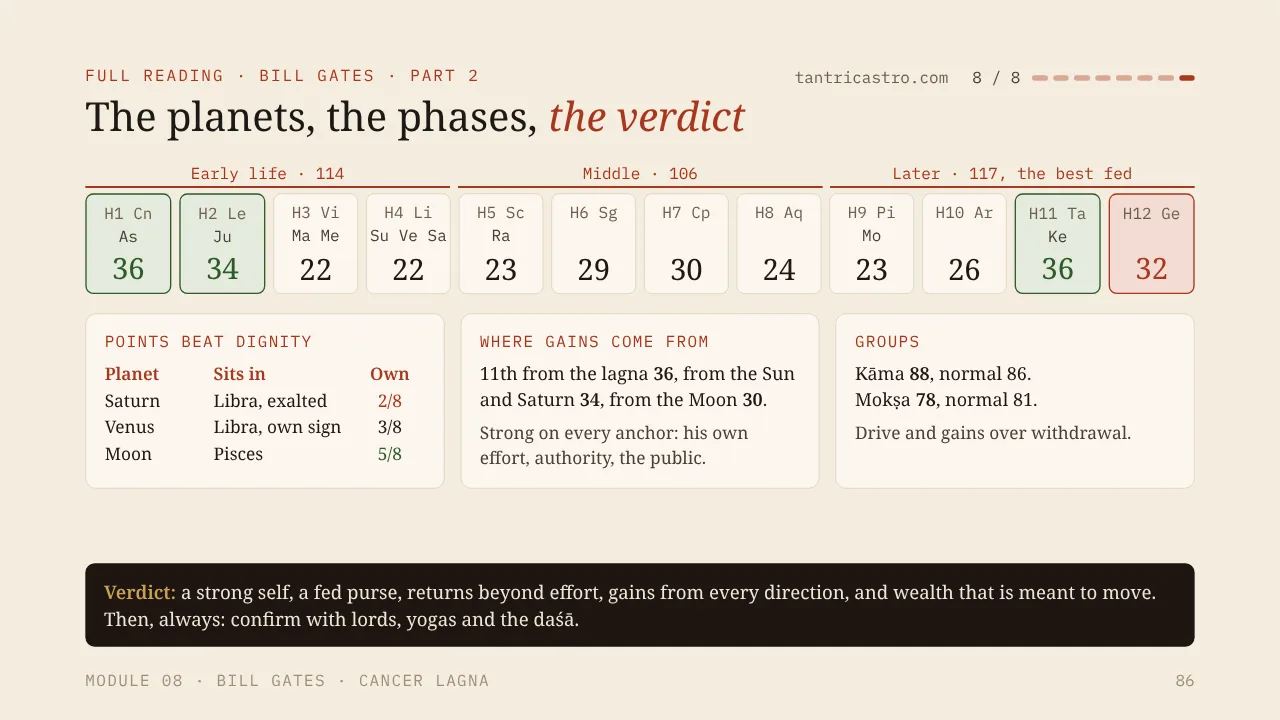
Part two of the Gates reading. Points beat dignity: his Saturn is exalted in Libra, the textbook’s strongest Saturn, yet Saturn’s own card gives Libra only 2 points. Venus in its own sign Libra has 3. The best own score is the Moon in Pisces with 5.
So in this chart the exalted Saturn is not the engine; the clusters and the 11th are. Where do gains come from? The 11th from the lagna is 36, from the Sun and from Saturn 34, from the Moon 30. Strong from every anchor: his own effort, authority and institutions, and the public. Ages of life: houses 1 to 4 total 114, 5 to 8 total 106, 9 to 12 total 117.
The best-fed phase is the last one, which is the decades of the foundation. The groups: Kāma, drive and gains, is 88, above its typical 86; Mokṣa is 78, below its typical 81.
Put it all together: a strong self, a fed purse, returns beyond effort, gains from every direction, and wealth that is built to move outward. That is what aṣṭakavarga alone says. Then, always, the last step: confirm it with the lords, the yogas and the daśā before you say it to anyone.
| Planet | Sits in | Own |
|---|---|---|
| Saturn | Libra, exalted | 2/8 |
| Venus | Libra, own sign | 3/8 |
| Moon | Pisces | 5/8 |
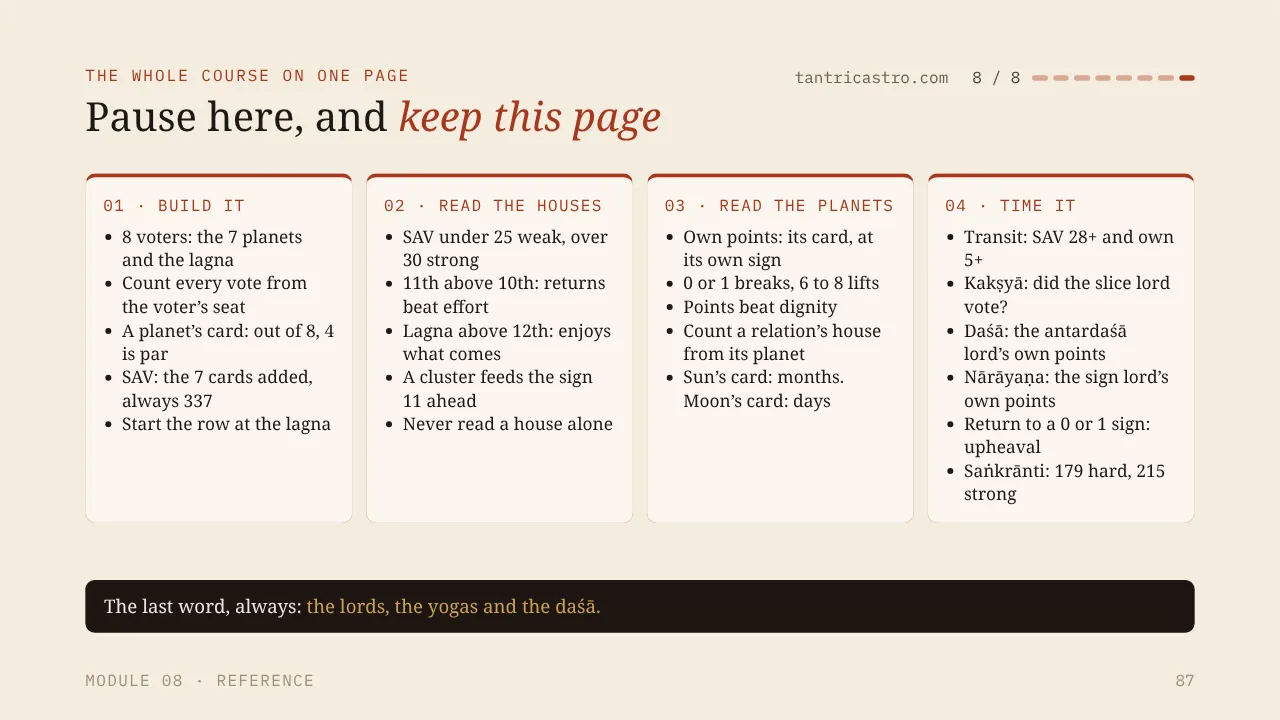
Before we close, here is the whole course on one page. Build it: eight voters, every vote counted from the voter’s seat, a planet’s card out of eight with four as par, and the SAV of all seven cards always adding to 337, started at the lagna.
Read the houses: under twenty-five weak, over thirty strong, the 11th against the 10th, the lagna against the 12th, clusters feeding the sign eleven ahead, and never a house alone. Read the planets: own points on the planet’s own card at its own sign, zero or one breaks, six to eight lifts, points beat dignity, count a relation from its planet, and the Sun and Moon cards for months and days.
Time it: a transit needs good ground and a strong planet, the kakṣyā fine-tunes it, the daśā lord’s own points decide the period, the Nārāyaṇa sign lord’s points too, a return to a zero or one sign brings upheaval, and the Saṅkrānti total judges the month. And the last word always belongs to the lords, the yogas and the daśā.
- 8 voters: the 7 planets and the lagna
- Count every vote from the voter’s seat
- A planet’s card: out of 8, 4 is par
- SAV: the 7 cards added, always 337
- Start the row at the lagna
- SAV under 25 weak, over 30 strong
- 11th above 10th: returns beat effort
- Lagna above 12th: enjoys what comes
- A cluster feeds the sign 11 ahead
- Never read a house alone
- Own points: its card, at its own sign
- 0 or 1 breaks, 6 to 8 lifts
- Points beat dignity
- Count a relation’s house from its planet
- Sun’s card: months. Moon’s card: days
- Transit: SAV 28+ and own 5+
- Kakṣyā: did the slice lord vote?
- Daśā: the antardaśā lord’s own points
- Nārāyaṇa: the sign lord’s own points
- Return to a 0 or 1 sign: upheaval
- Saṅkrānti: 179 hard, 215 strong
That is the complete aṣṭakavarga course. If I had to put all eight modules into one line, it would be this: count correctly, compare houses instead of reading single numbers, read each planet’s own card, and let the daśā have the last word. You now know where every number on your screen comes from and exactly how to read it.
If you want to keep going, the Parāśarī course opens its waitlist for early 2027. And if you want your own chart read properly, I do live consultations on Zoom; the details are on tantricastro.com. Thank you for staying with me through all of it. Namaste.
Questions people ask
What is ashtakavarga?
A point system from the Bṛhat Parāśara Horā Śāstra, chapters 66 to 72. Eight points of reference, the seven planets from the Sun to Saturn and the lagna, each give or withhold one point to every sign, counted from where that reference sits. Counted for one planet that is its bhinnāṣṭakavarga, nought to eight per sign; all seven planets added together is the sarvāṣṭakavarga, always 337 points over the twelve signs.
What is a good sarvashtakavarga score for a house?
Parāśara gives the scale in 72.3: more than thirty is good, twenty-five to thirty is middling, and signs with few points bring trouble, so under twenty-five is weak. The average sign holds about twenty-eight. A number never decides a house alone; the lord, the occupants and the daśā are read with it, which is what Module 3 is about.
What is bhinnashtakavarga and how is it read?
One planet’s own card: how many of the eight voters approve each sign for that planet. Four is par. Read it twice: natally, in the sign the planet occupies, which is how far that planet can deliver; and in transit, in the sign it is passing through, which is how that transit will feel.
Why do two apps show different bindu tables for the Moon or Venus?
Two traditions differ on four cells. In Parāśara the Moon gives itself the 9th and Mars does not, Jupiter gives the Moon the 2nd rather than the 12th, and Mars gives Venus the 4th rather than the 5th; the variant, usually credited to Varāhamihira, swaps each pair. The totals stay 49 and 52 either way, so the 337 check cannot catch it. This course and the calculator follow Parāśara.
How are transits read with ashtakavarga?
With two numbers for the sign being crossed: its sarvāṣṭakavarga, which says what the house can give, and the transiting planet’s own points there, which say how that planet behaves in it. Kakṣyā, the eight slices of 3°45′ in each sign, narrows a transit to the days when the planet crosses a slice whose lord gave it a point. Parāśara’s own word in 72.31 is that plain transit reading stops once the aṣṭakavarga is known.
What is the shodhya pinda?
A planet’s card after the two reductions, trikoṇa śodhana and ekādhipatya śodhana, with each remaining figure multiplied by its sign’s measure and its planet’s measure and added up (chapters 67 to 69). Parāśara uses it for timing: the piṇḍa multiplied by the figure of the house in question, divided by 27 for a nakṣatra or by 12 for a sign, points to where Saturn’s transit brings the matter of that house to a head. Modules 5 and 7 work it on real charts.
Where can I compute my own?
The ashtakavarga calculator on this site gives the prastāra, every bhinnāṣṭakavarga and the sarvāṣṭakavarga for the rāśi chart and any varga, free, in your browser, with nothing stored.
If you want your own sheets read with the daśās, that is what a Practical Prediction consultation is for.
Sources: Bṛhat Parāśara Horā Śāstra, chapters 66 to 72, in the enjoylearningsanskrit edition, and P. V. R. Narasimha Rao, Vedic Astrology: An Integrated Approach, chapter 12, for the tables, the reductions and the two traditions. Birth data as stated on each case slide. Sidereal, True Citrapakṣa ayanāṁśa, whole-sign houses.
Tantric Astro · Tirth Doshi · AhmedabadWhatsApp +91 63531 92253tirthdos@gmail.com
Want it read for you?
The course gives the method. What your own sheets say depends on the whole chart, and on the daśā you are in.