Vimśāṁśa series · Aṁśa 1, odd signs · Kālī · 12 min read
Kālī holds the first ninety minutes of every odd sign, and what she does to a planet there is cut it free of whatever it was holding.
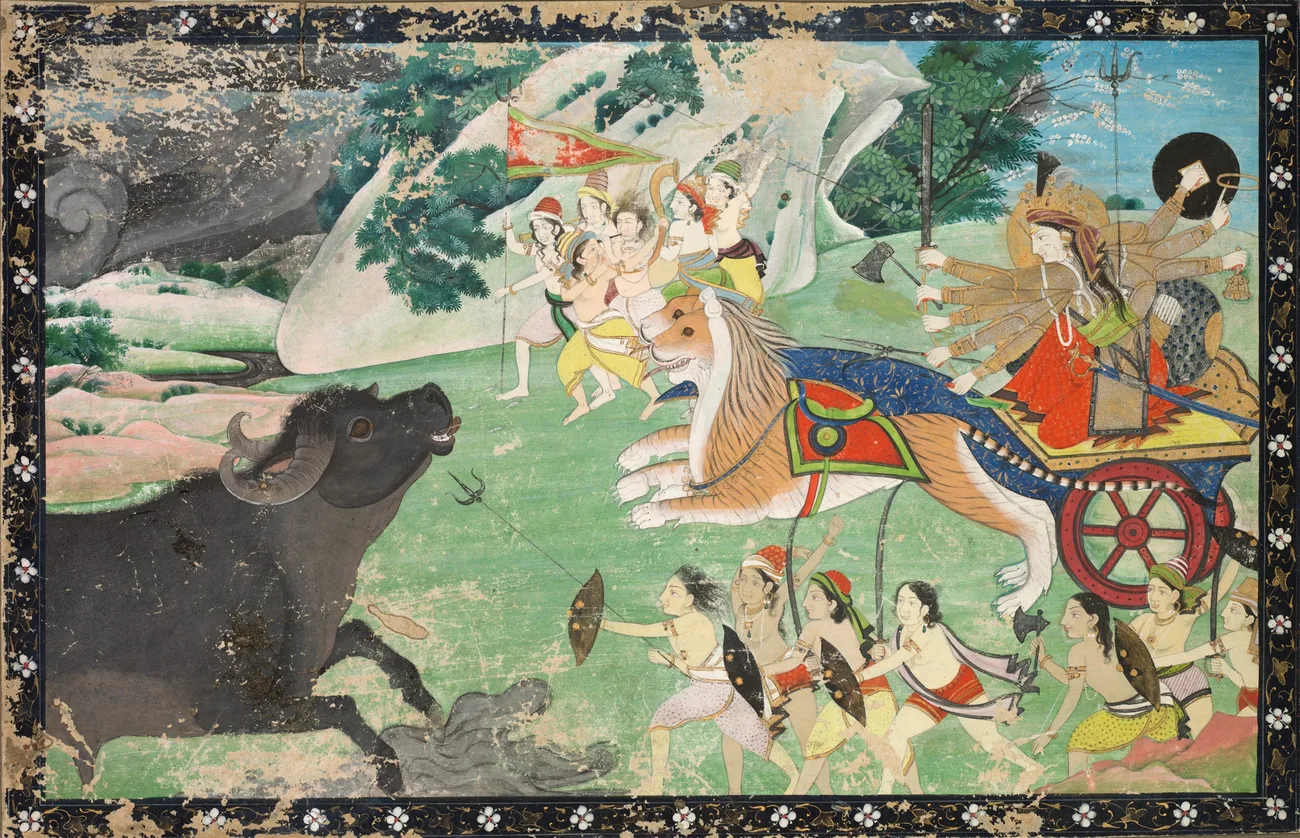
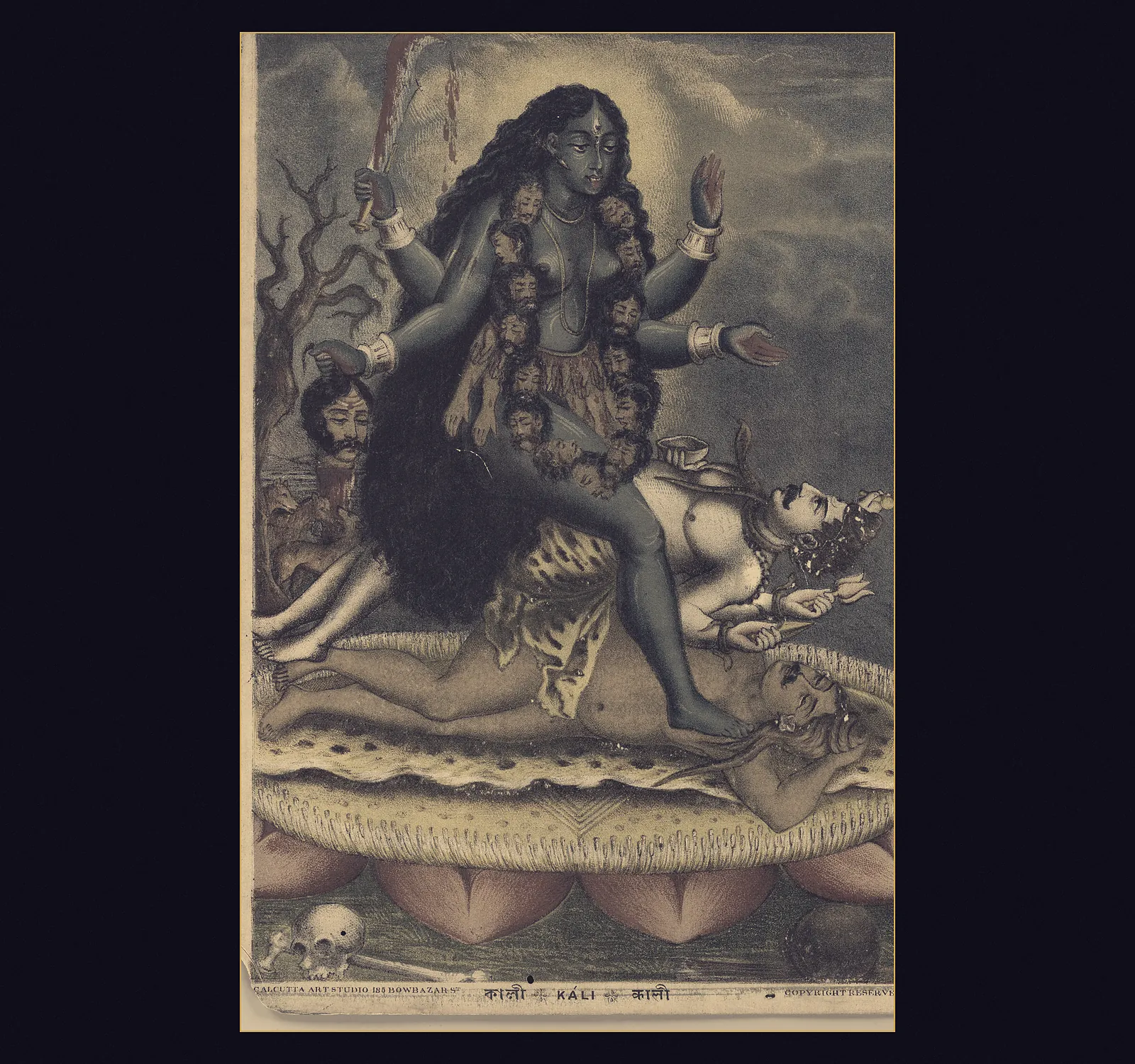
The scene everybody knows is in the seventh chapter of the Devī Māhātmya. Caṇḍa and Muṇḍa come at Ambikā with drawn weapons. She does not raise a hand. Her face goes black with anger, and out of the surface of her forehead something steps.
ततः कोपं चकारोच्चैरम्बिका तानरीन्प्रति।
कोपेन चास्या वदनं मषीवर्णमभूत्तदा॥५॥
भ्रुकुटीकुटिलात्तस्या ललाटफलकाद्द्रुतम्।
काली करालवदना विनिष्क्रान्तासिपाशिनी॥६॥
विचित्रखट्वाङ्गधरा नरमालाविभूषणा।
द्वीपिचर्मपरीधाना शुष्कमांसातिभैरवा॥७॥tataḥ kopaṃ cakāroccair ambikā tān arīn prati |
kopena cāsyā vadanaṃ maṣīvarṇam abhūt tadā ||5||
bhrukuṭīkuṭilāt tasyā lalāṭaphalakād drutam |
kālī karālavadanā viniṣkrāntāsipāśinī ||6||
vicitrakhaṭvāṅgadharā naramālāvibhūṣaṇā |
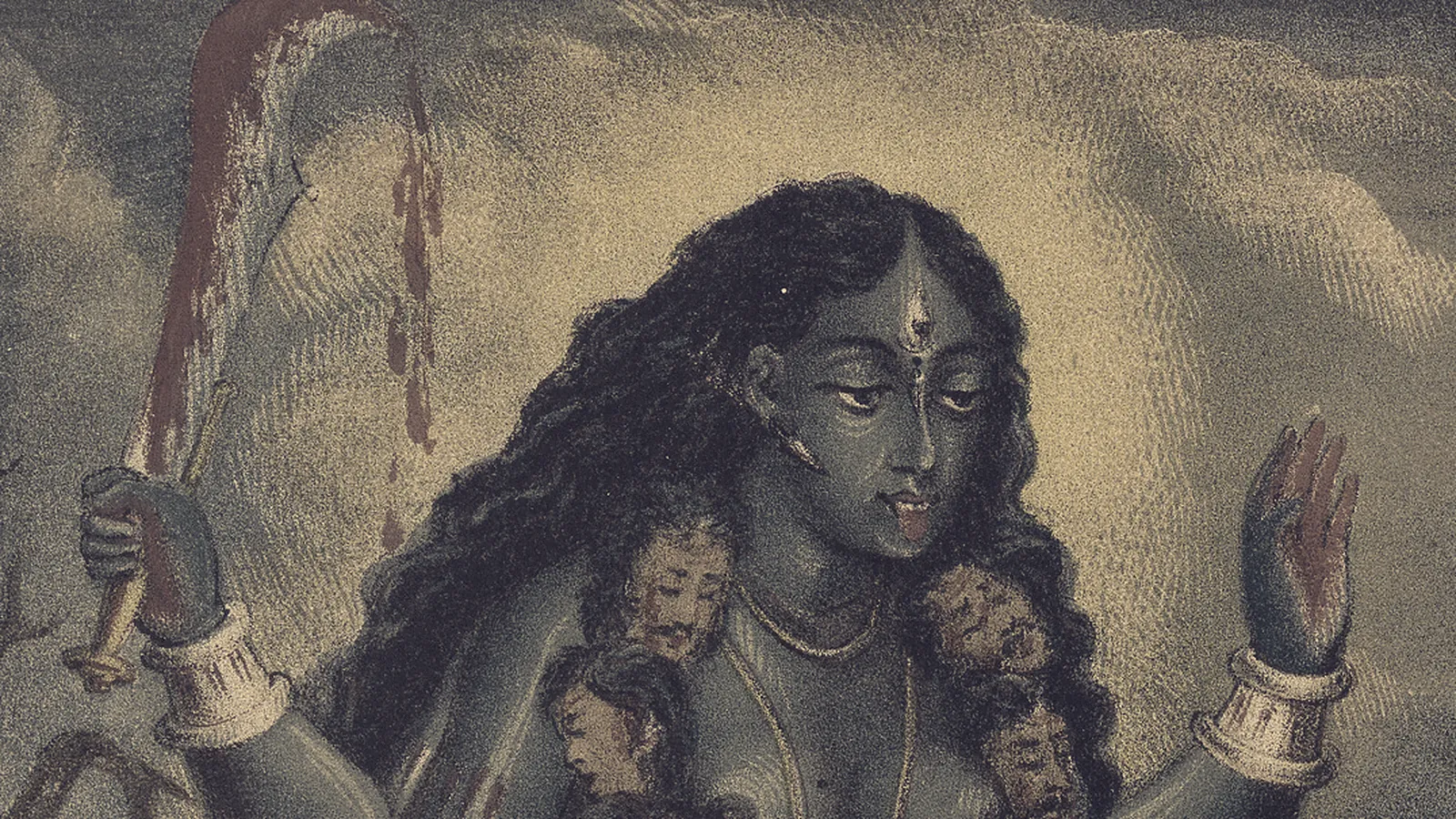
dvīpicarmaparīdhānā śuṣkamāṃsātibhairavā ||7||“Then Ambikā grew violently angry with those enemies, and with that anger her face turned the colour of ink. Out of the surface of her forehead, bent with a frown, Kālī came striding, gape-mouthed, carrying a sword and a noose; bearing a strange skull-staff, wearing a garland of men, clothed in a tiger’s hide, terrible with her wasted flesh.”
Devī Māhātmya 7.5–7 · Sanskrit from the proofread Durgā Saptaśatī text
She decapitates both generals in one stroke, and the goddess renames her for it: Cāmuṇḍā. Raktabīja bleeds, and every drop that touches the ground stands up as another Raktabīja. The more the goddesses wound him, the more of him there is. Kālī ends it by drinking the blood in the air before it can land, and eating the duplicates as they come.
Raktabīja cannot be beaten by force. Rāhu is a head with no body: appetite that cannot digest, spreading without substance. A compulsion that grows the more you fight it, whether it turns up as a debt or a drink, doesn’t end instance by instance; somebody has to go to the source.
Kālī rules the first vimśāṁśa of every odd sign: 0°00′ to 1°30′ of Aries, Gemini, Leo, Libra, Sagittarius and Aquarius. Any planet inside those ninety minutes is hers. If the vimśāṁśa is new to you, Part 1 of this series has the two tables and the calculation; the short version is to divide the planet’s degrees within its sign by 1.5 and round up, and aṁśa 1 of an odd sign is Kālī.
Who she is
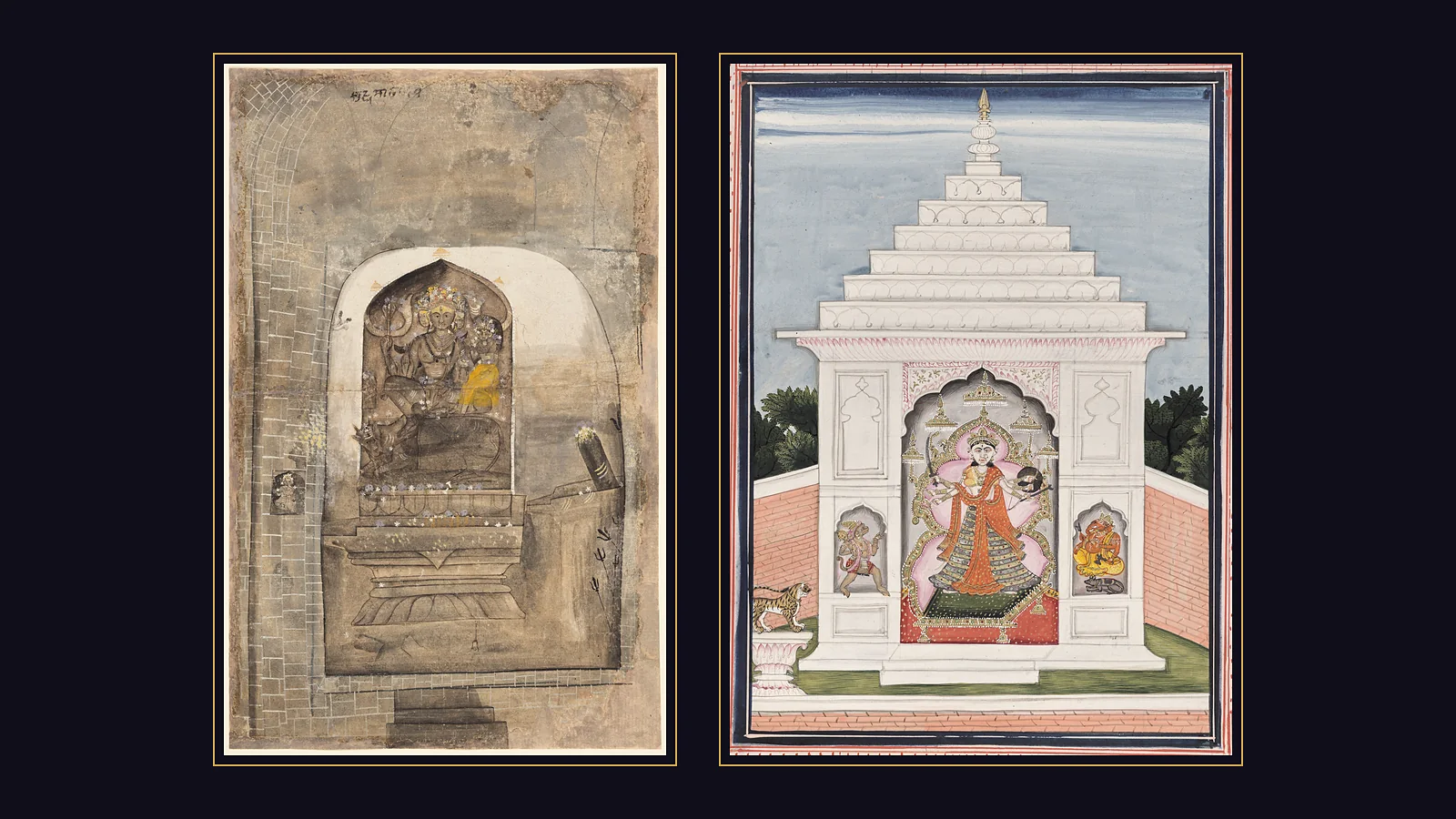
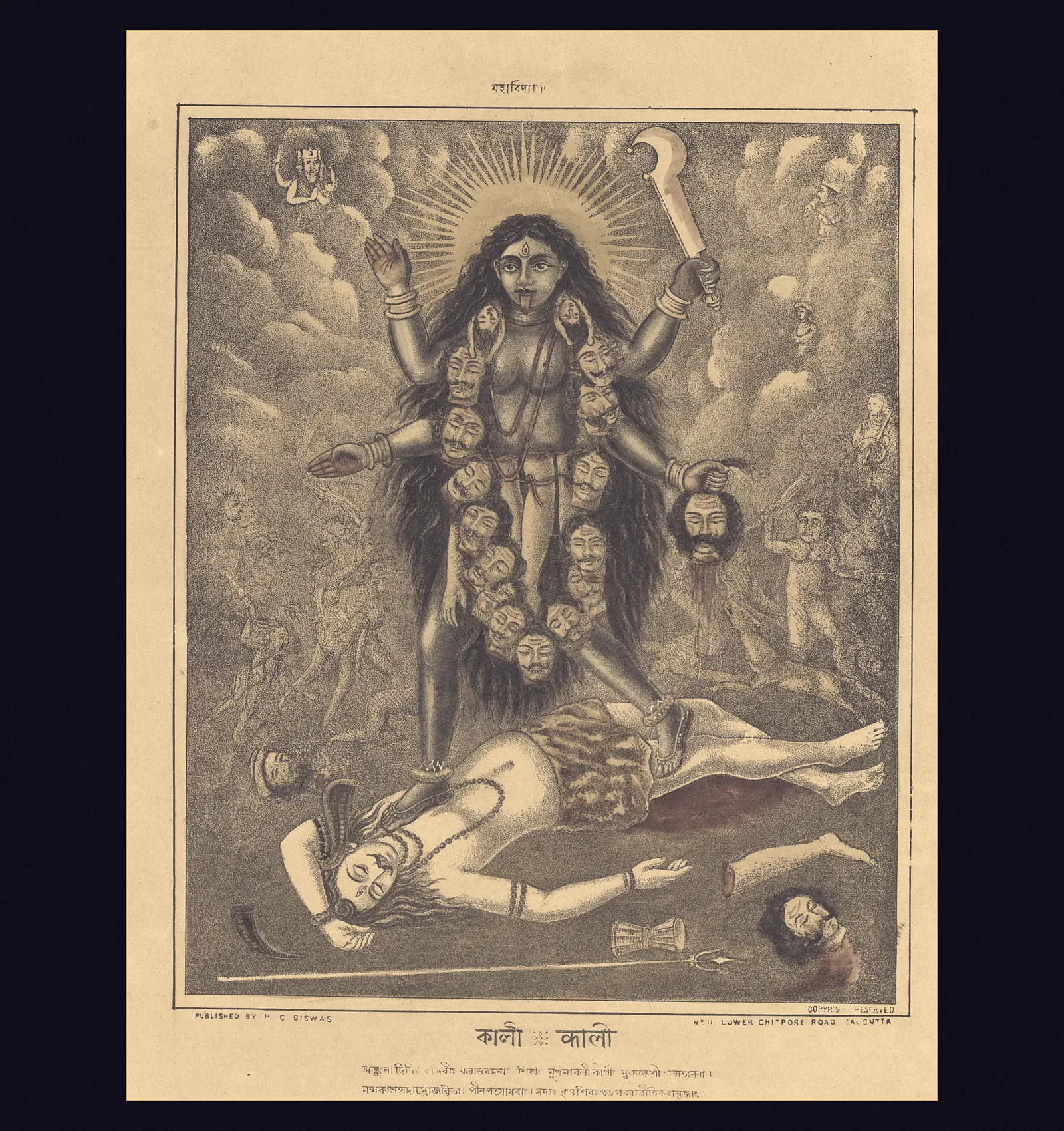
Kālī is the first Mahāvidyā. She is the oldest by a long way, and the rest of the group is medieval. She is in the Purāṇas, in the Devī Māhātmya, and in a sixth-to-eighth-century architectural manual that rules her temples must be built far from villages, near the cremation grounds (Kinsley, Hindu Goddesses, p. 118). By the eighth century she is on stage: Bhavabhūti’s Mālatī-Mādhava turns on a Kāpālika and his disciple preparing to cut a girl’s throat in front of Cāmuṇḍā, in a temple the audience was evidently expected to find plausible.
Kāla is time and Kālī is what eats it, which is the definition the Tantras give. Śiva as Mahākāla devours the universe at the dissolution, and she devours him. A chart is a map of time. She stands outside it, so the planet she holds keeps no appointments.
शिवाभिर्घोररूपाभिर्वेष्टितां भयनाशिनीम्।
मा भैर्मा भैः स्वभक्तेषु जल्पन्तीं घोरनिःस्वनैः॥१२॥
यूयं किमिच्छत ब्रूत ददामीति प्रभाषिणीम्।
ध्यायामि तां महाकालीं सर्वोपद्रववारिणीम्॥१३॥śivābhir ghorarūpābhir veṣṭitāṃ bhayanāśinīm |
mā bhair mā bhaiḥ svabhakteṣu jalpantīṃ ghoraniḥsvanaiḥ ||12||
yūyaṃ kim icchata brūta dadāmīti prabhāṣiṇīm |
dhyāyāmi tāṃ mahākālīṃ sarvopadravavāriṇīm ||13||“Ringed by she-jackals of horrible form, destroyer of fear, saying to her own devotees in dreadful sounds: do not be afraid, do not be afraid. Saying: speak, what do you want, and I give it. On that Mahākālī, who wards off every calamity, I meditate.”
Śrī Kālī Dhyānam 12–13 · proofread text, sanskritdocuments.org
She is standing in a burning ground ringed by jackals, saying mā bhaiḥ, mā bhaiḥ, do not be afraid, in a voice that is itself terrifying.
What Kālī does to a planet
She cuts the planet free at the source, in that planet’s own department. The planet itself isn’t damaged. The thing it was leaning on gets taken away, and afterwards it stands on its own.
Karma that would have been paid out across ten or fifteen years arrives in two or three. It is fast. The fierce-deity literature says as much. So do the charts of people who never worshipped her and simply have a planet in her aṁśa. The daśā feels short even when it runs the full nineteen years of Saturn.
She removes the gap between what a person shows and what they are, in that planet’s matters. If a person has built something on a performance, it comes apart, and it comes apart publicly. Whatever has been recurring in that planet’s department for years, the same fight in a new costume, ends. She stops Yama, and in chart after chart the matter that should have finished the person does not.
Planet by planet
Find your planet in her aṁśa and read its row. If you have more than one in there, read both and expect the two daśās to rhyme.
| Planet in aṁśa 1, odd sign | What she takes | What the daśā gives back |
|---|---|---|
| Sun | The father, the patron, the position stood behind | A self that does not need the chair. Recognition arrives afterwards, from strangers. |
| Moon | Comfort, and the mind’s usual hiding places | A mind that has been through the dark and no longer fears it. The mother is Kālī: strong, feared, loved. |
| Mars | Restraint. The fight arrives whether or not it was wanted | A weapon in her hand. Wins, at cost. Turns on its owner if the owner is in the wrong. |
| Mercury | Diplomacy, the contract, sometimes a sibling | Speech that cuts, and cannot flatter. The tradition says she made Kālidāsa a poet in one night. |
| Jupiter | The teacher, or the belief | The real one, found after. Jupiter is the jīva; she takes what the jīva was gripping. |
| Venus | A marriage, a love, or the taste for comfort | The strongest work of the person’s life, made afterwards. Vairāgya arriving through bhoga. |
| Saturn | The schedule. Saturn is Kāla and she eats Kāla | Karma cleared wholesale. The one placement where ten years into two is almost literal. |
| Rāhu | The endless spreading. Raktabīja is Rāhu’s own signature | The antidote laid on the disease. Best Rāhu in the twenty for a sādhaka, worst for anyone getting away with something. |
| Ketu | Nothing. Ketu has already let go | A mokṣa-heavy chart, and doubly so in Aśvinī, Maghā or Mūla, which is where her aṁśa falls in three of the six signs. |
| Lagna | Ordinary life | The whole chart takes her temper. Nothing in the life is gradual. |
Saturn’s own promise is delay and hers is that delay does not exist. The delay is real right up until it isn’t, and then the whole backlog arrives together. You will describe your Saturn daśā as the worst and the most productive stretch of your life.
Raktabīja is Rāhu’s principle exactly. I have seen addictions end in that daśā the way a tap closes.
Her window is two and a half percent of the sky, so every row in it rests on a thin file.
When she holds a kāraka
A kāraka in her aṁśa is stronger news, because a kāraka is a standing office and a planet is one department. Parāśara defines these by degrees: the planet with the highest degrees is the Ātmakāraka, the next is the Amātyakāraka, and so on down to the Gnātikāraka, seventh in the eight.
Ātmakāraka under Kālī
The life has a before and an after, and you aren’t recognisable on the far side of it. Expect one complete stripping. The work, the money, the standing, the people, all inside one stretch. Kṛṣṇa says in the Bhāgavata that the man he favours is the man whose wealth he takes, after which the man’s own people leave him, and only then, sick of the chase, does he turn (Bhāgavata Purāṇa 10.88.8–9).
You’re drawn to fierce deities without having been taught to be. Whatever capacity for polite pretence the rest of us keep, you lose early, usually by being humiliated out of it, and you’re afterwards the most direct person in any room you walk into.
Amātyakāraka under Kālī
The minister, the one who finds you your work. Under her, the career is built out of endings. Surgery and emergency medicine, police and military, law and litigation, security and investigation, restructuring and liquidation, death care, and this discipline itself. You get called in when something has already gone wrong, and you’re strangely calm in the situation that panics everyone else.
A collapse, then a jump, then a plateau, then another collapse, then a bigger jump. I’ve stopped telling these clients their career will build steadily, because it won’t, and saying so makes the collapses frightening instead of useful. The person who lifts you usually arrives at your worst hour, and is often a woman, or somebody others find alarming. When the Amātyakāraka daśā runs, work arrives through a door that opens because another one was kicked in. See the 9th from the Moon for how I prescribe for this alongside the chart’s own deity.
Gnātikāraka under Kālī
The Gnātikāraka, which the Jaimini schools often call the Ghātikāraka, is the kāraka of cousins and rivals, of disease, debt, litigation, obstruction, and of the fight itself. It is the most protective placement in the vimśāṁśa against people who mean you harm.
The rival loses everything at once, often through something that has nothing to do with you, because a feud doesn’t survive contact with your chart. Disease, when it comes, is acute and survived.
She doesn’t check whose side she’s on before she cuts. If the person with this placement is the one in the wrong, the destruction lands on them with exactly the same completeness, and there’s no appeal and no slow slide to warn them, because the protection is conditional on your being worth protecting.
How the daśā feels from inside
First, the cut. Early in the period, sometimes in the first antardaśā. Something permanent turns out not to be. People describe it afterwards as something that happened to them.
Then the burning ground. The long middle, where nothing is being built and the old thing isn’t coming back, is the part doing the work. Ramprasad wrote his whole body of song from inside it. He tells her he knows exactly what her mercy is worth.
Then the speed. The last stretch moves at a rate that makes no sense against the first two. The karma that was going to be paid out slowly has already been paid, so what is left runs without friction.
Almost nobody inside the middle phase of a Kālī daśā believes it’s going anywhere, and they’re wrong.
What she asks for
If Kālī holds a planet in your chart, the upāsanā that fits is hers, and it starts far below the mantras people are curious about. The vimśāṁśa is the chart of upāsanā; that is what Parāśara says about it. A planet in her aṁśa is a standing instruction about how you’re meant to approach.
Begin with a stotra. The Karpūrādi Stotra, or the Ādyā Kālī Stotra in the fifth chapter of the Mahānirvāṇa, or the dhyāna above: read daily, out loud, in front of a picture you’ve chosen and won’t change. That alone is enough for most people for years, and it needs no initiation at all. Tuesdays, and the new moon, and the middle of the night if you can keep it up without theatre.
Do not take the bīja off the internet. Kālī’s bīja is a dīkṣā matter, and a mantra picked up without a guru is very often exactly the gap she won’t tolerate.
And if the fierce forms frighten you off, do not force it. Not everyone is meant to approach her directly, even with a planet in her aṁśa. Reading her stotra and understanding what she is doing in your chart is already a complete practice.
She says two things in the same verse: this will be terrible, and do not be afraid.
Questions people ask
Which degrees are Kālī’s in the D20?
0°00′ to 1°30′ of Aries, Gemini, Leo, Libra, Sagittarius and Aquarius, that is, aṁśa 1 of every odd sign. Aṁśa 1 of the even signs belongs to Dayā, not to Kālī.
Is a planet in Kālī’s vimśāṁśa bad?
No. Your planet loses whatever it was leaning on and afterwards works better than it did. The difficulty is real and it’s concentrated into a shorter span than it would otherwise take.
Can I chant her mantra without initiation?
Her stotras, yes, and they’re enough for years. The bīja mantra, no. Take it from a guru or leave it.
Where does this reading come from?
No classical text explains what any vimśāṁśa deity does to a planet. Parāśara names the twenty and assigns the varga to upāsanā, and the commentaries add nothing. It comes from the goddess’s own nature in the Purāṇas and Tantras, and from charts.
Next in the series is Gaurī, aṁśa 2 of the odd signs, and the two of them are one body split in two. The Devī Māhātmya 5.87–88 has Pārvatī part with a sheath: the golden queen who fights Śumbha steps out of it, and what stays standing turns black on the spot and takes the name Kālikā. Part 1, with the full table of all forty names, is here. To have your own vimśāṁśa read properly, with the deity and the daśā sequence together, book a consultation.
Sources: Devī Māhātmya 7.5–7 and 5.87–88, Sanskrit from the proofread Durgā Saptaśatī at sanskritdocuments.org. Śrī Kālī Dhyānam 12–13, same archive. Bṛhat Parāśara Horā Śāstra 6.17–21 (the twenty names), 7.4 (the varga assigned to upāsanā) and 32.13 (the kārakas); Chaukhamba edition with the Sudhā commentary, English checked against R. Santhanam. The Ādyā Kālī stotra in Mahānirvāṇa Tantra chapter 5, in Arthur Avalon’s translation; the Karpūrādi Stotra in the Woodroffe edition with Vimalānanda Svāmī’s commentary. Bhāgavata Purāṇa 10.88.8–9 from the GRETIL e-text. David Kinsley, Hindu Goddesses (1986), chapter 8, for Kālī’s early history and the Ramprasad songs. Images: Metropolitan Museum of Art, public domain.