Vimśāṁśa series · Aṁśa 9, odd signs · Jvālāmukhī · 11 min read
Śiva made her to drink a demon’s blood, and afterwards he couldn’t take her back. In the Kangra hills a goddess of the same name is a fire coming out of the rock, and nobody has managed to put it out.
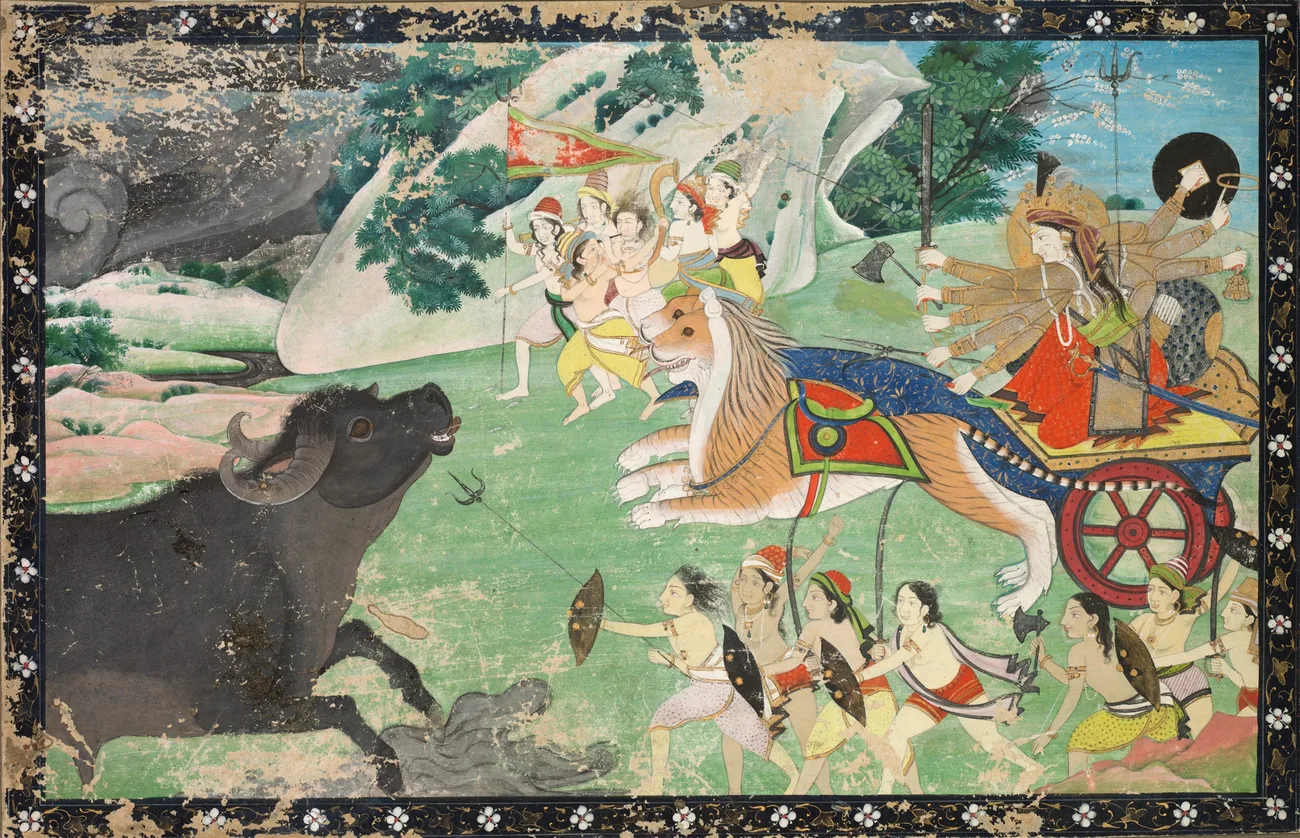
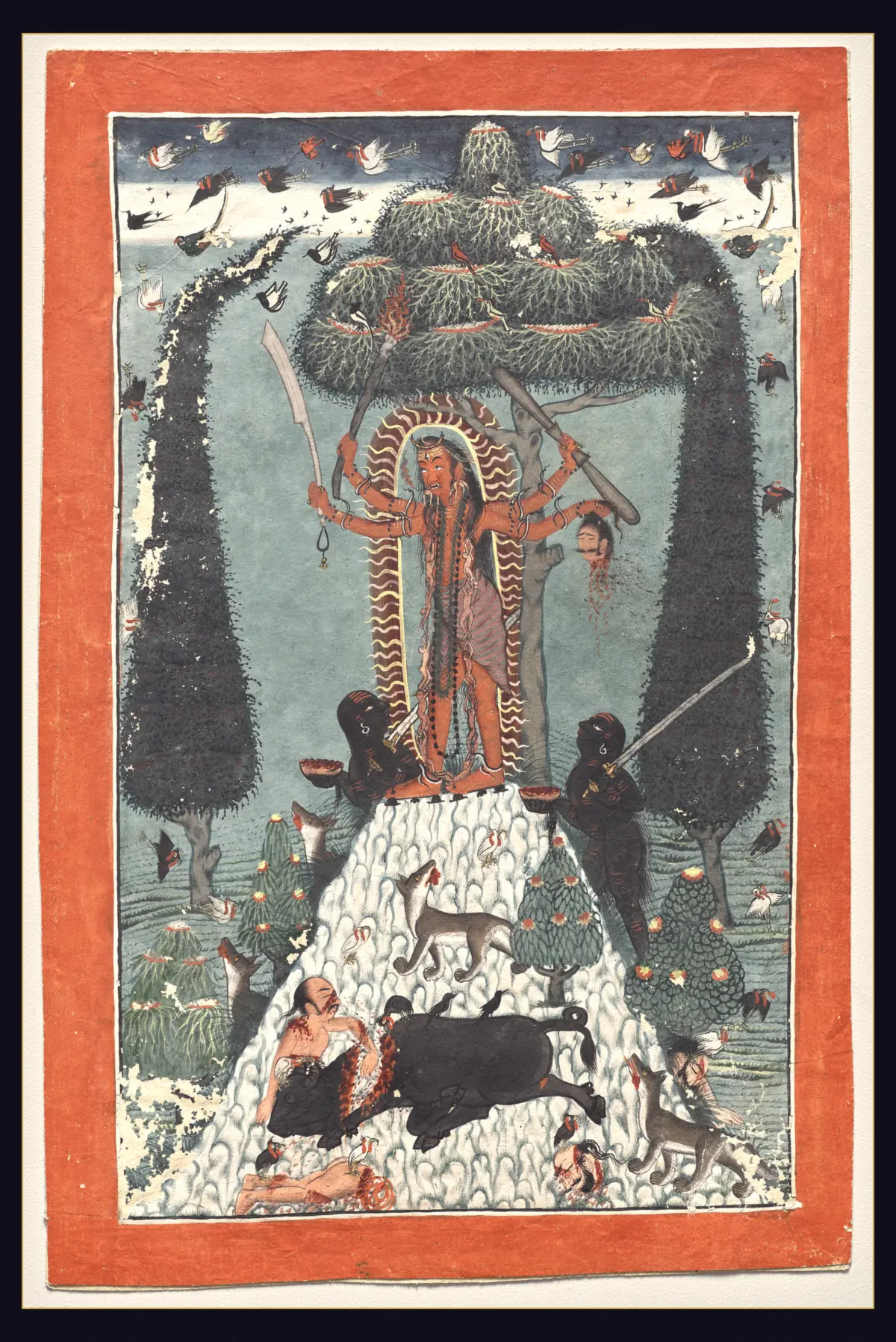
Rudra’s arrow split Andhaka open in the country of Avanti, near the Mahākāla forest, and wherever the blood fell another Andhaka stood up. They came by hundreds, then by thousands. Every one that was cut down bled more of them, until they filled the world.
Jvālāmukhī holds aṁśa 9 of every odd sign: 12°00′ to 13°30′ of Aries, Gemini, Leo, Libra, Sagittarius and Aquarius. If you have a planet in there, it was lit for a job, and it stays lit after the job is done.
Part 1 has the full table of forty names. Take your planet’s degrees inside its sign, divide by 1.5, throw away the remainder and add one. Tārā holds the ninety minutes directly below her.
The Mothers who would not stop
Śiva’s answer to the Andhakas was mouths. The Matsya Purāṇa has him create Mothers, mātaraḥ, for a single purpose, to drink the blood before it could stand up again, and it names them in a list that runs from verse 9 to verse 32. It opens with the Mothers everyone knows, Māheśvarī, Brāhmī and Kaumārī, and it closes on a cluster of fire and tongues.
पिण्डजिह्वा चलज्ज्वाला शिवा ज्वालामुखी तथा।
एताश्चान्याश्च देवेशः सोऽसृजन्मातरस्तदा॥३२॥piṇḍajihvā calajjvālā śivā jvālāmukhī tathā |
etāś cānyāś ca deveśaḥ so ‘sṛjan mātaras tadā ||32||“Piṇḍajihvā, Calajjvālā, Śivā and Jvālāmukhī: these and others the lord of the gods then created as Mothers.”
Matsya Purāṇa 179.32 · Ānandāśrama edition, p. 387
Hers is the last name in the list. Calajjvālā, two names before her, means flickering flame, and Piṇḍajihvā means something like lump-tongue.
The text says they reached utter satiety on the blood, and while they sat there full, the Andhakas came up again. So Śiva went to Viṣṇu for help. Viṣṇu made one more drinker, Śuṣkarevatī, dry Revatī, who took all of it in an instant and grew drier the more she drank.
Then the Mothers asked for the world. “Lord, by your grace we shall eat the gods, the asuras and men,” they said, and asked him to allow it. Śiva told them they were there to protect creatures and should turn their minds from it at once. They ignored him and began eating the three worlds.
He meditated on Nṛsiṃha, the man-lion, and when Nṛsiṃha appeared, Śiva told him what had gone wrong.
अन्धकस्य विनाशाय याः सृष्टा मातरो मया।
अनादृत्य तु मद्वाक्यं भक्षयन्त्युद्यताः प्रजाः॥६१॥
कृत्वा ताश्च न शक्तोऽहं संहर्तुमपराजित।
स्वयं कृत्वा कथं तासां विनाशमभिकारये॥६२॥andhakasya vināśāya yāḥ sṛṣṭā mātaro mayā |
anādṛtya tu madvākyaṃ bhakṣayanty udyatāḥ prajāḥ ||61||
kṛtvā tāś ca na śakto ‘haṃ saṃhartum aparājita |
svayaṃ kṛtvā kathaṃ tāsāṃ vināśam abhikāraye ||62||“The Mothers I created to destroy Andhaka ignore my word and are devouring the creatures, intent on it. I made them, and I cannot take them back, Unconquered one. I made them myself: how could I bring about their destruction?”
Matsya Purāṇa 179.61–62 · Ānandāśrama edition, p. 388; Sanskrit Wikisource numbers them 60–61
Nṛsiṃha didn’t take them back either. He made more goddesses out of his own body, among them thirty-two Mothers from his limbs. Among the eight who attend Revatī, the one who drank the Andhakas dry, there’s a Jvālāmukhī again. The new Mothers ran at the old ones with their eyes wide, and the old ones couldn’t bear the heat of that gaze and went to Nṛsiṃha for shelter.
They were to protect the worlds the way people and cattle protect their young, to harm no devotee of Śiva, and to protect anyone who remembered Nṛsiṃha. Whoever offered them bali regularly would get what they wanted from them, and Śiva would give them his fierce form. Where it ended a tīrtha called Kṛtaśauca came up, and Śiva set the seven Mothers there with himself among them as Ardhanārīśvara, half woman, and vanished.
Her name is among the hungers Śiva couldn’t recall and among the goddesses Nṛsiṃha made to hold them. The Viṣṇudharmottara tells the same story nearly word for word until Nṛsiṃha vanishes, and keeps only the second Jvālāmukhī, the one who serves Revatī. I read her with the Matsya, which has the name on both sides.
The fire at Jwalamukhi
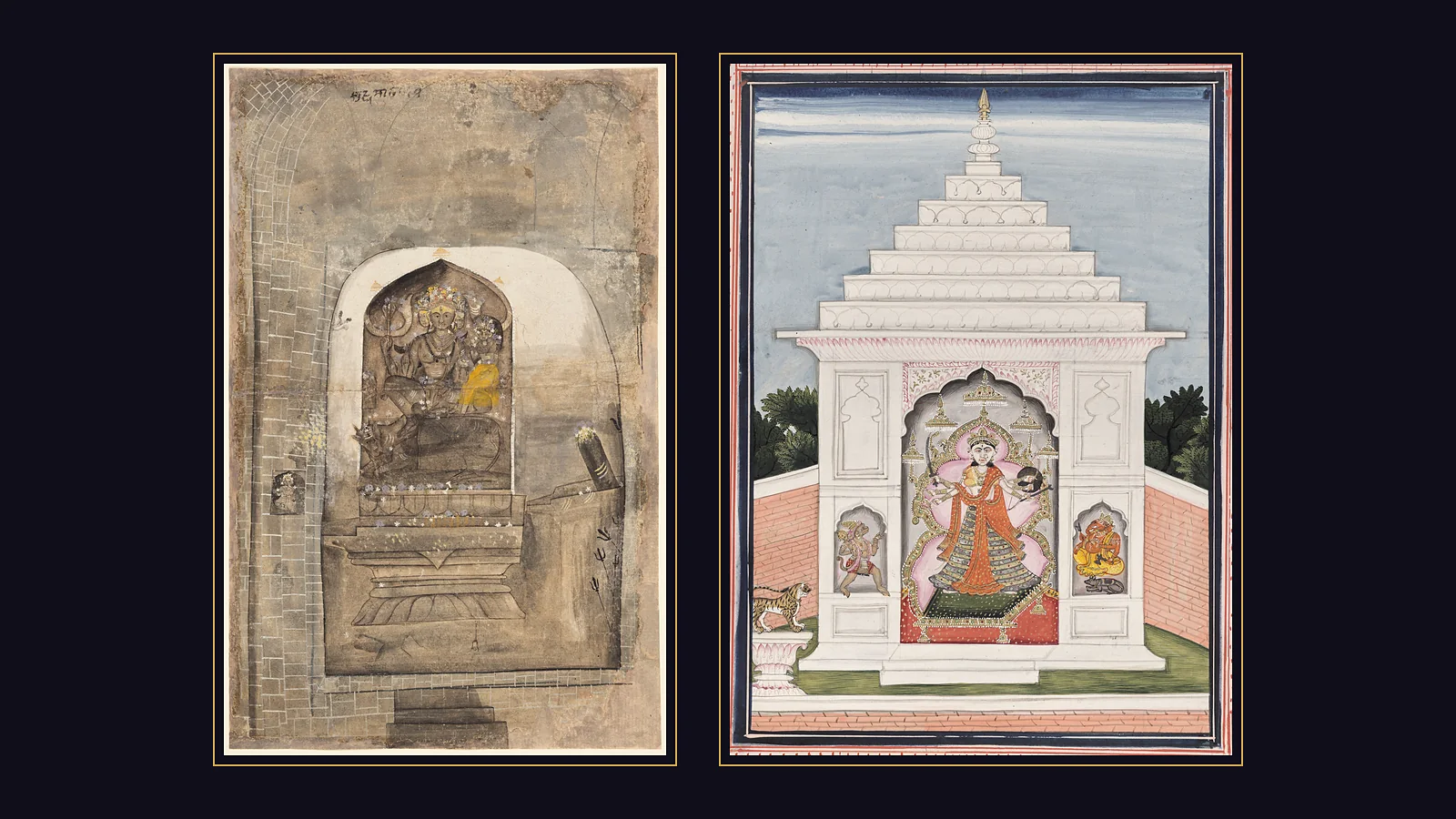
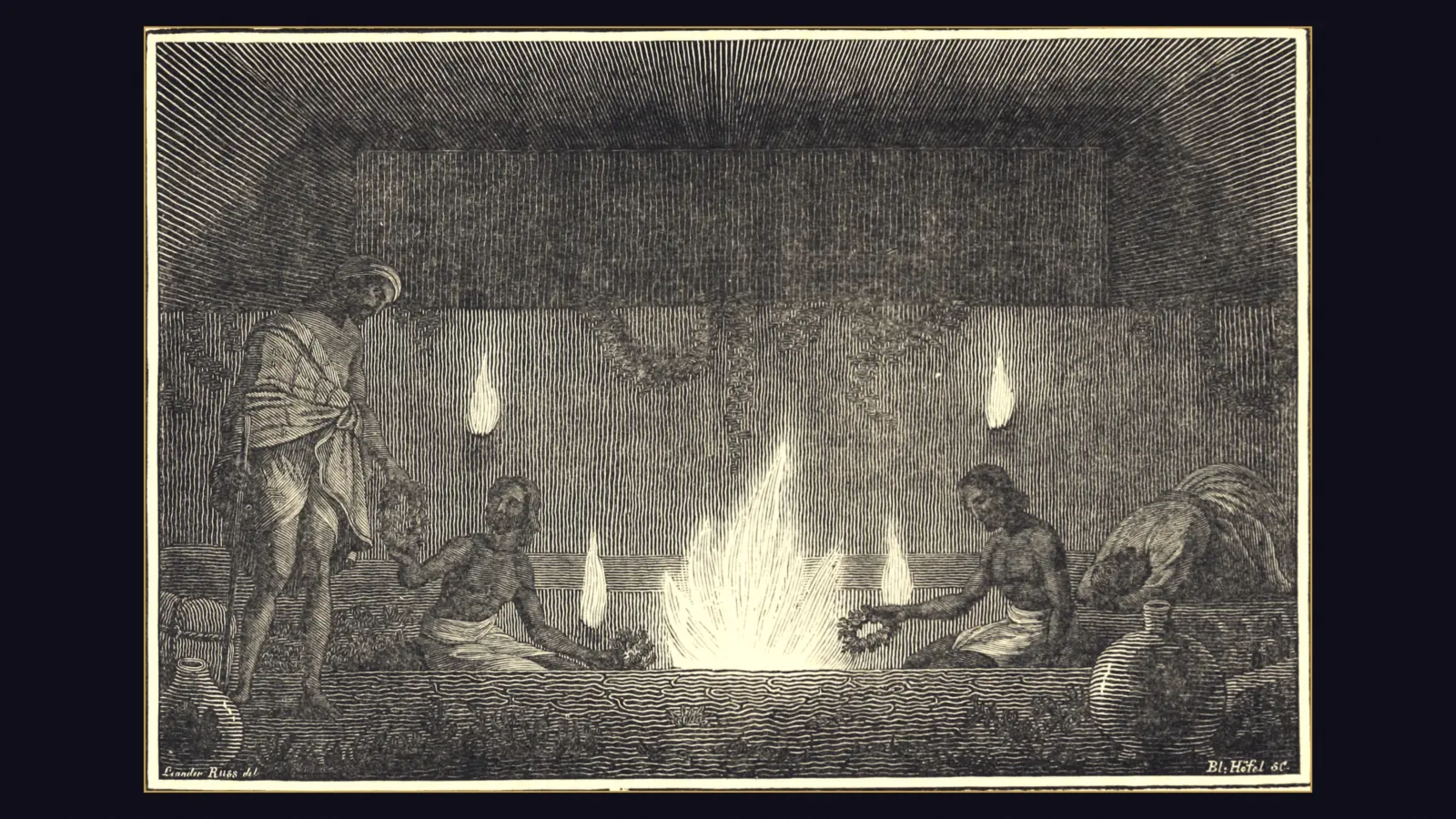
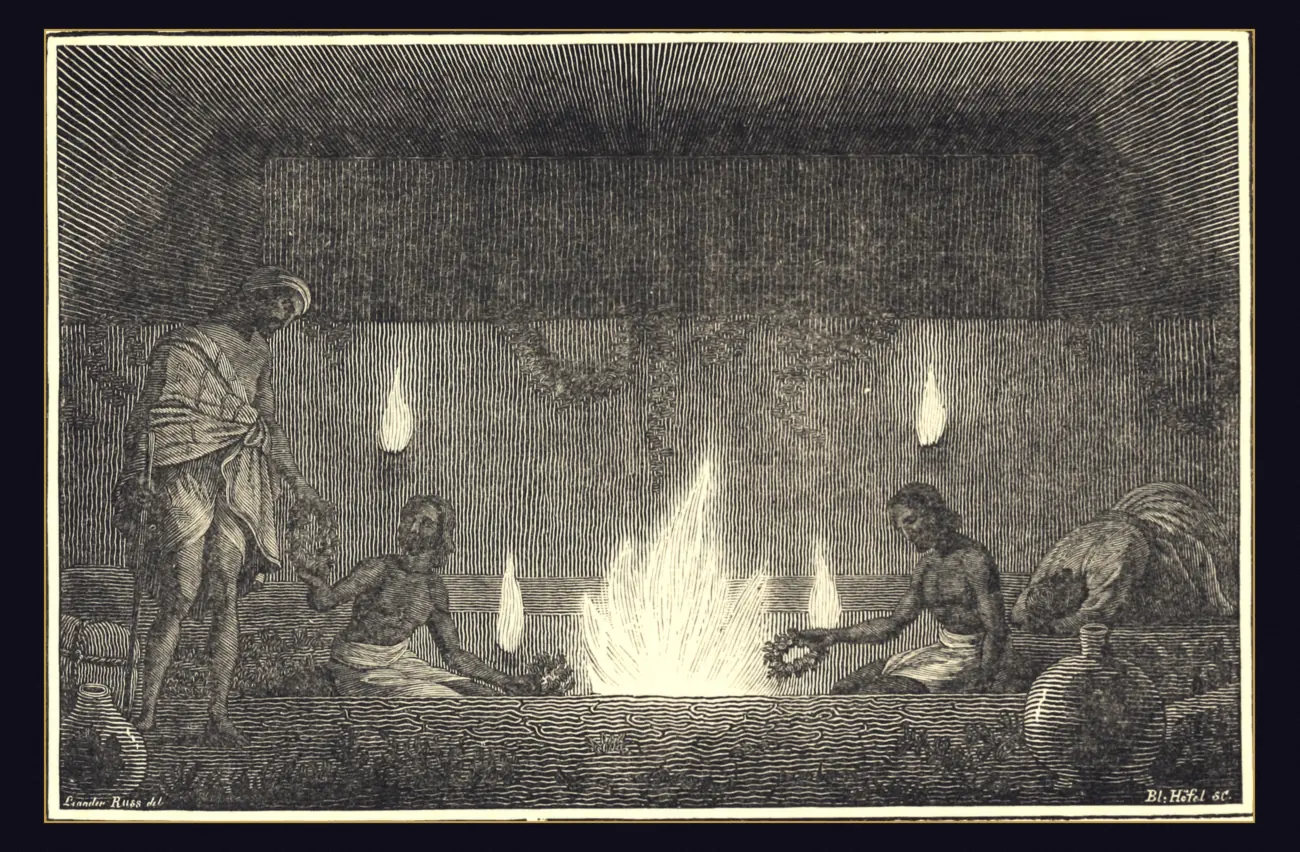
About twenty-five kilometres south of Kangra, at the town of Jwalamukhi, there’s a temple built over a pit in the rock. Gas comes up through fissures in the stone and burns, 87.8 percent methane by the Directorate General of Hydrocarbons‘ figure. The Kangra district gazetteer of 1883 to 1884 says that when pilgrims are numerous the Brahmans keep the flames up by feeding them with ghee, and that there is “no idol of any kind, the flaming fissure being considered as the fiery mouth of the goddess”.
The oldest datable writer to name it is ʿAfīf, historian of Fīrūz Shāh Tughluq’s reign, writing after 1398, who had the story from his father. His father rode with the Sultan against Nagarkot in the 1360s. ʿAfīf puts “the idol, Jwala-mukhi, much worshipped by the infidels” on the road to Nagarkot.
Badāʾūnī, writing in the 1590s, reports that the temple held thirteen hundred books of the old Brahmans, and that one of them was put into Persian verse for Fīrūz, which he calls the Dalāʾil-i Fīrūzī, a book “on the risings and settings of the seven planets, and their good and evil import”. He read it in Lahore in 1591 or 1592, and it seems not to have survived. He also says the flame could not be put out, “No, not by thousands of mashks of water”.
What she does to a planet
Satī makes a planet put down what it inherited, and Tārā makes it pick up what was never its own. Jvālāmukhī is the first goddess past 12°00′, where Parāśara’s planets come of age. The state that begins there, yuvā, is the one he grades at full results, and what she brings to a planet at full strength is appetite.
Your planet in her aṁśa was lit for a job. Something in that department of life needed a fire when you were young: a problem that kept multiplying, a family that needed a fighter, a gap somebody had to fill. Your planet dealt with it, usually early and usually well.
And it can’t be switched off. The parent who needed you to be like this can’t do it, the crisis that called it up can’t, and usually you can’t either.
The Purāṇa doesn’t put the fire out, and neither does the shrine. Nṛsiṃha gives the Mothers a job, a boundary and a meal, and the shrine at Jwalamukhi puts a roof over the flame and feeds it. If you do well with this placement, it’s because you stopped trying to calm the planet down and built the room around it: a discipline with fixed hours, a practice with a fixed offering, work that needs exactly that heat.
If you have this placement, you’ve probably been told to calm down for most of your life. Give the planet a hearth and a schedule and it becomes the thing that protects you.
Planet by planet
In Aries, Leo and Sagittarius her first eighty minutes sit in the last pāda of a Ketu nakṣatra, Aśvinī, Maghā and Mūla, and her last ten spill into Venus’s, Bharaṇī, Pūrva Phalgunī and Pūrva Āṣāḍhā. In Gemini, Libra and Aquarius she’s Rāhu’s the whole way through, in Ārdrā, Svātī and Śatabhiṣā.
| Planet in aṁśa 9, odd sign | What it was lit for | What the daśā does |
|---|---|---|
| Sun | Standing up for the family | He becomes the one the family sends in, and then the one who runs things. The daśā brings a post big enough for the heat or a fight with whoever holds it. |
| Moon | Keeping a frightened house calm | The mind never idles. Worry turns into vigilance and then into care for a great many people, and the daśā asks for a routine the mind can burn inside. |
| Mars | Fighting | Fire in her fire. He wins the first fight early and goes looking for the next. Sport, surgery, the army, any trade with an enemy in it. Left without one, he picks fights at home. |
| Mercury | Answering back | A tongue that burns. Hired for it and fired for it, sometimes in the same year. The daśā decides whether the words get a platform or a lawsuit. |
| Jupiter | Keeping a teaching alive | The sacred fire proper: study, yajña, a library carried in the head. The teacher who can’t stop teaching. |
| Venus | Making something out of want | Desire as fuel. In the fire signs her last ten minutes are Venus’s own nakṣatras. Art made from appetite, a marriage that runs hot and stays. |
| Saturn | Enduring | The slow seam under the hill. Twelve and a half days if he goes straight through. About half the time his retrograde loop brings him back over her, two or three passes spread across about nine months, some two months inside her in all. Work that goes on for decades after everyone else has stopped. |
| Rāhu | Wanting more | The hunger with no floor, and in her air signs he’s in his own nakṣatras. This is the Mothers asking for the world. The daśā needs a hard boundary from outside, early, or it eats its own house. |
| Ketu | Nothing, because he doesn’t eat | In the fire signs he’s in his own nakṣatra for eighty of her ninety minutes. This is tapas: the attachments burn off and the person is lighter afterwards. |
| Lagna | The whole life | A life that runs hot from the start and learns where to put it. The ascendant crosses her ninety minutes in about six minutes of clock time, so rectify the birth time first. |
Mars is the row to read first, because it’s her element twice over. In the D20 itself every planet in her aṁśa lands in a fire sign, which is true of every fourth aṁśa from Kālī’s on, and a Mars here usually shows up early in a family story as the one who did the fighting.
When she holds a kāraka
Parāśara ranks the kārakas by degrees, highest first. At 12°00′ to 13°30′ your planet sits a little under halfway up its sign, and on the arithmetic, on the eight-kāraka scheme with Rāhu that I use, the commonest results are the Pitṛkāraka at about 29 percent, the Putrakāraka at 24 and the Mātṛkāraka at 22.
Mātṛkāraka in her aṁśa
The mothers in these charts protect the way the Matsya’s Mothers were told to, the way people protect their young, and they don’t stop when the danger has passed. Your job as the adult child is Nṛsiṃha’s: give her a role that uses the heat. If you argue with it you lose, and if you hand her a department you get the fiercest ally you’ll ever have.
Gnātikāraka in her aṁśa
The kāraka of kinsmen by name, and in practice of rivals, disease, debt and litigation, and here the trouble is the Andhaka kind: every blow you land on it makes more of it. A case answered with a case, a loan paid off with a loan. What stopped them multiplying wasn’t a harder blow. It was a drinker who took all of it at once and dried out doing it, and in these charts the trouble stops when one side stops feeding it. Where it’s an illness, see a doctor and read the sixth house.
Inside the daśā
Something in the planet’s department keeps coming back, every attempt to deal with it produces another one, and you usually spend the first year hitting it harder.
Then the fire arrives, and it works. The long part comes afterwards, when the heat that solved the problem has nothing left to solve and turns on the household, the partner, the body or the job. What turns the period is almost never your decision to cool down. Something outside sets the boundary, a teacher, an institution, a routine with hours, and the fire goes into it, and from then on it gives.
What she asks for
Her mantra is a dīkṣā matter and I’m not printing any part of it. The texts that give it wrap it in seed syllables, and the Kashmiri fire manual that carries her hymn has the worshipper ask her to devour his enemies, which is not a thing to start without a teacher.
What is public: the Devī Kavaca, recited before the Devī Māhātmya, names her in its thirty-fifth verse, jvālāmukhī nakhajvālām, may Jvālāmukhī guard the blaze of the nails. Recite it daily. Light a ghee lamp at the same hour every day and let it burn down, because that’s her shrine’s liturgy in small: a fire with a roof over it that somebody feeds. And the Matsya’s own protection costs nothing, because Nṛsiṃha told the Mothers to keep safe anyone who remembers him.
Questions people ask
Which degrees are Jvālāmukhī’s in the D20?
12°00′ to 13°30′ of Aries, Gemini, Leo, Libra, Sagittarius and Aquarius, which is aṁśa 9 of every odd sign. Aṁśa 9 of the even signs belongs to Aruṇā.
Is she the goddess of the Jwalamukhi temple?
They share a name. I can’t show they share more. The name is a description, flame-mouthed, and the Varāha Purāṇa gives it to Cāmuṇḍā. The Matsya’s Jvālāmukhī is a Mother made in a battle at Avanti, the Kubjikāmata‘s lives in a nimba tree at a pīṭha called Jayantī, with a sword in her hand, and the Śiva Purāṇa‘s is a flame from Satī’s body worshipped on a mountain it doesn’t name, which is the one that looks like Kangra.
Did Satī’s tongue fall at Jvālāmukhī?
The Pīṭhanirṇaya says so, and most of its manuscripts say the great tongue. D. C. Sircar dates it to about 1690 to 1720, and texts that follow it, such as Bhāratacandra’s Annadāmaṅgala of 1752, repeat it. Other accounts disagree about what’s there: the Śiva Purāṇa has a flame from her body, and an interpolated passage in a Bengali poem has her head. The Satī chapter has why the dismemberment itself is late.
Where does this reading come from?
No classical text explains what a vimśāṁśa deity does to a planet. Parāśara names the forty and assigns the varga to upāsanā. The two commentaries I’ve read stop there. What’s here comes out of her story in the Matsya and the flame shrine at Jwalamukhi, and out of charts.
Next in the series is Śvetā, aṁśa 10 of the odd signs. Part 1, with the full table of all forty names, is here. If you want your own vimśāṁśa read properly, with the deity and the daśā sequence together, that’s what a consultation is for.
Sources: Matsya Purāṇa 179 in the Ānandāśrama edition (ĀnSS 54, pp. 386 to 389), read against its page images for verses 32 to 43, 61 to 62 and 73, with Sanskrit Wikisource, whose numbering drifts from the Ānandāśrama’s after verse 36. Viṣṇudharmottara Purāṇa 1.226 for the parallel telling. Kubjikāmata 22.26, GRETIL e-text of the Goudriaan and Schoterman edition. Śiva Purāṇa, Rudrasaṁhitā, Satīkhaṇḍa 1.41 to 43, Varāha Purāṇa 95.51 and the Devī Kavaca, Sanskrit Wikisource. Pīṭhanirṇaya verse 8 in D. C. Sircar, The Śākta Pīṭhas (1948), pp. 23 to 24, 33, 39 and 44. The Agnikāryapaddhati, a Kashmiri fire-ritual manual (J&K Research Library MS 781, on Sanskrit Wikisource), for her hymn and mantra, neither printed here. For Kangra: Shams-i Sirāj ʿAfīf in Elliot and Dowson, History of India, vol. III, p. 318; Badāʾūnī, Muntakhab al-Tawārīkh, trans. Ranking, vol. I, pp. 331 to 332; Carl Ernst, Iranian Studies 36.2 (2003), p. 175; Kangra District Gazetteer 1883 to 1884, p. 255; Directorate General of Hydrocarbons, National Data Repository. Bṛhat Parāśara Horā Śāstra 6.17 to 21 for the forty names, 7.4 for the varga assigned to upāsanā, 45.4 in Santhanam’s numbering for the bālādi grades, and chapter 32 for the kārakas.