Vimśāṁśa series · Aṁśa 8, odd signs · Tārā · 11 min read
The Buddha in Tārā’s crown is the standard proof that she was borrowed from Buddhism. The Sanskrit calls him a snake.
A sage called Vasiṣṭha sat on the shore and tried to worship a goddess by the method he had been trained in. It didn’t work. She told him to go to Mahācīna and learn it properly, and what he found there frightened him.
Tārā holds aṁśa 8 of every odd sign: 10°30′ to 12°00′ of Aries, Gemini, Leo, Libra, Sagittarius and Aquarius. If you have a planet in there, the thing that eventually works for you in that department of life is a method you were not raised in.
Part 1 has the full table of forty names. Take your planet’s degrees inside its sign, divide by 1.5, throw away the remainder and add one. Satī holds the ninety minutes directly below her.
What is on her head
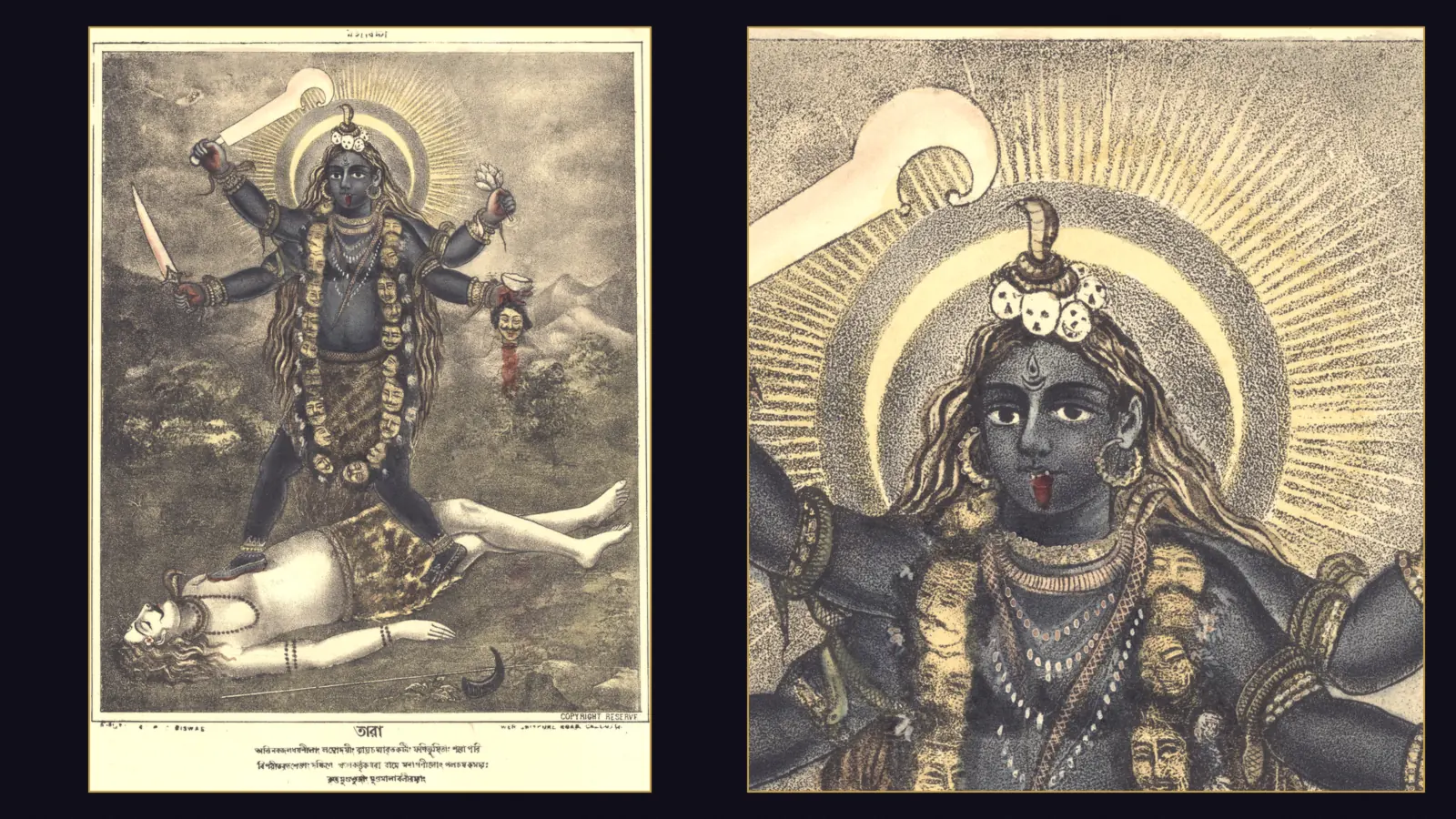
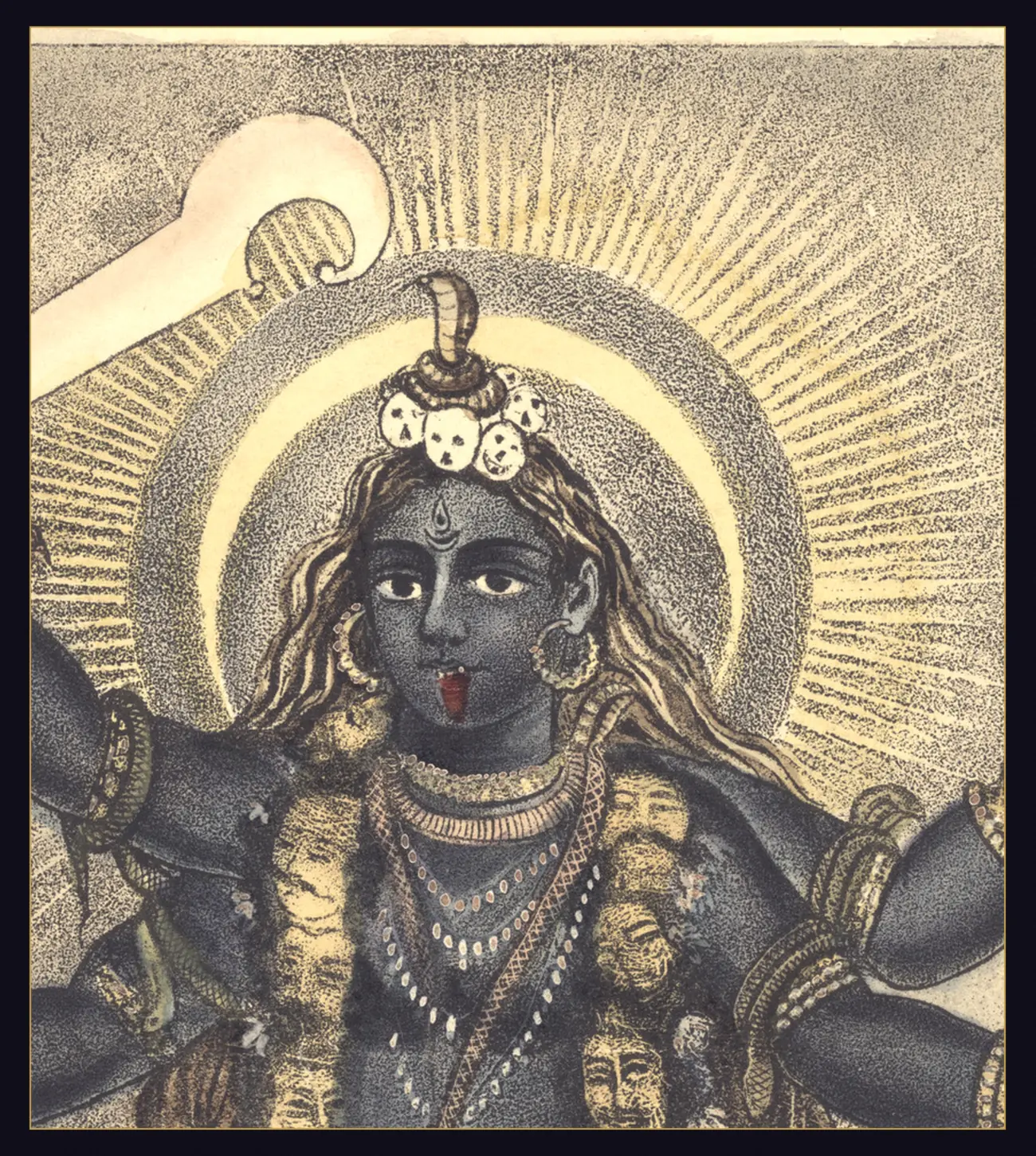
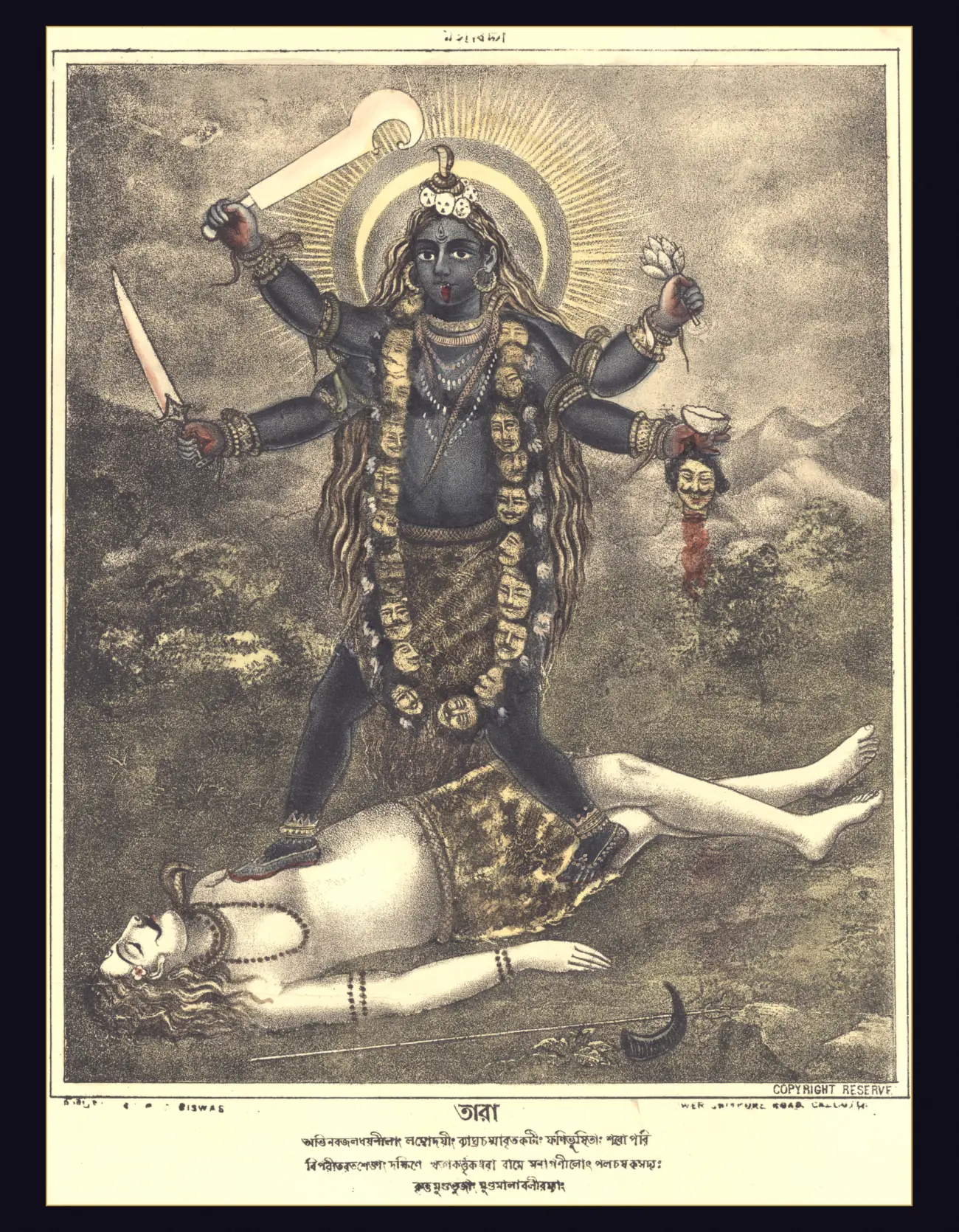
Tārā is the second of the ten Mahāvidyās, after Kālī. She stands in a cremation fire on a corpse, blue, short, pot-bellied, in a tiger skin, with a knife and a skull-bowl, and in her matted hair she carries something called Akṣobhya.
Akṣobhya is a Buddha. He is one of the five Tathāgatas. In the Buddhist sādhanas of this goddess his image sits in her single coil of hair. You will read, in nearly every English account, that the Hindu texts kept him there by accident, a fossil left in the crown, proof that she came over from Buddhism and nobody dared file off the serial number.
The Hindu texts say what he is, and it isn’t a Buddha.
The Puraścaryārṇava’s dhyāna gives her hair as akṣobhya-nāga-sambaddha-jaṭājūṭām, the matted knot bound with the Akṣobhya-snake, with the name and the word for serpent inside one compound. That verse it takes from the Mantracūḍāmaṇi. The gloss printed beside it quotes the Bhāvacūḍāmaṇi and spells the point out: atrākṣobhyo nāgarūpaḥ, here Akṣobhya is in serpent form. Seventy verses further on it quotes the Brahmasaṁhitā making the ritual assignment, akṣobhyo devatā proktas trimūrtir nāgarūpa-dhṛk. Mahīdhara’s Mantramahodadhi, in 1589, says it too, and David Kinsley translates it as sage Akṣobhya, in the form of a serpent, situated on her head.
And the Toḍala Tantra does not leave the name alone either. It gives it an etymology.
समुद्रमथने देवि कालकूटं समुत्थितम्।
सर्वे देवाः सदाराश् च महाक्षोभम् अवाप्नुयुः॥५॥
क्षोभादिरहितं यस्मात् पीतं हालाहलं विषम्।
अत एव महेशानि अक्षोभ्यः परिकीर्तितः॥६॥samudramathane devi kālakūṭaṃ samutthitam |
sarve devāḥ sadārāś ca mahākṣobham avāpnuyuḥ ||5||
kṣobhādirahitaṃ yasmāt pītaṃ hālāhalaṃ viṣam |
ata eva maheśāni akṣobhyaḥ parikīrtitaḥ ||6||“At the churning of the ocean, goddess, the kālakūṭa poison rose up, and all the gods with their wives fell into great agitation. Because he drank the hālāhala free of agitation, therefore, Maheśānī, he is called the Unshakeable.”
Toḍala Tantra 1.5–6 · GRETIL e-text of Gopinath Kaviraj’s edition
A-kṣobhya, not-agitated. The one who drank the poison at the churning and did not flinch is Śiva Nīlakaṇṭha, and the Toḍala has just handed the Buddha’s name to him, with a derivation, in two verses. It pairs the others with Śaiva consorts in the same chapter: Kālī gets Mahākāla, Chinnamastā gets the headless Kabandha, Mātaṅgī gets Mataṅga. Dhūmāvatī gets nobody, because she is the widow. It derives some of their names too, in the same formula: Tryambaka because he takes his pleasure in the three worlds, Mahākāla because she is destruction itself, Nārada out of the three syllables of his name. Those names were Śaiva already. Akṣobhya’s was not, and the machinery that explains the others is doing something else with him.
The same text’s worship sequence, at 4.35 to 4.36, has you honour Akṣobhya below the goddess and then a group it calls simply “those beginning with Vairocana”. No gloss is offered. Vairocana is another of the five Buddhas. The word can also mean Bali, and I don’t know which one is meant here.
Gudrun Bühnemann worked through the iconography. The snake is in the Hindu images and not in the Buddhist ones, and the name is in both.
She was imported, and the crown is not the evidence
None of this means she’s indigenous. Alexis Sanderson names Śāśvatavajra, a Buddhist author working in the last decades of the tenth century and the first of the eleventh, who wrote a sādhana of Ugratārā that survives as number 101 in the Sādhanamālā. Bühnemann showed that the Hindu Phetkāriṇītantra took it over almost in full, recast as a conversation between Śiva and Pārvatī, and that the later Hindu handbooks then quoted the Phetkāriṇī as the authority on her. The Puraścaryārṇava’s Tārā chapter opens with the Phetkāriṇī and nothing else: the heading at 9.565 reads “of the second vidyā, in the Phetkāriṇītantra”, and the first question Pārvatī asks in it is which goddess the poets got hold of before they wrote the Mahābhārata.
The Phetkāriṇī itself has no date. Sanderson says he cannot fix how long after Śāśvatavajra it was written, and brackets it between him and the fifteenth century, leaning early. So the tenth-century date belongs to the Buddhist end of the chain, and anyone who tells you the Hindu Tārā is an eleventh-century goddess has slid a date one link along.
The Śāradātilaka is the standard early Hindu Tantric handbook, and it has no chapter on Tārā at all. The Puraścaryārṇava cites it for Bhuvaneśvarī, for Bhairavī and for Lakṣmī, and in a hundred and fifty verses on Tārā never cites it once, because there’s nothing there to cite.
What she does to a planet
Satī, ninety minutes below her, makes a planet put down what it inherited. Tārā makes it pick up what was never its own.
In that planet’s department you were trained in one method. It didn’t work for you. The thing that eventually did work came from outside: a different school, a different country, a trade nobody in the family had, a teacher your own people would not have chosen. Over twenty years it stopped looking foreign, and now it is simply how you work. The Puraścaryārṇava quotes the Phetkāriṇī on what she actually does.
खर्वा नीलविशाल
पिङ्गल जटाजूटोग्र नागैर् वृता।
जाड्यं न्यस्य कपालके त्रिजगतां हन्त्य् उग्रतारा स्वयम्॥kharvā nīla
viśāla piṅgala jaṭājūṭogra nāgair vṛtā |
jāḍyaṃ nyasya kapālake trijagatāṃ hanty ugratārā svayam ||“Short, ringed by fierce serpents in her broad dark tawny matted hair: having put the dullness of the three worlds into her skull-bowl, Ugratārā destroys it herself.”
Puraścaryārṇava 9.640, second half, quoting the Phetkāriṇītantra · the first half names a seed syllable, so it is left off
Jāḍya is the word. It means coldness, stiffness, torpor. The skull-bowl she carries is where it goes. And the verse just above that one in the digest, which comes from the Tāropaniṣad rather than the Phetkāriṇī, calls her kavitva-kāriṇī, the maker of poetic power.
Something in that planet’s department is stuck, and stuck for years. What comes out afterwards is articulacy. The person can suddenly say what they do, teach it, write it, sell it. She is called Nīla Sarasvatī, the blue Sarasvatī, and in the Rudrayāmala’s telling of the Vasiṣṭha story, which I have only in Woodroffe’s English, she is never called Tārā at all, and she’s called Sarasvatī twice.
Clients with this placement keep trying to make the family way work for another five years first. It doesn’t, and the daśā is usually spent on that attempt. If you already know what the outside method is, start.
Planet by planet
In Aries, Leo and Sagittarius her window sits in a Ketu nakṣatra. In Gemini, Libra and Aquarius it is Rāhu’s, and Rāhu is the foreigner by nature, so that half of the column reads louder.
| Planet in aṁśa 8, odd sign | Where the method comes from | What the daśā does |
|---|---|---|
| Sun | Not the father’s trade | Authority earned in a field the family has no standing in. The father usually doesn’t understand the work, and says so. |
| Moon | Not the mother tongue | The mind settles in a second language, or a second country. Often the person dreams in it before they notice. |
| Mars | Not the technique he was drilled in | He wins with something he picked up sideways. Instructors find it irritating and it keeps working. |
| Mercury | Not the register he was taught | Her own element, and the strongest of the ten. The stuck speech comes loose and the livelihood is speech thereafter. |
| Jupiter | Not the paramparā | The teaching that formed him came from outside the line he was initiated into. He usually stops explaining this at about fifty. |
| Venus | Not the community | Marriage or partnership across a language, a religion or a border. The aesthetic is borrowed too, and it is the good kind of borrowed. |
| Saturn | Not the apprenticeship | Twelve days to cross if he goes straight through, and some two months inside her ninety minutes, spread across about nine months, if he stations there, which happens half the time. The slowest and the most thorough: he learns the foreign method properly and out-lasts everyone who learned it at home. |
| Rāhu | Foreign by nature, doubled here | The loudest version. Emigration, conversion, a career nobody in the family can name. He is at home in her air signs and restless in her fire signs. |
| Ketu | Nothing, because he arrives already knowing | In the fire signs he is in his own nakṣatra as well. The method comes back rather than arrives, and the person can’t say where they learned it. |
| Lagna | The whole life, not one department | A life lived in a borrowed idiom and eventually owning it. The ascendant crosses her ninety minutes in about six minutes of clock time, so rectify the birth time first. |
Mercury is the row I look for. In the charts I have, a Mercury here goes with a specific early history: the person was slow to speak, or spoke badly, or spoke a language that got them mocked, and the adult work runs entirely through the mouth or the page.
Her window sits wholly inside one nakṣatra pāda in every odd sign. Aśvinī 4, Ārdrā 2, Maghā 4, Svātī 2, Mūla 4, Śatabhiṣā 2. She also closes the kumāra block exactly, ending on 12°00′, which is where Parāśara’s adolescent state ends and the adult one begins.
One correction to my own Vimalā chapter, which said aṁśas 6 through 9 are all wholly nodal. Aṁśa 8 is the last one for which that is true. Aṁśa 9 spills its final ten minutes into a Venus nakṣatra in the three fire signs, so the run is clean for three and leaks on the fourth.
When she holds a kāraka
Parāśara ranks the kārakas by degrees, highest first. At 10°30′ to 12°00′ she sits a little over a third of the way up a sign, so your planet in her aṁśa lands in the middle of the order. On the arithmetic, and on the eight-kāraka scheme with Rāhu that I use, the two commonest are the Pitṛkāraka and the Putrakāraka at about 28 percent each, and I do not have enough of either on file to write about them.
Gnātikāraka in her aṁśa
The kāraka of rivals, disease, debt and litigation. Here your rival is the person who learned the method the proper way. The dispute is about legitimacy. It’s decided by results, and it takes you about a decade. In the body, read it with the sixth house.
Ātmakāraka in her aṁśa
Rare: it needs all seven of the other kārakas to sit below your planet’s degree, which happens in about one chart in a thousand. When it happens the whole life is the import, and you are usually the first in your family to leave.
Inside the daśā
The first stretch is the old method failing, repeatedly, in public, and you working harder at it because working harder is what you were taught to do.
Then the substitution, which is rarely dramatic. Somebody hands you something, or you read something, or you take a job in a place you’d never have picked. It doesn’t feel like a turning point at the time, and it dates the rest of the period.
What she asks for
Her mantra is a dīkṣā matter and I’m not going to print any part of it. In the Tārārṇava’s version of the story, Vasiṣṭha’s curse landed. He worshipped her, got nothing, and cursed the vidyā, and from then on it gave fruit to nobody. Then the same passage takes it back twice. It prints an emendation to the seed syllable and says that from then on the vidyā is glorious again, victorious, destroying poison, giving immortality. And its commentary adds that the curse ran only as far as the Kṛṣṇa avatāra and was released when he was born. So the text that curses the mantra lifts the curse on the next line, and people still sell the removal of it.
What is public and needs nothing: the Devī Māhātmya, and any Sarasvatī practice, because she is Sarasvatī with a cremation ground attached. If you want one thing to do, the Sarasvatī side is the part of her that is actually addressed to this placement.
Vasiṣṭha stayed on the shore doing the method he already knew, for a very long time, before he went and learned another one.
Questions people ask
Which degrees are Tārā’s in the D20?
10°30′ to 12°00′ of Aries, Gemini, Leo, Libra, Sagittarius and Aquarius, which is aṁśa 8 of every odd sign. Aṁśa 8 of the even signs belongs to Bhadrā.
Is the Hindu Tārā the same as the Tibetan one?
No, and the article above is about the Hindu one only. They are related by a traceable act of borrowing, from a Buddhist sādhana written around the year 1000 into a Hindu tantra of no fixed date. The goddess the Hindu texts took is the fierce Ugratārā, who carries the cremation ground on the Buddhist side too. The Tārā most people mean, the green and the white one who is asked for protection and long life, has a large career of her own and is not this goddess.
Is Akṣobhya in her crown the Buddha?
In the Buddhist sources, yes. In the Hindu ones he is a snake, and more than one text says so, and the Toḍala Tantra derives the name from Śiva drinking the poison at the churning. The snake appears in the Hindu images and not in the Buddhist ones.
Did Vasiṣṭha go to Tibet?
The text says Mahācīna, and the Brahmayāmala’s version places it beside the Himālaya. Tibet is a modern gloss. Two other things usually said about that story are not in it, at least not in the scanned text I can read: the word cīnācāra never occurs, and the goddess is never called Tārā. She is Kuleśvarī, Mahāvidyā, and twice Sarasvatī.
Is Tārā in the Lalitā Sahasranāma?
No, in any recension. The hymn belongs to Tripurasundarī and does not enumerate the Mahāvidyās. Where you see tārā in it the word means star.
Where does this reading come from?
No classical text explains what a vimśāṁśa deity does to a planet. Parāśara names the twenty and assigns the varga to upāsanā. The commentaries stop there. What is here comes out of her own texts and out of charts.
Next in the series is Jvālāmukhī, aṁśa 9 of the odd signs. Part 1, with the full table of all forty names, is here. If you want your own vimśāṁśa read properly, with the deity and the daśā sequence together, that’s what a consultation is for.
Sources: Toḍala Tantra 1.3 to 1.22 and 4.35 to 4.36, GRETIL e-text of Gopinath Kaviraj’s edition in Tantrasaṁgraha vol. 2 (1970), which serves IAST; the Devanāgarī printed here is a mechanical transliteration of it and not a separate witness. Puraścaryārṇava, taraṅga 9, the Tārā section at 9.565 to 9.718, in the Devanāgarī of the vishvasa.github.io edition; the chapter heading at 9.565, the Mantracūḍāmaṇi dhyāna at 9.618 to 9.631, the Bhāvacūḍāmaṇi gloss printed after 9.642, the Brahmasaṁhitā assignment at 9.714, the Tāropaniṣad verse at 9.639, the Phetkāriṇī verse at 9.640, and the Tārārṇava’s curse at 9.583 to 9.586 with the release at 9.587, which the digest attributes to a further tantra it does not name. Rudrayāmala, Uttaratantra, paṭala 17, verses 108 to 164; the Sanskrit witness is an OCR of a scanned edition and nothing is quoted from it here that Arthur Avalon’s 1929 English does not independently carry. Gudrun Bühnemann, “The Goddess Mahācīnakrama-Tārā (Ugra-Tārā) in Buddhist and Hindu Tantrism”, BSOAS 59.3 (1996), for the Phetkāriṇī’s take-over of Sādhanamālā 101 and for the iconography of the snake; cited from its abstract and from Sanderson’s summary of it, not read in full. Alexis Sanderson, “The Śaiva Age” (2009), p. 241, for Śāśvatavajra’s dates and for the bracketing of the Phetkāriṇī. Nothing on the Buddhist side of this article was read in Sanskrit; the Sādhanamālā is consulted here only through those two scholars. Teun Goudriaan and Sanjukta Gupta, Hindu Tantric and Śākta Literature (1981), for the Rudrayāmala’s status and for the Śāradātilaka’s missing Tārā chapter. David Kinsley, Tantric Visions of the Divine Feminine (1997), chapter 4, cited as secondary. Bṛhat Parāśara Horā Śāstra 6.17 to 21 for the twenty names, 7.4 for the varga assigned to upāsanā and chapter 32 for the kārakas.